Picture this: You’ve just joined a new online chat room, an old-school forum, or maybe a multiplayer game lobby. Within seconds, a stranger sends you three letters — ASL — and you’re left staring at the screen, wondering what they mean.
You’re not alone.
ASL is one of those internet acronyms that has quietly shaped the way people communicate online for decades. It started in the early days of the internet, traveled through the chaotic world of chat rooms, evolved through gaming communities, and today it’s transformed into something entirely new in the world of modern texting and social media slang.
Whether you’re a digital native or someone trying to decode what your teenager is typing, this article covers everything you need to know about ASL meaning in text — where it came from, how it’s used today, and what it might mean depending on who’s saying it.
Let’s dive in.
What Does ASL Mean in Text?
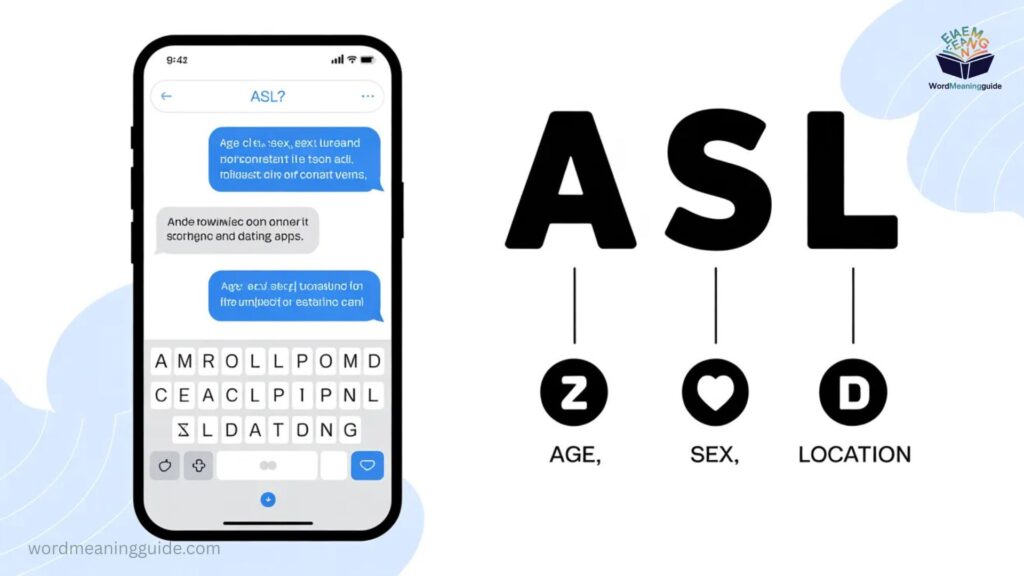
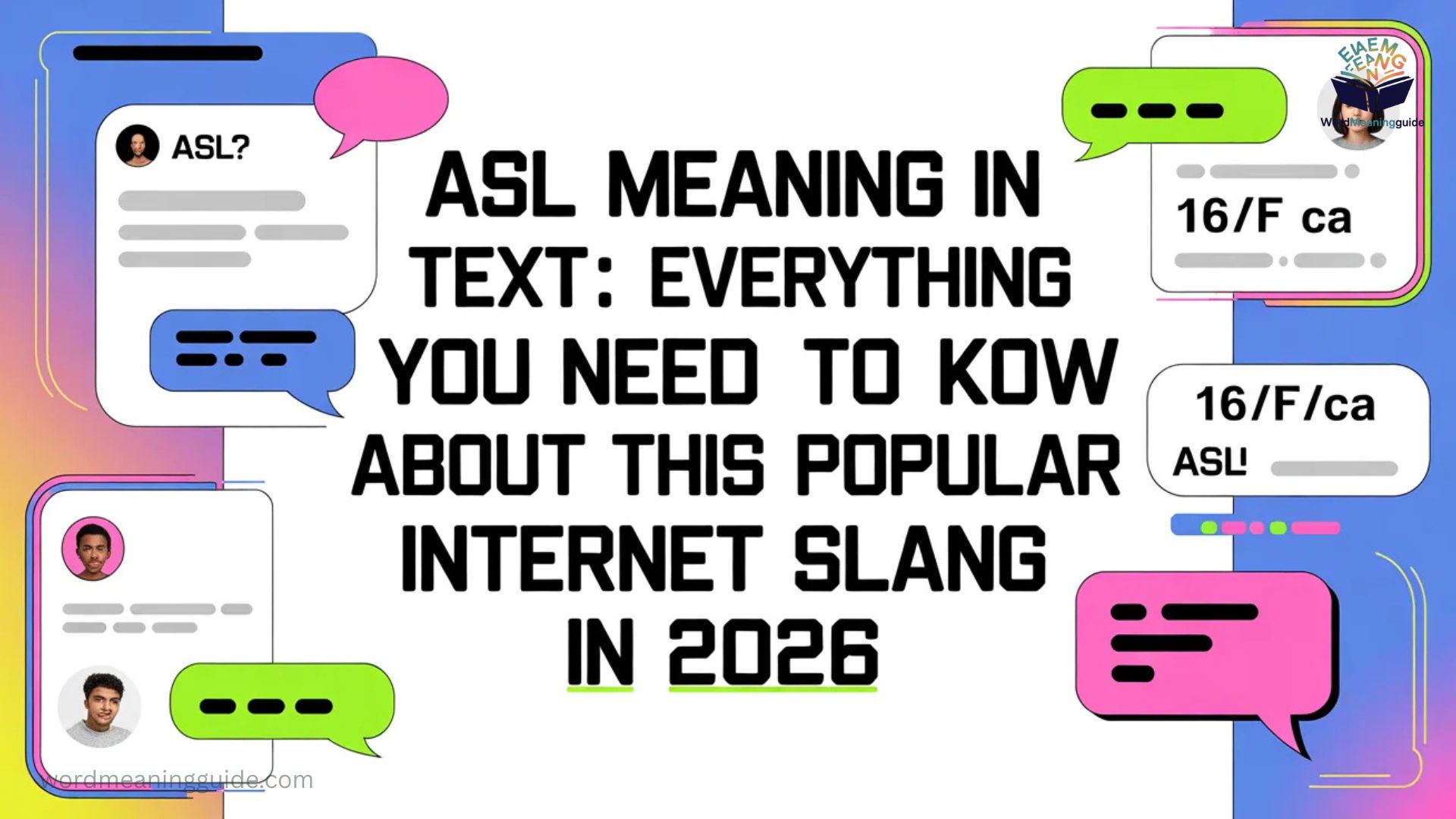
At its most fundamental level, ASL is an acronym that stands for Age, Sex, Location. For decades, this was the go-to opening question in online chat rooms, where strangers wanted to quickly establish basic details about the person on the other side of the screen.
But that’s only part of the story.
In modern texting and social media — particularly on platforms like TikTok, Snapchat, and Twitter/X — ASL has taken on an entirely new meaning. Today, it’s widely used as a shorthand for “as hell”, a casual intensifier used to emphasize feelings or descriptions.
So when someone texts “I’m tired asl,” they’re saying they are extremely tired. When someone says “That movie was funny asl,” they mean it was incredibly funny.
Explore more WYO Meaning in Text: Everything You Need to Know About This Popular Slang In 2026
Two meanings. Same three letters. Context is everything.
Simple Example
Here’s how ASL appears in real conversations:
Old-school usage (Age, Sex, Location):
Stranger: “Hey! ASL?” You: “19, Male, New York.”
Modern usage (As Hell):
Friend: “How was the exam?” You: “Hard asl, I barely finished.”
Both are completely valid uses — just from different eras of internet culture, and sometimes from different generations of users sharing the same digital spaces today.
ASL Meaning in Slang
In current slang, ASL = As Hell. This usage has exploded especially among Gen Z users, where intensifiers in casual speech are extremely common.
Think of “as hell” as the modern equivalent of “very” or “extremely” — but cooler, faster to type, and perfectly suited for the rapid-fire pace of online messaging.
You’ll hear someone say “that concert was loud asl” or “she’s sweet asl” — and the meaning is instantly clear to anyone fluent in current internet slang. It punches up the sentence, adds emphasis, and does it in just three letters.
Linguists who study internet language note that this kind of compression — taking a common phrase and reducing it to an acronym — is a natural evolution of informal written communication. “Language always finds shortcuts,” says Dr. Lauren Squires, a linguist who has researched digital communication. “Acronyms like ASL reflect how speakers optimize expression for speed and social bonding.”
Continue reading Wyd Meaning in Text: Simple Guide You Need Today In 2026
Origin and Background of the Term
The roots of ASL (Age, Sex, Location) trace back to the early 1990s and late 2000s, when internet chat was in its infancy. Platforms like AOL Instant Messenger (AIM), IRC (Internet Relay Chat), and Yahoo! Chat were the primary social hubs of the internet.
At a time when there were no profile pictures, no verified accounts, and no Facebook timelines to scroll through, users had virtually no information about who they were talking to. Asking “ASL?” was a quick, efficient way to get three key pieces of information: how old someone was, their gender, and their general whereabouts.
It was social media before social media existed.
The question felt normal then. The internet was anonymous by design, and ASL served as the universal icebreaker. It was typed millions of times daily across chat platforms around the world.
As social media evolved — bringing with it photos, bios, and detailed profiles — the need for ASL as a question faded. But the letters stuck around, eventually getting repurposed entirely.
How ASL Is Used in Daily Life
1. Starting Conversations Online
Even today, some older internet users or those on anonymous platforms still use ASL as a conversation opener. On text-based chats where anonymity is the norm, breaking the ice with “ASL?” remains a recognized pattern — even if it feels retro to younger users.
Don’t miss this HN Meaning in Text: Shocking Truth You Should Know In 2026
2. Random Chat Platforms
Platforms like Omegle (before its closure) or Chatroulette kept the ASL tradition alive well into the 2010s. Matched with complete strangers, users would default to ASL simply because they had no other information to work with. It was functional, fast, and universally understood.
3. Gaming Communities
Gaming lobbies — especially in multiplayer games like Call of Duty, Roblox, or Minecraft — became the unexpected home of ASL. Younger players, bonding over shared gameplay, would ask each other’s age and location to find common ground. The ASL question thrived in this environment well beyond the chat room era.
4. Social Media DMs
On Instagram, Snapchat, or Twitter/X, ASL slides into DMs as slang — the modern “as hell” version. Someone might comment “this fit is clean asl” or DM a friend “that post had me laughing asl.” It’s casual, expressive, and native to how Gen Z communicates in 140 characters or less.
5. Online Forums or Communities
Reddit communities, Discord servers, and niche forums are spaces where both meanings of ASL coexist. In a thread about internet history, someone might reference old ASL culture nostalgically. Meanwhile, in a meme thread, someone might use it as “as hell” without a second thought. The platform context helps decode which one is meant.
6. Nostalgic Internet Culture
There’s a growing wave of nostalgia for early-2000s internet culture, and ASL is right in the middle of it. You’ll find TikTok videos, memes, and tweets referencing old-school chat culture — complete with dramatizations of getting asked “ASL?” in a chat room. For millennials especially, it triggers a very specific kind of digital nostalgia.
Emotional or Practical Meaning of ASL
ASL carries more emotional weight than its three letters might suggest.
Keep reading FT Meaning in Text: Shocking Truth You Should Know In 2026
For anyone who grew up in the AIM or IRC era, seeing “ASL?” is a portal back to childhood or teenage years — the thrill of anonymous connection, the curiosity about who was on the other side, the excitement of making a “pen pal” from a different state or country.
For Gen Z users, ASL as “as hell” is an expression of emotional intensity. “I’m stressed asl” isn’t just a status update — it’s a way of communicating how heavy something feels without writing a long explanation. The slang allows emotional shorthand that resonates instantly with peers.
In both cases, ASL serves a deeply social purpose: it connects people quickly and authentically, whether by sharing information or by intensifying shared feelings.
Similar or Related Terms
Understanding ASL meaning in text becomes clearer when you compare it to related terms:
- A/S/L — Same as ASL, just formatted with slashes. Common in early chat rooms.
- ASLA — Age, Sex, Location, Appearance. An extended version sometimes used in the 2000s.
- AF — “As F***,” a cruder but functionally identical intensifier to the modern ASL slang.
- TBH — “To Be Honest,” another three-letter acronym widely used in casual texting.
- NGL — “Not Gonna Lie,” similar in structure and tone to modern ASL usage.
- IRL — “In Real Life,” another relic of early internet language that has survived into modern usage.
The Primary Meaning: ASL = Age, Sex, Location
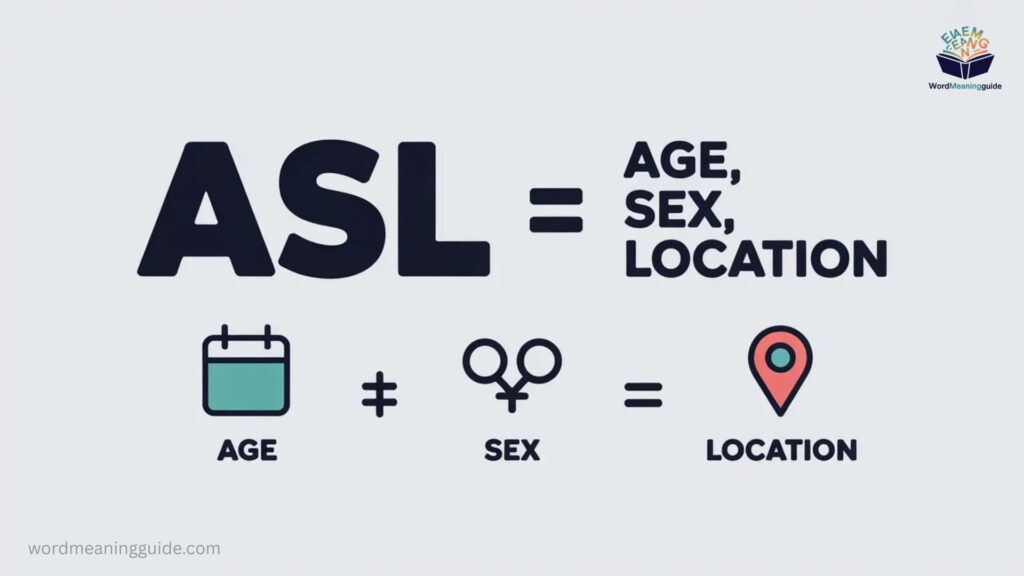
Let’s give this meaning its proper place in history.
When someone typed “ASL?” in an AOL chat room in 1998, they were doing something socially significant: they were trying to make a real human connection through the barrier of anonymity. Without emojis, profile pictures, or mutual friends, those three data points — age, sex, location — were all you had to form an idea of who you were speaking to.
The answer would typically come back formatted like: “17/F/California” or “23/M/London.”
It was brief, structured, and universally understood. A protocol for human connection in a new digital world.
Interestingly, studies on early internet behavior suggest that users who exchanged ASL information were more likely to continue longer conversations — the shared context reduced social friction and made interactions feel more personal.
Explore now GNG Meaning in Text (2026): Texting Slang Explained Fast
Why People Used ASL in Chats
There were several reasons ASL became the universal chat opener:
Anonymity was the norm. Early internet culture valued anonymous interaction. Usernames like “xX_DarkWolf_Xx” gave nothing away, so ASL filled the information gap.
Text was the only medium. Before video calls and voice chats were mainstream, all you had was typed text. ASL was a verbal shortcut for profiling.
Community safety. In group chat rooms, knowing someone’s age mattered — parents and moderators sometimes encouraged age disclosure to protect minors from adult conversations.
Geographic curiosity. Before the world felt “small” and globalized, knowing someone was from a different city or country felt fascinating and exotic.
ASL in Modern Texting: How It’s Used Today
Fast-forward to 2025, and ASL looks very different in most text conversations.
The “as hell” meaning now dominates. According to data from social listening platforms, the phrase “asl” used as an intensifier appears millions of times per month across TikTok comments, Twitter/X posts, and Snapchat messages — far outpacing its traditional usage.
A teenager today might find the original meaning puzzling. “Why would you just ask someone’s age and location?” is a legitimate question in an era where your Instagram bio, location tag, and age are often publicly visible.
But the slang form? It’s everywhere.
“Bored asl.” “Beautiful asl.” “This song hits different asl.” It follows the same grammatical pattern every time — adjective or phrase, followed by “asl” — and the meaning is unmistakable.
The Rise of ASL as Slang (“As Hell”)
The evolution of ASL into “as hell” didn’t happen overnight.
Linguists trace the casual use of “as hell” as an intensifier back to African American Vernacular English (AAVE), where expressions like “funny as hell” and “cold as hell” have long been common in spoken language. As AAVE has historically influenced mainstream American slang — particularly through music, pop culture, and social media — “as hell” gradually became widespread.
When text-speak compressed it to “asl,” the slang entered a new phase: it became typable, shareable, and searchable.
Platforms like Twitter (now X), where brevity is rewarded, and TikTok, where comment culture drives slang adoption, accelerated this spread. By the early 2020s, “asl” as an intensifier had become standard vocabulary for millions of young people.
Continue reading LOML Meaning in Text (2026): Easy Definition, Real Examples & How to Use It
According to a 2023 report on digital language trends by the Global Language Monitor, informal intensifiers — including slang acronyms — are among the fastest-evolving categories in modern English.
ASL vs. ASL (American Sign Language)
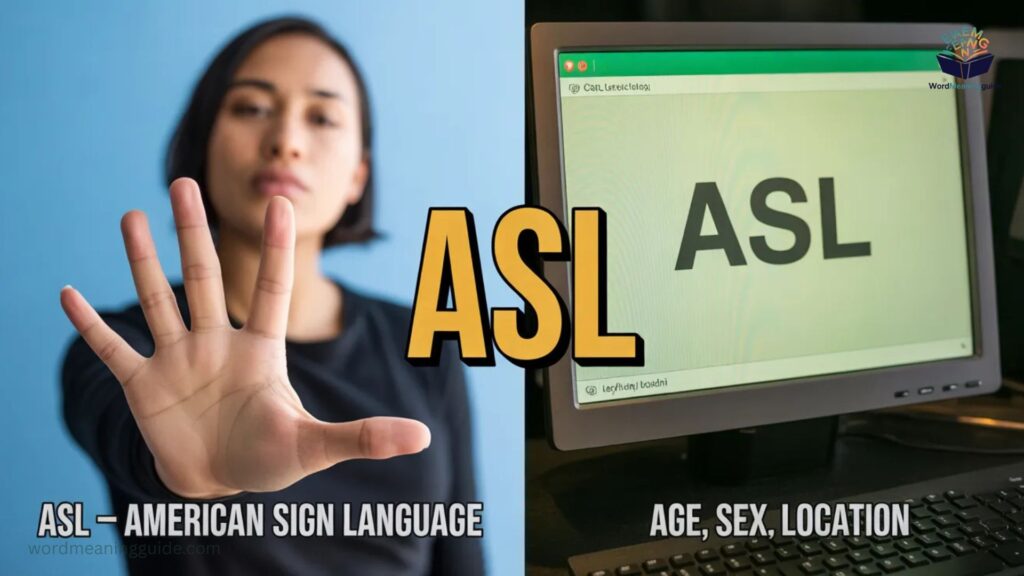
Here’s where things can get confusing.
ASL also stands for American Sign Language — the complete, natural language used by the Deaf and hard-of-hearing community in the United States and parts of Canada.
American Sign Language is a rich, complex language with its own grammar, syntax, and cultural traditions. It is not simply English translated into hand gestures — it is an entirely independent linguistic system with hundreds of thousands of users.
So when you type “ASL” in a text conversation, the meaning depends entirely on context:
- “What’s your ASL?” → Age, Sex, Location (internet slang)
- “I’ve been learning ASL for a year.” → American Sign Language
- “This traffic is bad asl.” → As Hell (modern slang)
All three are legitimate, widely-used meanings of the same three letters.
How to Know Which ASL Someone Means
Context clues make it straightforward in most cases:
- If someone asks “ASL?” as a standalone question in a chat intro, they likely mean Age, Sex, Location.
- If ASL appears at the end of a sentence after a description (“she’s cool asl”), it almost certainly means as hell.
- If the conversation is about language learning, accessibility, or Deaf culture, it likely refers to American Sign Language.
Explore more Second Base Meaning in a Relationship – Simple Definition, Examples & Modern Usage (2026 Guide)
When in doubt, the safest move is to look at the full sentence, the platform, and the person’s apparent age or communication style. A 15-year-old on Snapchat probably means “as hell.” Someone on a language learning forum probably means American Sign Language.
The Cultural Evolution of ASL
ASL’s journey from chat room relic to modern slang is a fascinating case study in how language lives and breathes through digital culture.
It was born out of practical necessity, became a cultural artifact of early internet life, nearly faded into irrelevance as social media matured, and then was reborn with an entirely different meaning by a new generation.
This isn’t unusual in language history. Words and phrases regularly get repurposed, recycled, and reloaded with new meaning by new communities. Think of how “sick” came to mean “excellent,” or how “literally” is now used figuratively. ASL follows the same pattern — old letters, new life.
What makes ASL’s story particularly interesting is that all three meanings are active simultaneously, used by different communities in different contexts. That kind of multilayered existence is relatively rare in slang.
Common Misunderstandings About ASL
1. ASL Always Means Age, Sex, Location
This is the most common misconception, particularly among older internet users. Many people assume that ASL only refers to the Age, Sex, Location question — but anyone under 25 is far more likely to use it as “as hell.” Assuming one meaning in the wrong context can lead to real confusion.
2. ASL Is Only Used by Teenagers
While Gen Z has driven the modern “as hell” usage, ASL in various forms is used across age groups. Millennials recognize both meanings; older users may only know the original. It’s a multi-generational term.
3. ASL Is a New Internet Trend
The “as hell” version may feel fresh, but ASL has been part of internet culture since the mid-1990s. It’s one of the oldest surviving internet acronyms, just wearing a new outfit.
Find out more WS Meaning in Text (2026 Guide): What Does “WS” Stand For in Messages & Social Media?
4. ASL Is Always Appropriate
Like any slang, context matters. Using “asl” in a professional email or formal text would read as unprofessional. It’s casual language designed for informal settings — keep it there.
5. ASL Is Common on Modern Social Media
Interestingly, while “asl” is common in comments and DMs, it’s less common in formal social media posts or captions. It thrives in conversational spaces — comment sections, group chats, and gaming lobbies — rather than polished public posts.
Modern Variations of ASL in Text 🔄
As with any living slang, ASL has spawned variations:
- “asl bro” — Adding emphasis by addressing the reader, e.g., “This is crazy asl bro.”
- “asf” — A cruder but related intensifier (“as f***”), used in similar contexts.
- “fr asl” — Combining “for real” and “as hell” for extra emphasis: “That test was hard fr asl.”
- “lowkey asl” — Blending “lowkey” (somewhat, subtly) with “asl” for nuanced intensity.
These variations show that ASL isn’t static — it continues to evolve even within its modern form.
Why People Still Use ASL in 2025 🌐
In 2025, ASL persists for several reasons:
Efficiency. Three letters replace three words. In an era of quick-fire messaging, that matters.
Belonging. Using current slang signals membership in a cultural group. Saying “bored asl” marks you as someone fluent in the social language of your peer group.
Expressiveness. Intensifiers are emotionally satisfying. “I’m tired asl” carries more weight than “I’m very tired.” Slang often does emotional heavy lifting in a way formal language can’t.
Nostalgia. For millennials, using or referencing old-school ASL carries a warm, ironic charm — a knowing wink at internet culture’s past.
ASL Meaning in Different Platforms 📲
ASL on Dating Apps ❤️
On platforms like Tinder, Hinge, or Bumble, ASL in its original sense occasionally reappears — particularly from users who want to quickly establish basic compatibility. “What’s your ASL?” might come from someone who wants to confirm age and location before investing in conversation. However, most modern dating apps surface this information in profiles automatically, making the question largely redundant.
ASL on Gaming Chats 🎮
Gaming communities remain one of the last strongholds of original ASL usage. In voice-chat-free lobbies, players still text “ASL?” to connect with teammates. Knowing someone’s age or location can affect how you communicate, which server you’re on, or whether you’ll face timezone issues for co-op play. At the same time, the “as hell” version thrives in gaming too — “That boss was hard asl” is perfectly natural post-game commentary.
ASL on Social Media 💬
On TikTok, Instagram, and Twitter/X, “asl” almost exclusively means “as hell.” Comment sections are flooded with it. “She ate that performance asl.” “This song slaps asl.” It’s quick, emphatic, and perfectly suited to the reactive, expressive tone of social media commentary.
Continue reading WSG Meaning in Text (2026): Definition, Examples & How to Use It
Examples of ASL in Sentences
Here are real-world style examples showing how ASL appears in different contexts:
- “Hey, ASL?” — Classic chat room opener (Age, Sex, Location)
- “That game was intense asl.” — Modern slang (as hell)
- “I’ve been taking ASL classes at the community center.” — American Sign Language
- “She’s confident asl and I love it.” — Compliment using modern slang
- “Back in the day, you’d always get hit with ASL as soon as you joined a chat.” — Nostalgic reference
- “The weather today is hot asl.” — Casual observation using slang
- “17/F/Texas” — A classic ASL response from the chat room era
Why Understanding ASL Matters Today
You might wonder — why does understanding a three-letter acronym matter?
Because language is how we connect.
Misreading someone’s intent online — whether you mistake “asl” for a creepy question or misunderstand a nostalgic reference — can create unnecessary confusion or social friction. In a world where so much of our communication happens through screens, being fluent in the language of digital spaces isn’t just helpful, it’s essential.
Understanding ASL in all its forms also reflects a broader truth about internet culture: nothing really disappears. Old slang gets recycled. Old platforms inspire new ones. Old acronyms put on new meanings. The internet has a long memory, and keeping up with its evolving language keeps you connected to the people — and conversations — that matter to you.
Expert Insight: The Linguistic Side of ASL
Language scholars have long been fascinated by how internet communication compresses and reinvents language.
Dr. John McWhorter, a linguist and Columbia University professor who has written extensively on language evolution, argues that text-based communication is not degrading language — it’s creating new, parallel registers of expression. “Texting is fingered speech,” he has said, suggesting that informal digital writing follows the natural rhythms of human conversation rather than formal grammar.
ASL fits perfectly into this framework. Its original form (Age, Sex, Location) was practical fingered speech — a quick spoken-style exchange in written form. Its modern form (as hell) is emotionally expressive fingered speech — an intensifier that mimics the emphasis we’d apply with our voice in real conversation.
Both versions of ASL are, in their own way, linguistically clever.
How to Use ASL Naturally in Your Own Texts
If you want to use “asl” as modern slang without sounding forced, here are some natural patterns:
- Adjective + asl: “She’s funny asl.” / “That movie was long asl.”
- Verb phrase + asl: “It hit different asl.” / “He played well asl.”
- Emotional state + asl: “I’m happy asl right now.” / “We’re tired asl after that hike.”
The key is to let it flow like speech. If you’d naturally say “as hell” out loud in casual conversation, “asl” works in text.
Tips to Avoid Miscommunication Online
Given that ASL has multiple meanings, here’s how to keep your communication clear:
- Read the full sentence before assuming meaning. Context almost always reveals intent.
- Know your platform. Gaming chat vs. social media comment vs. language forum — each has its dominant ASL interpretation.
- Know your audience. Texting your 45-year-old cousin? They probably know ASL as Age/Sex/Location. Texting your 17-year-old sibling? Almost certainly “as hell.”
- When in doubt, ask. There’s no shame in saying “Wait, what did you mean by ASL?”
- Avoid ASL in professional contexts. Whether as slang or as the original question, ASL has no place in work emails or professional messages.
Is ASL Still Used to Ask Age, Sex, Location?
Honestly? Less than before — but it hasn’t disappeared entirely.
On anonymous chat platforms, in online gaming, and in certain communities that prize the retro internet aesthetic, the original ASL question still pops up regularly. It’s become something of a cultural artifact — familiar, recognizable, and occasionally used with a wink of irony.
A 2022 survey on internet slang familiarity found that over 78% of millennials immediately recognized ASL as “Age, Sex, Location,” while over 65% of Gen Z respondents associated it primarily with “as hell.” Both generations showed awareness of multiple meanings, but generational defaults differed significantly.
Don’t miss this BSF Meaning: Simple Definition, Full Form, Examples, and Usage Guide In 2026
Other Popular Slang Related to ASL
If you’re building your digital communication vocabulary, these related terms are worth knowing:
- AF — “As F***” — a stronger intensifier with the same function as modern ASL
- Lowkey — Mildly or secretly; often combined with slang intensifiers
- Highkey — Openly or obviously; opposite of lowkey
- FR — “For Real” — used to confirm or emphasize truth
- NGL — “Not Gonna Lie” — precedes a candid admission
- IYKYK — “If You Know, You Know” — used for inside references
- Slay — To do something impressively well
- No cap — No lie; truthfully
Understanding these alongside ASL gives you a fuller picture of how modern digital slang operates as a system, not just a collection of isolated terms.
FAQs
What does ASL mean in text from a guy or girl?
Regardless of who sends it, ASL typically means the same thing — either “Age, Sex, Location” (an introductory question on anonymous platforms) or “as hell” (a modern intensifier). The meaning depends on context, not on who’s sending it. If it arrives as a standalone opener in a new chat, it’s likely the old-school version. If it’s embedded in a sentence, it’s almost certainly slang.
Is ASL appropriate for all ages?
The “as hell” version of ASL is casual slang suitable for informal settings among peers. It’s not appropriate for professional environments, academic writing, or conversations with people who may not be familiar with internet slang. The original “Age, Sex, Location” version is largely associated with older internet culture and can feel intrusive or outdated in most modern contexts.
Why do people say “asl” at the end of sentences?
Because it functions as an intensifier — similar to saying “very,” “really,” or “extremely.” Placing it at the end of a sentence after an adjective or description is the standard grammatical form: “It’s hot asl outside” means “It’s extremely hot outside.” This pattern comes from the phrase “as hell,” which has long been used in casual American speech.
Does ASL mean the same thing on all platforms?
Not exactly. On gaming platforms and anonymous chat, ASL as “Age, Sex, Location” still surfaces regularly. On social media platforms like TikTok, Instagram, and Snapchat, “as hell” dominates. On language learning or accessibility forums, ASL almost always refers to American Sign Language. Platform and context determine which meaning applies.
Is learning ASL (American Sign Language) related to internet slang ASL?
No — they share the same acronym but are completely unrelated. American Sign Language is a fully developed natural language used by the Deaf community. Internet slang “ASL” is an acronym that either asks for personal chat information or serves as a shorthand intensifier. The only connection is three shared letters.
Will ASL slang eventually fade out?
All slang has a lifespan — some fade quickly, others stick around for decades. Given that “as hell” is deeply embedded in spoken American English, it’s likely that “asl” as its textual equivalent will remain in use for the foreseeable future. However, as with all slang, newer expressions may eventually push it aside among younger generations.
Conclusion
Three letters. Three meanings. One remarkable journey through internet history.
ASL meaning in text is a story about how language adapts, communities evolve, and how the words we type carry more cultural weight than they might appear to. From anonymous AOL chat rooms in the 1990s to TikTok comment sections in 2025, ASL has proven itself to be one of the internet’s most resilient and versatile acronyms.
Whether you’re using it to ask where someone lives, to emphasize how ridiculously funny something was, or to describe the signed language you’ve been learning for a year, ASL is a small but meaningful part of how we communicate in the digital age.
Understanding it — all of it — makes you a more fluent, more connected, and more culturally aware communicator. And in a world that’s increasingly lived through screens and text boxes, that’s worth more than it might seem.
So the next time someone throws “ASL?” your way, you’ll know exactly what they mean — or at least, you’ll know how to figure it out.

Mr. Yaseen is a passionate content creator and language enthusiast dedicated to making words simple and meaningful for everyone. As the author behind WordMeaningGuide.com, he focuses on delivering clear, accurate, and easy-to-understand definitions that help readers improve their vocabulary and communication skills. With a keen eye for detail and a love for language, Mr. Yaseen ensures every piece of content is user-friendly, informative, and valuable for learners of all levels.