Language never sits still. Every generation reshapes words, flips their meanings upside down, and launches new slang into the digital stratosphere faster than any dictionary can keep up. One of the most fascinating — and frequently misunderstood — examples of this is the term DSL.
If you’ve ever seen “DSL” pop up in a text message, on a TikTok comment, in a meme caption, or buried deep in a Discord thread and thought it was just about internet connection speeds, you might have been caught completely off guard by what the person actually meant. You’re not alone.
The story of DSL in modern slang is one of collision — where technical jargon and internet culture smashed together to produce something wildly different from its original meaning. Today, DSL lives a double life: a perfectly respectable broadband technology on one side, and a loaded piece of informal slang on the other.
This guide covers everything you need to know about DSL slang — its meaning, origins, cultural context, how it spreads across platforms like TikTok and Snapchat, how to respond if someone uses it, and whether it’s ever offensive. Whether you’re a curious parent, a researcher, a content creator, or just someone who wants to stay fluent in internet culture, this is the most comprehensive breakdown you’ll find.
Let’s decode DSL — all of it.
DSL Slang Meaning in Texting, Social Media & Modern Usage 2026
The term DSL has taken on a very different cultural weight in texting and social media compared to its original technical definition. In casual digital conversation, DSL is widely understood as slang for “Dick Sucking Lips” — a crude but commonly used expression that describes someone perceived to have full, prominent, or sensual lips.
It’s blunt. It’s explicit. And it’s everywhere online.
Used primarily as a physical compliment (or, in some circles, an insult), DSL has migrated from locker room whispers to mainstream social media threads. As of 2026, it appears in comments on Instagram Reels, in TikTok duets, in Snapchat DMs, and in the lyrics of viral tracks. Its usage spans age groups and demographics, though it remains most popular among teenagers and young adults aged 16 to 30.
Understanding it is no longer optional if you want to navigate modern digital communication with confidence.
What Does DSL Mean in Slang?
In everyday slang, DSL means “Dick Sucking Lips.” It refers to lips that are considered thick, full, or prominently shaped — typically used in a sexual or suggestive context.
The phrase is primarily used as a form of physical commentary. When someone texts “she’s got DSL” or leaves a DSL comment on a photo, they are almost always referencing this slang meaning, not internet connectivity.
It’s worth noting that DSL can function as both a compliment and an objectifying remark depending on tone, context, and the relationship between speakers. Among close friends, it might be playful and affectionate. In other contexts — especially when directed at strangers — it can easily cross into harassment.
What Does DSL Stand For in Slang?
In slang, DSL stands for “Dick Sucking Lips.” Each letter maps directly: D for Dick, S for Sucking, L for Lips.
While the acronym is the same as the one used in telecommunications (Digital Subscriber Line), the two uses share nothing except their letters. The slang version emerged organically from internet culture and has no formal origin document or creator — it evolved through repetition across forums, message boards, and eventually social media.
Where Did DSL Slang Originate?
The origins of DSL as slang are rooted in early internet culture, specifically the crude and unfiltered humor that dominated forums like Something Awful, early Reddit threads, 4chan, and various anonymous messaging boards in the early-to-mid 2000s.
These spaces had a culture of repurposing official or technical-sounding acronyms with vulgar alternatives — a kind of linguistic rebellion against formal language norms. DSL was a perfect candidate: it was already a widely recognized acronym thanks to the broadband internet revolution of the late 1990s and early 2000s, which made the joke land harder because of the absurd contrast.
Over time, it trickled from niche internet boards into mainstream digital culture, boosted by the rise of meme culture, viral videos, and eventually short-form video platforms.
Etymology of DSL
The word “DSL” in its technical form stands for Digital Subscriber Line, a telecommunications technology developed in the 1980s and popularized through the 1990s as a method of transmitting data over telephone lines.
The slang usage borrowed this established abbreviation and recontextualized it entirely. Linguistically, this process — called semantic shift or reappropriation — is not unusual in the history of language. Words and acronyms frequently get hijacked for entirely new meanings when a community finds humor, relatability, or utility in them.
In the case of DSL slang, the etymology is one of irony: a corporate, technical term co-opted to describe something entirely human and physical. The juxtaposition is part of what made it memorable and repeatable online.
History of DSL as Slang
The slang history of DSL follows a fairly predictable arc for internet-born terminology.
Phase 1 — Underground Origins (Early 2000s): DSL as slang first circulated in anonymous internet forums and chat rooms. It was crude, insider humor shared among small communities.
Phase 2 — Meme Culture Adoption (2010s): As meme culture exploded, DSL appeared in image macros, Vine videos, and early YouTube commentary. It became more widely known but was still considered relatively niche.
Phase 3 — Mainstream Social Media (2018–2022): Instagram, Twitter, and Snapchat normalized a huge amount of previously underground slang. DSL started appearing in public comment sections and DMs with increasing frequency.
Phase 4 — TikTok Era (2022–2026): TikTok turbocharged DSL’s cultural footprint. Short-form video creators used it in captions, voiceovers, and reaction content. By 2025, it had become one of the more widely recognized pieces of body-focused slang among Gen Z and younger millennials.
Misinterpretations of DSL
One of the most common misinterpretations of DSL is that the person using it is talking about broadband internet. This causes real confusion — and occasionally embarrassing moments — in professional or cross-generational conversations.
Imagine a parent reading their teenager’s text and seeing “omg she has total DSL vibes” and assuming it’s a conversation about Wi-Fi speeds. Or a teacher noticing “DSL” in a student’s online comment and being completely baffled about the context.
This confusion is actually useful in one sense: it gives younger users a layer of plausible deniability. Because the technical meaning is so well-established, saying “I was talking about internet!” remains a credible, if transparent, defense in mixed company.
DSL in Professional vs Casual Contexts
In professional and technical contexts, DSL almost exclusively means Digital Subscriber Line. You’ll see it in IT documentation, telecom industry reports, network configuration guides, and customer service discussions at internet providers.
In casual contexts — especially digital communication between young people — DSL almost exclusively means the slang version. Context is everything. If your coworker mentions DSL in a meeting about network infrastructure, they are not making a crude joke. If your 19-year-old nephew says “bro, DSL for real” after scrolling someone’s Instagram, he probably is.
The key is reading the surrounding conversation for clues. Technical jargon nearby? Probably telecommunications. Discussions about appearance, attraction, or physical traits? Almost certainly slang.
DSL in Modern Culture & Social Media 2026
By 2026, DSL has fully embedded itself into the vocabulary of digital culture. It appears across platforms, genres, and demographics — sometimes subtly, sometimes brazenly.
Social media algorithms on platforms like TikTok have become increasingly adept at flagging explicit content, which means users have evolved to use DSL as a “coded” term that slips under automated content moderation. This has actually helped accelerate its spread: because it doesn’t trigger the same red flags as more explicit language, it flows freely through comment sections, captions, and video scripts.
Influencers, content creators, and even some mainstream celebrities have used the term in public posts, further normalizing it. Research into online language trends suggests that coded sexual slang grows faster than explicit language specifically because of platform moderation — a linguistic arms race between users and content filters.
Is DSL Always Sexual?
No — though the primary and most widely understood slang meaning of DSL is sexual, context can shift its weight considerably.
Between very close friends who share a particular sense of humor, DSL might be used in a completely lighthearted and affectionate way — more teasing than suggestive. In certain creative or artistic communities, discussing someone’s “DSL” might even be framed as aesthetic appreciation rather than sexual commentary.
That said, the sexual connotation is so deeply embedded in the term’s current usage that it can almost never be completely stripped away, especially in text-based communication where tone is hard to read. If there’s any doubt about how a message might land, avoiding the term is the safest choice.
DSL in Gendered Language
The slang usage of DSL has historically been applied more frequently to women and femme-presenting individuals, which reflects broader patterns of gendered objectification in digital language.
However, modern usage has become more fluid. DSL is used across genders and orientations, particularly in LGBTQ+ digital spaces where the phrase has been reclaimed, playfully subverted, or used within communities in ways that feel empowering rather than objectifying.
Linguists who study internet slang have noted that the gendered application of body-focused slang is gradually shifting as younger, more gender-conscious generations reshape language norms online. DSL is part of that evolving landscape.
Legal or Safety Considerations for DSL
While DSL is commonly used informally, it’s important to understand its legal and safety implications in certain contexts.
Using DSL slang in a workplace environment could constitute sexual harassment, particularly if directed at a colleague without consent. Under most workplace anti-harassment policies, sexually suggestive comments about a person’s physical appearance — even in coded or abbreviated form — can create a hostile work environment.
In school settings, students who use DSL in a way that targets or demeans another student could face disciplinary action under harassment or bullying policies. Many school districts explicitly prohibit sexually charged language even when it’s presented as slang.
Parents and guardians should also be aware that encountering DSL in their child’s messages, comments, or viewing history may warrant a conversation about digital boundaries, body autonomy, and respectful communication online.
What Does DSL Mean in Schools
In school contexts, DSL takes on a specific and important meaning in the UK education system that is completely separate from its internet slang definition.
In British schools, DSL stands for Designated Safeguarding Lead — a trained staff member responsible for child protection and safeguarding within the school. Every school in England and Wales is legally required to have a DSL. This person is the first point of contact for concerns about a child’s safety or wellbeing.
This is one of the starkest examples of how different the same acronym can be in different contexts. A student texting “DSL lol” to a friend means something very different from a school document referencing the “DSL’s responsibilities.”
What Does DSL Mean for Girls
When DSL is directed at or used in reference to girls, it typically still carries the primary slang meaning of “Dick Sucking Lips.” The comment is usually about physical appearance — specifically the fullness or shape of lips — often framed as attraction or desirability.
For girls and young women who encounter this term, it’s important to know that it is widely considered objectifying language. While some individuals may receive it as a compliment, others find it demeaning, reductive, or unwelcome.
Girls who encounter DSL in unsolicited messages or comments have every right to find it inappropriate. The fact that it is “just slang” does not neutralize the impact of unwanted sexually charged commentary on someone’s appearance.
DSL in Popular Music and Movies
DSL has made notable appearances in popular music lyrics over the past decade, particularly in hip-hop, R&B, and trap music, where body-focused slang is frequently woven into song lyrics as a form of praise or bravado.
Several viral songs from the early 2020s onward have referenced DSL either directly or in ways that clearly nod to the slang meaning. These appearances in commercially distributed music have done as much as social media to normalize and amplify the term’s reach.
In film and television, DSL has appeared in raunchy comedies and adult animated series. These appearances — often treated as throwaway jokes — nonetheless signal how deeply the acronym has moved from underground internet slang into mainstream entertainment vocabulary.
What Does DSL Mean in Text Messages?
In text messages, DSL almost always refers to the slang meaning — “Dick Sucking Lips.” When someone sends a DSL message in a personal or casual texting context, they are almost never discussing broadband internet.
Common text usage patterns include:
Commenting on a photo someone has shared — “bro DSL energy” — as a response to someone’s appearance. Joking with a close friend about a celebrity or public figure. Using DSL in a flirtatious or suggestive exchange between people who are romantically interested in each other.
Texting removes facial expression, tone, and body language from communication. This means DSL in a text can land very differently depending on who sent it, your relationship with them, and what came before in the conversation.
DSL Meaning on TikTok and Other Platforms
TikTok has become the primary engine of slang evolution in 2026. The platform’s algorithm-driven content distribution means that a single popular video can normalize a term for millions of users almost overnight.
DSL on TikTok functions both as a comment-section staple and as a topic of creator content. You’ll find TikTok videos explaining the meaning of DSL to newcomers, reaction videos to DSL comments, and comedy skits that play on the dual meaning of the term.
DSL Meaning Slang TikTok
On TikTok specifically, DSL is used in comments under photos and videos featuring close-up shots of someone’s face, particularly lips. It appears in duet captions, stitch reactions, and “lip sync” videos where the double meaning becomes part of the joke.
TikTok’s community guidelines technically flag sexually explicit content, but DSL — because it is an acronym rather than a spelled-out phrase — often bypasses these filters. This has made it a go-to coded term for TikTok users who want to make suggestive comments without triggering removal or account penalties.
DSL Meaning Snapchat
On Snapchat, DSL appears primarily in direct messages and in caption overlays on Snaps where someone is commenting on another person’s appearance. Snapchat’s more private, one-to-one communication style means DSL here is almost always a personal comment rather than a public broadcast.
Because Snaps disappear after viewing, DSL on Snapchat is often used with even less inhibition than on more public platforms. This is worth bearing in mind for parents monitoring younger teens’ Snapchat activity.
DSL Meaning Slang Meme
As a meme, DSL has taken on several recognizable formats. The most common involves a juxtaposition — an image or video captioned with something technical or innocent paired with a DSL comment that subverts expectations. The humor comes from the contrast between the mundane technical definition and the crude slang meaning.
There are also reaction memes where someone realizes mid-sentence that DSL was meant as slang rather than a reference to internet speeds. These play on the plausible deniability element and have been widely shared across Reddit, Twitter/X, and Instagram.
DSL Meaning Safeguarding
In safeguarding contexts — particularly in UK schools, healthcare settings, and child protection services — DSL stands for Designated Safeguarding Lead.
The DSL is a legally mandated role in educational and care settings, responsible for managing safeguarding concerns, liaising with authorities, and ensuring child protection policies are properly followed. The role is defined under statutory guidance including “Keeping Children Safe in Education” in England.
If you are a professional working in education or child services and see “DSL” in documentation or job listings, this is almost certainly the meaning intended — and it has nothing whatsoever to do with internet slang.
DSL Meaning WiFi
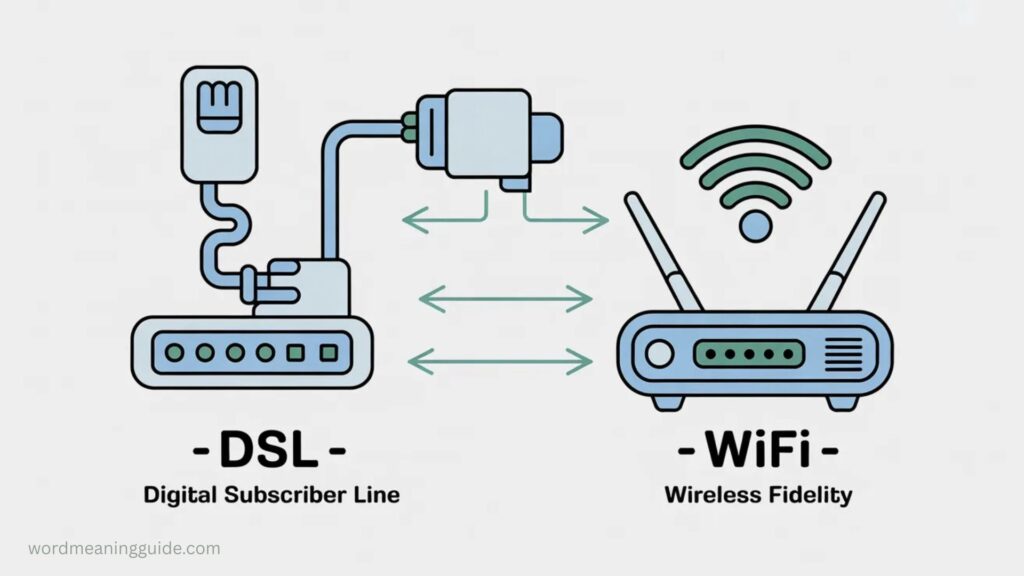
In the world of internet and telecommunications, DSL means Digital Subscriber Line — a technology that delivers internet access by transmitting data over traditional copper telephone lines. It was one of the first widely available broadband options for home users.
While DSL internet has largely been superseded by fiber optic connections in many areas, it remains in use globally — particularly in rural regions where fiber infrastructure hasn’t yet been laid. The term appears in ISP marketing, tech support documentation, modem packaging, and network engineering.
If your internet provider or a tech manual references DSL, they mean the broadband technology — not the slang.
DSL Meaning Medical
In medical and clinical contexts, DSL does not have a single universal standard meaning, though it has been used as shorthand in specific specialties.
In neurology, DSL is sometimes used as an abbreviation for Distal Sensory Latency, a measurement used in nerve conduction studies to assess peripheral nerve function. In ophthalmology, it appears occasionally in clinical shorthand for specific procedures or findings.
If you encounter DSL in a medical report or clinical note, the context of the surrounding document will make the intended meaning clear. When in doubt, always ask the healthcare professional for clarification — medical abbreviations vary by specialty, institution, and country.
How to Respond if Someone Uses DSL
How you respond to DSL depends entirely on context, your relationship with the sender, and whether the comment was directed at you or someone else.
If it was a joke between friends: You can choose to laugh along, redirect the conversation, or simply ignore it. No obligation exists to engage with every piece of slang someone throws your way.
If it was directed at you and you’re uncomfortable: It is completely valid to say so. You might say something like, “I’d prefer you didn’t comment on my appearance like that” or simply, “Not cool.” Direct, calm responses tend to be more effective than escalating.
If it was in a professional or school context: This may warrant a formal report, depending on your organization’s harassment policies. Screenshot or document the interaction before taking it further.
If your child received it: Use it as an opportunity for a conversation about online communication, boundaries, and what respectful digital behavior looks like.
How to Choose the Right Version of DSL
With multiple meanings of DSL floating around, choosing the right interpretation comes down to a few simple questions.
First: what is the context? Is the conversation about technology, networking, or internet service? Then DSL likely means Digital Subscriber Line. Is the conversation social, personal, or image-focused? Then DSL likely means the slang term.
Second: who is saying it? A tech professional, IT support rep, or telecom engineer using DSL is almost certainly referring to the broadband technology. A teenager, social media user, or content creator is almost certainly using the slang.
Third: what platform or medium is it on? DSL in a network documentation file means broadband. DSL in a TikTok comment section means slang. DSL in a safeguarding policy document means Designated Safeguarding Lead.
When in genuine doubt, the safest move is to ask for clarification rather than assume.
Is DSL Offensive in Any Context?
Yes — DSL can absolutely be offensive, depending on the context and how it’s used.
When directed at someone without their consent, DSL functions as a form of sexual objectification — reducing a person to a physical attribute in a sexually charged way. Many people find this deeply disrespectful, regardless of whether it was intended as a compliment.
It is particularly offensive when used about someone who is underage, when used in a professional or educational environment, or when used repeatedly after someone has expressed discomfort with the term.
Even in casual settings, DSL can come across as reductive and crass. Understanding that the term carries real weight — and that its impact depends on the target’s feelings, not the sender’s intent — is essential for responsible digital communication.
Common Contexts for DSL Slang
1. Romantic Texting
DSL appears frequently in flirtatious text exchanges between adults. In this context, it often functions as a form of physical compliment — a coded way of expressing attraction. When both parties understand the reference and are comfortable with it, DSL might form part of playful, consensual banter.
2. Friend Groups and Playful Messaging
Among close friends who share a ribald sense of humor, DSL becomes part of an internal vocabulary. It might be used ironically, affectionately, or as part of ongoing in-jokes. Context within the friendship group usually determines how it lands.
3. Gaming and Roleplay
Online gaming communities — particularly voice chat and in-game text communication — have long embraced crude slang as part of their culture. DSL appears in gaming spaces as commentary on character appearances, streamer clips, or general banter. In roleplay contexts, it might be used as part of character description or in-world humor.
4. Social Media Posts
Social media is where DSL has the widest reach. It appears in comments, captions, reaction posts, and viral content across virtually every major platform. Its presence on social media ranges from clearly joking and community-specific to targeted and uncomfortable.
DSL vs Technical DSL
The table of difference between slang DSL and technical DSL is sharp and worth summarizing:
Technical DSL (Digital Subscriber Line) is a broadband technology. It connects homes and businesses to the internet over copper phone lines. It is a legitimate, professional, and neutral term used globally in telecommunications.
Slang DSL (Dick Sucking Lips) is a crude, sexually suggestive acronym that describes a physical attribute. It originated in internet culture and has no professional or technical application.
The two uses are entirely separate in meaning, origin, and appropriate usage. The fact that they share letters is coincidence — or, from the perspective of internet humor, intentional irony.
Common Mistakes Using DSL
One of the most common mistakes is using DSL in a professional context while meaning the slang — or vice versa. Both errors can cause significant confusion or even embarrassment.
Another frequent mistake is assuming the recipient understands the joke. Not everyone has the same level of internet culture fluency. Using DSL as a compliment with someone unfamiliar with the slang can be baffling at best and accidentally offensive at worst.
A third mistake is using DSL in public social media comments directed at specific individuals. Even when meant lightheartedly, unsolicited comments about another person’s physical appearance in a sexual register can be perceived as harassment and may violate platform community guidelines.
Finally, some people make the error of dismissing the impact of DSL because it’s “just slang.” The fact that something is informal or abbreviated does not reduce its potential to harm, offend, or violate another person’s sense of dignity.
Real-Life Examples of DSL in Text and Social Media
DSL is used in different ways depending on context, tone, and relationship. Here are some clear, real-life style examples to help you understand how it works in everyday conversations:
Flirty Messages
“Good night, DSL 😘 sleep tight”
👉 Used in a playful or affectionate way, often between close friends or partners.
Friend Group Jokes
“DSL, you’re the best at game night!”
👉 Here, DSL adds a fun and friendly tone, making the message feel more personal.
Gaming Chat
“Our DSL team member carried us in the match!”
👉 In gaming, DSL can be used as a nickname or playful tag for someone skilled.
Social Media Captions
“DSL vibes only ✨ #cutetexting #slangtrends”
👉 Often used to create a trendy, expressive caption that feels modern and engaging.
Psychological and Cultural Impact of DSL
DSL highlights how digital communication continues to evolve. People naturally prefer short, expressive phrases that save time while still showing emotion. Slang like DSL allows users to communicate affection, humor, or personality in a quick and relatable way.
It also plays a role in building social connections. When people use the same slang, it creates a sense of belonging and shared understanding within friend groups or online communities. This is especially common among younger users who quickly adopt and spread new terms.
At a broader level, DSL shows how language adapts in the digital age. Traditional expressions are being reshaped into shorter, more creative forms. This mix of emotion and efficiency is what makes modern texting slang so popular and constantly evolving.
Trending Examples of DSL in 2026
In 2026, DSL has evolved from a static slang term into a flexible cultural reference that appears in multiple trending formats.
Comment threads on beauty and lifestyle content frequently feature DSL as shorthand for a particular aesthetic quality. Lip filler trends on TikTok and Instagram have reignited interest in the term, with creators both embracing and critiquing the DSL label in the context of cosmetic enhancement.
Some content creators in the beauty space have intentionally reframed DSL as a power statement — reclaiming it as self-confident body positivity language. Meanwhile, critics in the digital wellness space have used the term’s prevalence as an example of how online culture continues to objectify physical appearance under the guise of harmless abbreviation.
Future of DSL Slang in 2026
Slang evolves in cycles — terms rise, peak, become clichéd, and either fade or transform. In 2026, DSL sits at an interesting inflection point.
On one hand, its usage remains robust and widespread, particularly on video platforms. On the other, the growing awareness of gendered objectification online — driven by media literacy campaigns and the evolving values of younger digital natives — is creating more friction around crude body-focused slang.
It’s possible that DSL will gradually drift toward ironic or self-aware usage rather than direct sexual commentary, as often happens with slang that becomes oversaturated. It may also inspire successor terms that carry the same cultural weight but arrive fresh and undetected by content filters.
What is certain is that as long as digital communication exists, slang will continue to shape and reshape itself around language’s deep relationship with the body, attraction, and humor.
Frequently Asked Questions
What is the most common meaning of DSL in slang?
The most common slang meaning of DSL is “Dick Sucking Lips,” referring to full or prominent lips in a sexually suggestive context. This meaning dominates in casual digital communication, especially among teenagers and young adults.
Is DSL appropriate to use in conversation?
It depends on the context. Between consenting adults who understand the reference, DSL might be considered harmless banter. However, in professional settings, schools, or when directed at strangers or minors, DSL is widely considered inappropriate and potentially offensive.
What does DSL mean in a UK school context?
In UK education, DSL stands for Designated Safeguarding Lead — a specific, legally required role responsible for child protection within a school or educational setting. This meaning has nothing to do with internet slang.
Can DSL be considered harassment?
Yes. If DSL is used to make unwanted sexual comments about a person’s appearance — particularly in a workplace, school, or via repeated messaging — it can constitute sexual harassment under applicable employment or education law.
Why do people use abbreviations like DSL instead of spelling out the phrase?
Abbreviations like DSL serve multiple functions: they save time, they act as in-group signals for those familiar with internet culture, and they provide plausible deniability when platforms or authority figures might otherwise flag explicit language.
Does DSL mean anything in medical or technical contexts?
Yes. In telecommunications, DSL means Digital Subscriber Line — a broadband internet technology. In some medical specialties, DSL is used as shorthand for Distal Sensory Latency in nerve conduction studies. Always rely on surrounding context to determine which meaning applies.
What should I do if my child is using or receiving DSL messages?
Treat it as an opportunity for an open, non-judgmental conversation about digital communication, body respect, and consent. Explain what the term means, discuss why it can be harmful when used without consent, and help your child understand appropriate online boundaries.
Is DSL trending in 2026?
Yes. DSL remains in active circulation across major platforms including TikTok, Instagram, Snapchat, and X (formerly Twitter), with particularly strong usage in beauty, lifestyle, and entertainment content communities.
Conclusion
Language is a living thing — and DSL is a perfect example of how a single acronym can hold entirely different worlds inside it depending on where you are, who you’re talking to, and what platform you’re standing on.
From the technical depths of broadband infrastructure to the buzzing comment sections of TikTok, from the safeguarding offices of UK schools to the flirtatious DMs of adults on Snapchat — DSL travels all of these spaces simultaneously, meaning something different in each.
What this guide ultimately reveals is not just the definition of a piece of slang, but something larger: the extraordinary speed at which language evolves in the digital age, the way internet culture borrows and subverts established terms, and the responsibility that comes with using charged language in connected, public spaces.
Knowing the full spectrum of DSL’s meanings in 2026 makes you a more informed communicator, a more aware digital citizen, and — if you’re a parent, educator, or professional — a more effective guardian of the spaces you inhabit online. Words carry weight. Abbreviations carry weight. And in an era where a three-letter acronym can mean a fiber optic cable or a crude remark depending on context, understanding that weight is not optional. It’s essential.

Mr. Yaseen is a passionate content creator and language enthusiast dedicated to making words simple and meaningful for everyone. As the author behind WordMeaningGuide.com, he focuses on delivering clear, accurate, and easy-to-understand definitions that help readers improve their vocabulary and communication skills. With a keen eye for detail and a love for language, Mr. Yaseen ensures every piece of content is user-friendly, informative, and valuable for learners of all levels.