Picture this: You just walked out of a job interview that felt electric. The conversation flowed, the interviewer smiled, and you genuinely connected. As you shook hands at the door, you said the same three words everyone else said — “Thank you for the opportunity.”
Nothing wrong with that. But here’s the thing — so did the 12 other candidates who sat in that same chair before you.
The language we use to express gratitude is one of the most underestimated tools in professional communication. According to a 2023 survey by the Society for Human Resource Management (SHRM), over 68% of hiring managers say a thoughtful follow-up message influences their final hiring decision. Yet most people reach for the same tired, overused phrase without a second thought.
Whether you’re wrapping up a job interview, closing a business meeting, accepting a speaking invitation, or simply thanking a mentor who gave you their time — the way you express appreciation shapes how people perceive you. It signals your emotional intelligence, your communication skills, and your genuine gratitude.
This guide gives you 55+ powerful, polished, and professional alternatives to “thank you for the opportunity” — organized by tone, context, and situation — so you always have exactly the right words, no matter the moment.
When Should You Use These Alternatives?
Before diving into the phrases themselves, it’s worth asking a deeper question: when does expressing gratitude about an opportunity actually matter?
The answer is: almost constantly in professional life.
You’ve just finished a podcast interview. You’ve been given a chance to present at a conference. A senior colleague mentored you through a difficult project. A client trusted you with their business. A professor recommended you for a research role. In every one of these moments, the words you choose carry weight.
The phrase “thank you for the opportunity” works — but it’s generic. It sounds scripted. It doesn’t say who you are or how you specifically feel. Swapping it for a more intentional alternative can transform a forgettable closing remark into a memorable impression.
Here are the most common situations where these alternatives shine:
- After a job interview — formal, professional, sincere
- After a guest speaking appearance — warm, gracious, personal
- When accepting a promotion or new role — confident, appreciative, forward-looking
- After a networking meeting — conversational, genuine, brief
- In a thank-you email or letter — written, polished, thoughtful
- When being introduced to a new team — humble, enthusiastic, relationship-building
- After receiving mentorship or coaching — personal, heartfelt, meaningful
Is It Professional and Polite to Say “Thanks for Having Me” Professionally?
This is a question many professionals quietly wonder about. Is “thanks for having me” too casual for a corporate setting?
The short answer: it depends entirely on context.
“Thanks for having me” originated in casual social settings — dinner parties, casual get-togethers, informal visits. When transplanted into a professional context, it can feel jarring or even flippant if the setting is formal. Saying it to a CEO after a board presentation, for instance, might raise an eyebrow.
However, in many modern workplaces — especially in tech, media, creative industries, and startups — professional culture has shifted significantly toward warmth and informality. In these environments, “thanks for having me” actually reads as refreshingly human and unpretentious.
The golden rule: Match the language to the culture. Observe how people in that organization communicate. If the company values traditional formality, go formal. If it celebrates casual connection, warmth will serve you better than stiffness.
That said, even in casual contexts, there are richer, more memorable ways to express the same sentiment — and you’ll find dozens of them below.
Formal Alternatives to “Thank You for the Opportunity”
When the setting demands polish and professionalism, these phrases elevate your gratitude without sounding robotic:
- “I sincerely appreciate the opportunity you’ve extended to me.”
- “I am deeply grateful for this professional opportunity.”
- “Please accept my sincere appreciation for this opportunity.”
- “I am honored to have been considered for this role.”
- “I wish to express my heartfelt thanks for this valuable opportunity.”
- “I am truly grateful for the trust you have placed in me.”
- “It is a privilege to have been given this opportunity.”
- “I want to formally express my appreciation for this chance.”
These phrases work especially well in written correspondence — cover letters, formal thank-you emails, post-interview notes, or letters of acknowledgment. They communicate respect, professionalism, and genuine gratitude without sacrificing warmth.
Casual Alternatives to “Thank You for the Opportunity”
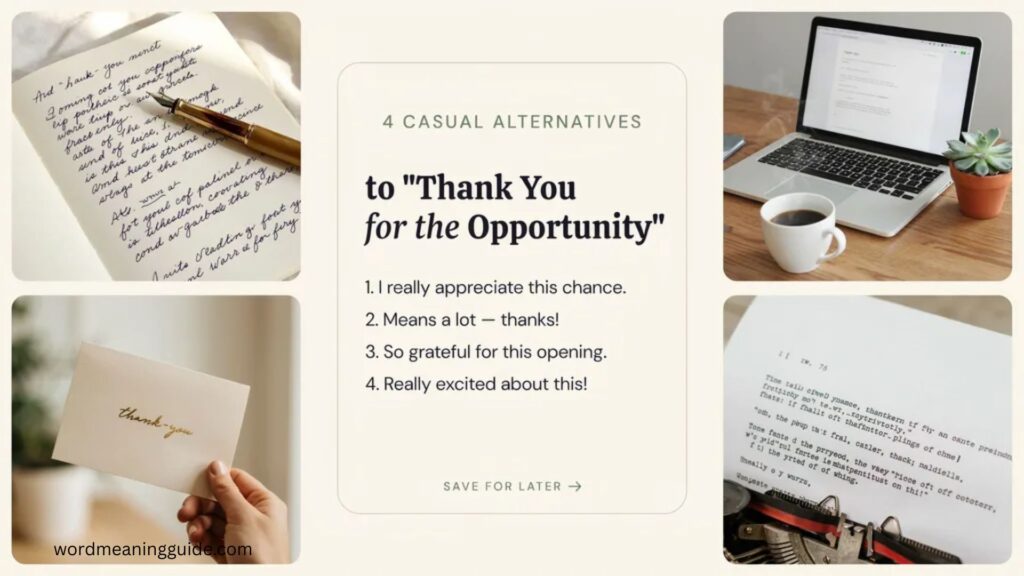
In team meetings, informal conversations, or lighter professional environments, these relaxed alternatives feel natural and genuine:
- “I really appreciate you thinking of me for this.”
- “Thanks so much for giving me this shot.”
- “I’m genuinely excited about this chance.”
- “Really grateful you included me in this.”
- “Thanks for letting me be a part of this.”
- “I’m so glad you reached out — this means a lot.”
- “This is such a great opportunity and I’m really thankful.”
- “Thanks for opening this door for me.”
These are perfect for Slack messages, casual follow-up texts, verbal exchanges with colleagues, or informal networking conversations. They feel warm and human without being overly effusive.
Professional Alternatives to “Thank You for the Opportunity”
These sit in the sweet spot between formal and casual — confident, clear, and appropriate for most professional settings:
- “I appreciate the opportunity.” — Clean, direct, versatile.
- “Thank you for this opportunity.” — A slight variation that feels more specific.
- “I’m grateful for the opportunity.” — Adds emotional weight without overdoing it.
- “I appreciate the chance.” — Slightly more conversational, still professional.
- “Thank you for giving me this chance.” — Acknowledges their active role in creating the moment.
- “I’m thankful for the opportunity.” — Warm and sincere.
- “I appreciate being considered.” — Perfect for competitive situations like interviews.
- “Thank you for believing in me.” — Adds a personal, trust-based dimension.
- “I appreciate the trust you’ve placed in me.” — Signals accountability and awareness.
- “Thank you for the chance to grow.” — Forward-looking and development-focused.
- “I’m honored by this opportunity.” — Adds respect and reverence.
- “I truly value this opportunity.” — Emphasizes depth of appreciation.
- “I appreciate the opportunity to contribute.” — Action-oriented, team-minded.
- “Thank you for opening this door for me.” — Vivid, metaphorical, memorable.
- “I’m grateful for the chance to be involved.” — Humble and collaborative.
- “Thank you for the learning opportunity.” — Growth-oriented, great for junior professionals.
- “I appreciate the opportunity to learn.” — Shows hunger for development.
- “Thank you for trusting me with this.” — Acknowledges the responsibility they’ve given you.
- “I’m thankful for this professional opportunity.” — Adds professional context explicitly.
- “I appreciate the opportunity to move forward.” — Progress-oriented and confident.
- “Thank you for this valuable opportunity.” — Acknowledges the significance.
- “I’m appreciative of this opportunity.” — Slightly formal, thoughtful variation.
- “I appreciate the opportunity to be considered.” — Ideal for interview follow-ups.
- “Thank you for this chance to prove myself.” — Bold, confident, driven.
- “I’m thankful for the opportunity to work with you.” — Relational, collaborative.
- “Thank you for the opportunity to take on this role.” — Role-specific, precise.
- “I sincerely appreciate this opportunity.” — Adds sincerity and genuine depth.
Warm and Grateful Expressions That Stand Out
Sometimes, what a moment calls for isn’t just professionalism — it’s genuine human warmth. These expressions go beyond politeness into authentic gratitude:
- “This opportunity means more to me than words can fully express.”
- “I’m moved by your confidence in me.”
- “Your belief in my potential inspires me to do my best work.”
- “I don’t take this opportunity lightly — thank you from the bottom of my heart.”
- “Working with someone of your caliber is something I’ve aspired to — thank you.”
- “This moment marks something truly significant for me, and I’m grateful you made it possible.”
These expressions are powerful in personal notes, handwritten thank-you cards, or meaningful one-on-one conversations. Use them sparingly — their impact comes from authenticity, not repetition.
Best Synonyms for “Thanks for Having Me” Professionally

These are especially useful after appearances, presentations, guest roles, or visits where someone hosted or invited you:
- “Thank you for your hospitality.” — Classic, gracious, timeless.
- “I appreciate your time.” — Respects their investment in you.
- “It was a pleasure to join you.” — Elegant, warm, memorable.
- “Grateful for the opportunity to be here.” — Simple and sincere.
- “Thanks for including me.” — Collaborative, humble, approachable.
- “I’m honored to be here.” — Adds gravity and genuine respect.
- “Thank you for the warm welcome.” — Personal, human, appreciative.
- “Thank you for having me over.” — Warmer version, great for informal professional visits.
- “I value your guidance.” — Great after mentorship or coaching sessions.
- “Thank you for your support.” — Broad, genuine, relational.
- “I appreciate your insights.” — Acknowledges the specific value they brought.
- “It was great connecting with you.” — Networking-perfect, modern, friendly.
- “Thank you for the opportunity to learn.” — Growth-minded and appreciative.
- “I’m thankful for your consideration.” — Formal, respectful, gracious.
- “I appreciate your invitation.” — Acknowledges their initiative in reaching out to you.
- “I’m grateful for your guidance.” — Mentorship-focused, personal.
- “Thank you for making me feel welcome.” — Acknowledges their effort and warmth.
- “I value the time you spent with me.” — Respectful of their investment.
- “It was a privilege to join you.” — Elevated, formal, sincere.
- “I appreciate your support and guidance.” — Combines both dimensions meaningfully.
- “Thank you for your kind invitation.” — Gentle, warm, appropriate.
- “I appreciate your consideration.” — Short, professional, versatile.
- “Thank you for welcoming me.” — Simple, genuine, unpretentious.
- “I’m thankful for this opportunity.” — Direct and heartfelt.
- “Thanks for letting me be part of this.” — Collaborative, team-oriented.
- “I’m grateful for your time and effort.” — Acknowledges what they gave, not just what you received.
- “Thank you for your thoughtfulness.” — Recognizes their care and intention.
- “I appreciate being included.” — Humble, warm, genuine.
- “I’m grateful for your invitation.” — Clean and sincere.
- “Thank you for your warm reception.” — Formal yet personal, great for professional events.
Common Mistakes When Expressing Gratitude Professionally
Even well-intentioned professionals make these mistakes. Knowing them helps you avoid them.
1. Being Overly Effusive
Phrases like “I can’t even begin to express how incredibly, unbelievably grateful I am…” can actually undermine your credibility. It sounds rehearsed or insincere. Genuine gratitude is specific, not theatrical.
2. Generic Over-Use
If you say “thank you for the opportunity” in every single email, message, and meeting, it starts to sound like a verbal reflex rather than real appreciation. Variety shows intentionality.
3. Forgetting to Be Specific
“Thank you for the opportunity” is vague. “Thank you for the opportunity to present my research to the senior leadership team” is specific, memorable, and meaningful. Specificity is the secret ingredient.
4. Poor Timing
Sending a thank-you three weeks after an event feels obligatory at best, insincere at worst. Timeliness matters. A thank-you email after a job interview should go out within 24 hours. A spoken thank-you should happen naturally in the moment.
5. Mismatching Tone to Context
Saying “Thanks for having me, it was super fun!” after a high-stakes board presentation is a mismatch. And sending a stiff, formal letter after a casual coffee chat feels cold. Reading the room — or the relationship — is everything.
When to Use “Thank You for the Opportunity”: Spoken vs. Written
The channel matters as much as the content.
Spoken Expression
When you’re expressing gratitude verbally, brevity is your friend. A long, elaborate thank-you in conversation can feel awkward. Keep it natural: “I really appreciate this chance — thank you.” Let your tone, eye contact, and sincerity carry the message.
Spoken thank-yous are perfect for:
- Closing a job interview
- Accepting an award or recognition
- Wrapping up a meeting or presentation
- Thanking someone in the moment
Written Expression
In writing, you have more room to be specific, heartfelt, and deliberate. This is where the more elaborate phrases shine. A well-crafted thank-you email or note demonstrates care, professionalism, and communication skill all at once.
Written thank-yous work best for:
- Post-interview follow-up emails
- Thank-you cards or letters
- LinkedIn messages after networking
- End-of-project acknowledgment emails
Formal vs. Informal: Choosing the Right Register
Understanding register — the level of formality in your language — is a crucial communication skill that many people overlook.
Formal registers are appropriate when:
- The recipient is significantly senior to you
- The context is a legal, medical, academic, or corporate setting
- The communication is in writing and will be on record
- You’ve had minimal personal relationship with the person
Informal registers are appropriate when:
- You have an established relationship with the person
- The workplace culture is casual or collaborative
- The communication is verbal or via messaging
- The context is low-stakes and relational
When in doubt, slightly formal is safer than slightly casual. It’s much easier to warm up a formal relationship than to repair a professional impression damaged by premature informality.
Bonus Section: Short Polite Variations You Can Use Right Now
Sometimes you need something quick, clean, and versatile. These short-form expressions are easy to remember and work across nearly any professional context:
- “Much appreciated.”
- “Truly grateful.”
- “This means a lot — thank you.”
- “I won’t forget this kindness.”
- “Grateful for your time.”
- “Thank you — this is significant to me.”
- “Really appreciate you.”
- “With sincere thanks.”
- “I’m in your debt.” (use carefully — best for genuine, substantial favors)
- “Deeply thankful.”
These work well as standalone sign-offs in emails, quick verbal expressions, or as closers in notes.
Final Writing Tips for Expressing Gratitude That’s Remembered
1. Be specific, always. Don’t just say what you’re grateful for — say why it matters. “Thank you for the opportunity to interview” is fine. “Thank you for the opportunity to interview — the conversation about your company’s approach to innovation was genuinely inspiring” is unforgettable.
2. Mention their contribution. The best expressions of gratitude acknowledge what the other person did, not just what you received. “I appreciate the time and thought you put into this process” is more meaningful than “Thanks for the chance.”
3. Show forward momentum. Where appropriate, connect your gratitude to action or intention. “I’m grateful for this opportunity and look forward to contributing meaningfully to the team” tells the reader you’re not just polite — you’re ready.
4. Write it, then wait before sending. If the message is important, write your thank-you, set it aside for 30 minutes, then read it again. You’ll catch awkward phrasing, overly formal language, or missed specifics. That second read is where good messages become great ones.
5. Personalize the salutation and close. “Dear Dr. Pemberton” and “Warm regards” is different from “Hi Sarah” and “Cheers.” Every element of your message contributes to its tone. Make sure they all sing the same note.
Frequently Asked Questions
Is “thank you for the opportunity” appropriate for all professional situations?
It works in most contexts but can feel generic if used too frequently or without personalization. The more specific and tailored your expression of gratitude, the more impact it has. For high-stakes situations — important interviews, major career moments, or influential relationships — always aim for something more specific.
How soon should I send a thank-you after a job interview?
Ideally within 24 hours of the interview. Research consistently shows that prompt follow-up leaves a positive impression. Waiting longer than 48 hours significantly reduces the impact of your message.
Is it okay to use “thanks for having me” in a business email?
Yes, but context matters. In a formal business environment, it can sound slightly casual. If the culture of the company or relationship supports it, it’s perfectly acceptable. For very formal correspondence, opt for something like “thank you for the opportunity to participate” or “I’m grateful for the invitation to join you.”
What’s the difference between “I appreciate the opportunity” and “I’m grateful for the opportunity”?
Both express genuine thankfulness, but they carry slightly different tones. “Appreciate” is generally a bit more measured and professional. “Grateful” carries a slightly more emotional and personal warmth. Use “appreciate” in formal emails and “grateful” when you want to convey deeper personal feeling.
Can I use multiple expressions of gratitude in one message?
You can, but be careful not to overdo it. One strong, specific expression of gratitude is more powerful than three vague ones stacked together. If you’re writing a longer message or email, one warm opening and one closing expression of thanks is usually the ideal structure.
How do I express gratitude without sounding sycophantic?
The key is specificity and brevity. A sycophantic thank-you is long, gushing, and vague. A genuine one is specific, concise, and tied to something real. “Thank you for sharing your framework on strategic decision-making — it gave me a completely new perspective on a challenge I’ve been wrestling with” is specific, credible, and genuine.
Are handwritten thank-you notes still relevant in 2026?
Absolutely — perhaps more than ever. In a world saturated with digital communication, a handwritten note stands out dramatically. For significant moments — after being hired for a major role, after an influential mentor conversation, or following exceptional hospitality — a handwritten note carries an emotional impact no email can match.
Conclusion:
Here’s the truth that most people miss: gratitude is a professional skill, not just a social nicety.
The way you express appreciation tells the world something about your character, your awareness, and your communication ability. In a landscape where attention is fragmented and impressions are fleeting, a well-chosen phrase of genuine thanks can leave a mark that lasts far longer than the moment itself.
You now have more than 55 alternatives to the overused “thank you for the opportunity.” But more than a list of phrases, what you have is a framework for thinking about gratitude more intentionally — considering the setting, the relationship, the formality, the channel, and the specific gift of what was given to you.
Use these expressions thoughtfully. Adapt them to your voice. Make them your own.
Because when you take the time to say the right thing, in the right way, at the right moment — people notice. And in a competitive, fast-moving professional world, being the person who truly, specifically, memorably says thank you is a distinction worth cultivating.

Mr. Yaseen is a passionate content creator and language enthusiast dedicated to making words simple and meaningful for everyone. As the author behind WordMeaningGuide.com, he focuses on delivering clear, accurate, and easy-to-understand definitions that help readers improve their vocabulary and communication skills. With a keen eye for detail and a love for language, Mr. Yaseen ensures every piece of content is user-friendly, informative, and valuable for learners of all levels.