Saying “thank you for reaching out to me” is one of those phrases we type almost on autopilot. A new email lands, a message pops up, and our fingers move before our brain even catches up. But here’s the thing: when you use the same phrase over and over, it starts to lose its warmth. It becomes background noise instead of a genuine acknowledgment.
Think about the last time someone thanked you for something in a way that felt fresh and sincere. Chances are, it stood out precisely because it wasn’t the same tired line everyone else uses. That’s exactly why expanding your vocabulary around gratitude matters, especially in professional communication where first impressions and tone carry real weight.
This guide walks you through everything you need to know about replacing “thank you for reaching out to me” with alternatives that fit your tone, audience, and context, whether you’re writing a formal business email, a quick Slack reply, or a customer service response.
What Does “Thank You for Reaching Out to Me” Mean?
At its core, this phrase is an acknowledgment. It tells the other person that their effort to contact you, whether through email, a phone call, a message, or a form submission, has been noticed and appreciated. “Reaching out” itself is a softer, more relational way of saying “contacting,” implying a sense of initiative or even vulnerability on the sender’s part.
When someone reaches out, they’ve taken a step toward connection. They might be asking a question, raising a concern, proposing a partnership, or simply checking in. Responding with thanks validates that action and sets a respectful, welcoming tone for whatever conversation follows.
When to Use “Thank You for Reaching Out to Me”
This phrase fits naturally into several situations:
- Replying to a new business inquiry or sales lead
- Responding to a customer support ticket
- Acknowledging a networking message on LinkedIn
- Thanking a job candidate or recruiter for initiating contact
- Replying to a cold email or introduction
- Opening a response to feedback or a complaint
It works best as an opening line, something that softens the transition into the main content of your reply. However, using it too often within the same conversation thread, or across every single email you send, can make your communication feel scripted rather than personal.
Is “Thank You for Reaching Out to Me” Polite or Professional?
Yes, it’s both polite and professional, but it’s also extremely common. According to communication researchers, overused business phrases can trigger what’s sometimes called “phrase fatigue,” where readers skim past familiar wording without truly registering it. A 2023 LinkedIn workplace communication study noted that recipients pay more attention to emails with distinct, human-sounding openers than to generic, templated language.
That doesn’t mean the phrase is wrong. It’s grammatically correct, courteous, and appropriate in almost any setting. The issue is repetition. If you’re sending dozens of emails a week, using the exact same opener every time can make your writing feel automated, even if your intentions are completely genuine.
Pros & Cons of Using “Thank You for Reaching Out to Me”
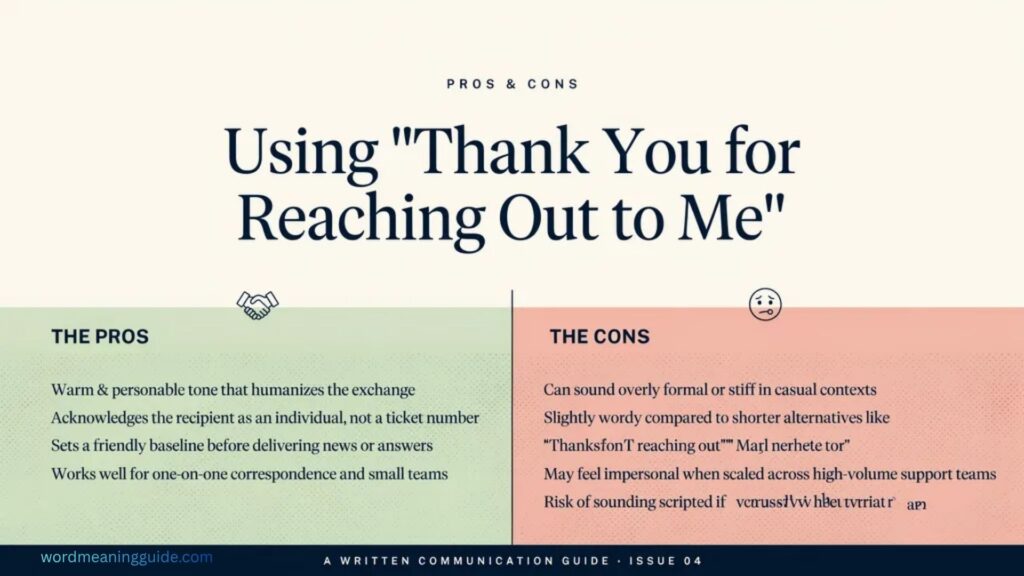
Pros:
- Universally understood and accepted in professional settings
- Sets a respectful, warm tone from the first line
- Works across industries and communication styles
- Safe choice when you’re unsure of the relationship’s formality level
Cons:
- Overused, which can make replies feel impersonal
- Doesn’t convey much personality or warmth on its own
- Can sound redundant in long email threads
- May come across as a placeholder rather than authentic gratitude
Understanding these trade-offs helps you decide when to stick with the original phrase and when it’s worth reaching for something more tailored.
Quick Alternatives List (One-Line Phrases Only)
- Thanks for contacting me
- I appreciate your message
- Thanks for getting in touch
- Grateful for your outreach
- Thanks for your note
- Thank you for your inquiry
- I value your outreach
- Many thanks for reaching out
- Appreciate you reaching out
- Thanks for connecting
- I appreciate your communication
- Thanks for checking in
- Thank you for your message
- Appreciate your note
- Grateful for your message
15 Alternatives to “Thank You for Reaching Out to Me”
1. Thanks for Contacting Me
A slightly more casual variation that still maintains professionalism. Works well in customer service replies.
2. I Appreciate Your Message
A warm, sincere alternative that emphasizes gratitude over formality.
3. Thanks for Getting in Touch
Friendly and conversational, ideal for networking or informal business contexts.
4. Grateful for Your Outreach
A more reflective tone, often used in formal or executive-level correspondence.
5. Thanks for Your Note
Short and approachable, perfect for quick replies.
6. Thank You for Your Inquiry
Best suited for sales, support, or service-related communication.
7. I Value Your Outreach
Conveys respect and acknowledges the effort behind the message.
8. Many Thanks for Reaching Out
A slightly more expressive version that still feels professional.
9. Appreciate You Reaching Out
Casual yet respectful, common in startup or modern workplace cultures.
10. Thanks for Connecting
Especially useful for LinkedIn messages or networking follow-ups.
11. I Appreciate Your Communication
A more formal phrase suited to corporate or legal contexts.
12. Thanks for Checking In
Best for ongoing relationships where ongoing contact is expected.
13. Thank You for Your Message
Neutral and safe, fits nearly any professional scenario.
14. Appreciate Your Note
Brief and warm, good for quick acknowledgments.
15. Grateful for Your Message
Adds a touch of sincerity without overcomplicating the tone.
35+ Formal Ways to Say “Thank You for Reaching Out to Me”
When writing to executives, clients, or in situations requiring heightened professionalism, these formal alternatives work well:
- I appreciate you contacting me
- Thank you for getting in touch
- I am grateful for your outreach
- I sincerely appreciate your message
- Thank you for contacting me
- I value your reaching out
- Thank you for your inquiry
- I appreciate your effort to connect
- Thank you for your correspondence
- I am thankful for your outreach
- I appreciate your initiative in contacting me
- Thank you for keeping in touch
- I am grateful for your message
- Thank you for your prompt outreach
- I sincerely thank you for reaching out
- I truly appreciate your contacting me
- Thank you for your interest in connecting
- I value your communication
- Thank you for reaching out regarding [topic]
- I appreciate you taking the time to contact me
- I am grateful for your prompt communication
- Thank you for keeping me informed
- I appreciate your reaching out at this time
- Thank you for initiating contact
- I sincerely value your communication
- Thank you for your thoughtful message
- I am thankful for your proactive outreach
- I truly value your message
- Thank you for your kind outreach
- I appreciate your initiative in reaching out
- I am grateful for your timely contact
- Thank you for your correspondence
- I sincerely appreciate your reaching out
- I value the effort you made to contact me
- Thank you for taking the time to reach out
Each of these works particularly well at the start of formal emails, client communications, or any context where precision and respect take priority over casual warmth.
Mini Dialogue Examples
Example 1 (Formal/Business):
“Thank you for your inquiry regarding our enterprise pricing plans. I’d be happy to walk you through the available options.”
Example 2 (Informal/Networking):
“Thanks for connecting! I really enjoyed your recent post about remote team management.”
Example 3 (Customer Service):
“Thanks for contacting me about the delayed shipment. Let me look into this right away and get back to you within the hour.”
Example 4 (Job Recruitment):
“I appreciate you reaching out about the marketing coordinator position. I’d love to schedule a time to discuss your background further.”
These examples show how the same underlying sentiment can shift tone depending on audience and purpose.
Mistakes to Avoid
One common mistake is pairing a formal alternative with an otherwise casual email, creating a mismatched tone that feels inconsistent. If your email is friendly and conversational throughout, opening with an overly stiff phrase like “I sincerely value your communication” can feel out of place.
Another mistake is overusing intensifiers. Phrases like “I am extremely, deeply, and sincerely grateful” pile on unnecessary words and can come across as insincere or excessive. Gratitude doesn’t need embellishment to be effective.
Repetition within the same thread is another pitfall. If you’ve already thanked someone for reaching out in your first reply, there’s no need to repeat the same sentiment in every follow-up message. Instead, move directly into addressing their question or request.
Finally, avoid using overly casual phrases in client-facing or executive communication. “Thanks for checking in” might work fine between coworkers but could feel too relaxed in a formal client relationship.
Cultural & Tone Tips
Workplace communication norms vary significantly across cultures and industries. In many Western business contexts, especially in the United States and United Kingdom, slightly informal gratitude phrases are increasingly common, even in professional settings. Tech startups and creative agencies, for example, often favor warmer, more conversational language.
In contrast, more traditional industries such as law, finance, and government tend to favor formal phrasing. Communication experts often note that mirroring the tone of the person you’re responding to is one of the safest strategies. If someone writes to you formally, respond formally. If their message feels casual and friendly, it’s usually safe to match that energy.
It’s also worth remembering that gratitude phrases carry different weight across cultures. In some regions, expressing thanks too briefly can come across as dismissive, while in others, excessive thanks may seem performative. When communicating internationally, a slightly more neutral and universally polite phrase, like “thank you for your message,” tends to translate well across contexts.
Comparison Table of 7 Best Alternatives
| Alternative Phrase | Tone | Best Used For |
| Thank you for your inquiry | Formal | Sales, support, business inquiries |
| I appreciate your message | Warm/Neutral | General professional replies |
| Thanks for getting in touch | Friendly | Networking, casual business |
| I am grateful for your outreach | Formal | Executive or client communication |
| Appreciate you reaching out | Casual | Startups, modern workplaces |
| Thanks for connecting | Friendly | LinkedIn, professional networking |
| Thank you for your correspondence | Formal | Legal, corporate, official letters |
This table offers a quick reference point when you’re unsure which phrase best fits your specific situation.
Frequently Asked Questions
Is it grammatically correct to say “thank you for reaching out to me”?
Yes, it’s grammatically correct and widely accepted in both written and spoken professional communication. The phrase functions as a polite acknowledgment and works well as an opening line in emails or messages.
What’s a more casual way to say “thank you for reaching out to me”?
Casual alternatives include “thanks for getting in touch,” “appreciate you reaching out,” and “thanks for connecting.” These work well in informal workplace settings, startups, or networking conversations.
Can I use “thank you for reaching out” without “to me” at the end?
Absolutely. Dropping “to me” often makes the phrase sound smoother and slightly less repetitive, since the subject is already implied. “Thank you for reaching out” reads just as naturally and is commonly used in professional emails.
Why should I avoid repeating the same thank-you phrase too often?
Repetition can make your writing feel automated or insincere, especially in ongoing conversations. Varying your language keeps your communication feeling genuine and shows attentiveness rather than reliance on a script.
What’s the most formal way to thank someone for contacting you?
Phrases like “I sincerely appreciate your message,” “thank you for your correspondence,” or “I am grateful for your prompt communication” tend to work best in formal, executive, or client-facing contexts.
Should I match the tone of the person who messaged me?
Yes, mirroring tone is generally a smart communication strategy. If someone writes formally, respond formally. If their message feels relaxed and conversational, it’s usually appropriate to respond in kind.
Conclusion
Gratitude is one of the simplest yet most powerful tools in professional communication, but its impact depends heavily on how it’s expressed. “Thank you for reaching out to me” will always be a safe, polite choice, but variety keeps your writing feeling authentic, attentive, and human.
Whether you’re crafting a formal client response, replying to a networking message, or handling customer inquiries, having a flexible vocabulary of gratitude phrases allows you to match tone, context, and relationship dynamics with precision. The next time you sit down to reply to a message, consider reaching for one of these alternatives. Small changes in language often make the biggest difference in how your communication is received.

Mr. Yaseen is a passionate content creator and language enthusiast dedicated to making words simple and meaningful for everyone. As the author behind WordMeaningGuide.com, he focuses on delivering clear, accurate, and easy-to-understand definitions that help readers improve their vocabulary and communication skills. With a keen eye for detail and a love for language, Mr. Yaseen ensures every piece of content is user-friendly, informative, and valuable for learners of all levels.