Words shape impressions long before actions do. When you tell a client, a boss, or a colleague “I will get back to you,” you’re making a small promise — and the phrase you choose to make that promise can sound confident, robotic, warm, or even careless, depending on context.
Maybe you’ve noticed it too: the same five words, repeated in every email thread, every Slack message, every meeting follow-up, until they start to feel like filler rather than a genuine commitment. That’s exactly why so many professionals are searching for fresher, sharper ways to say the same thing without sounding like a broken record.
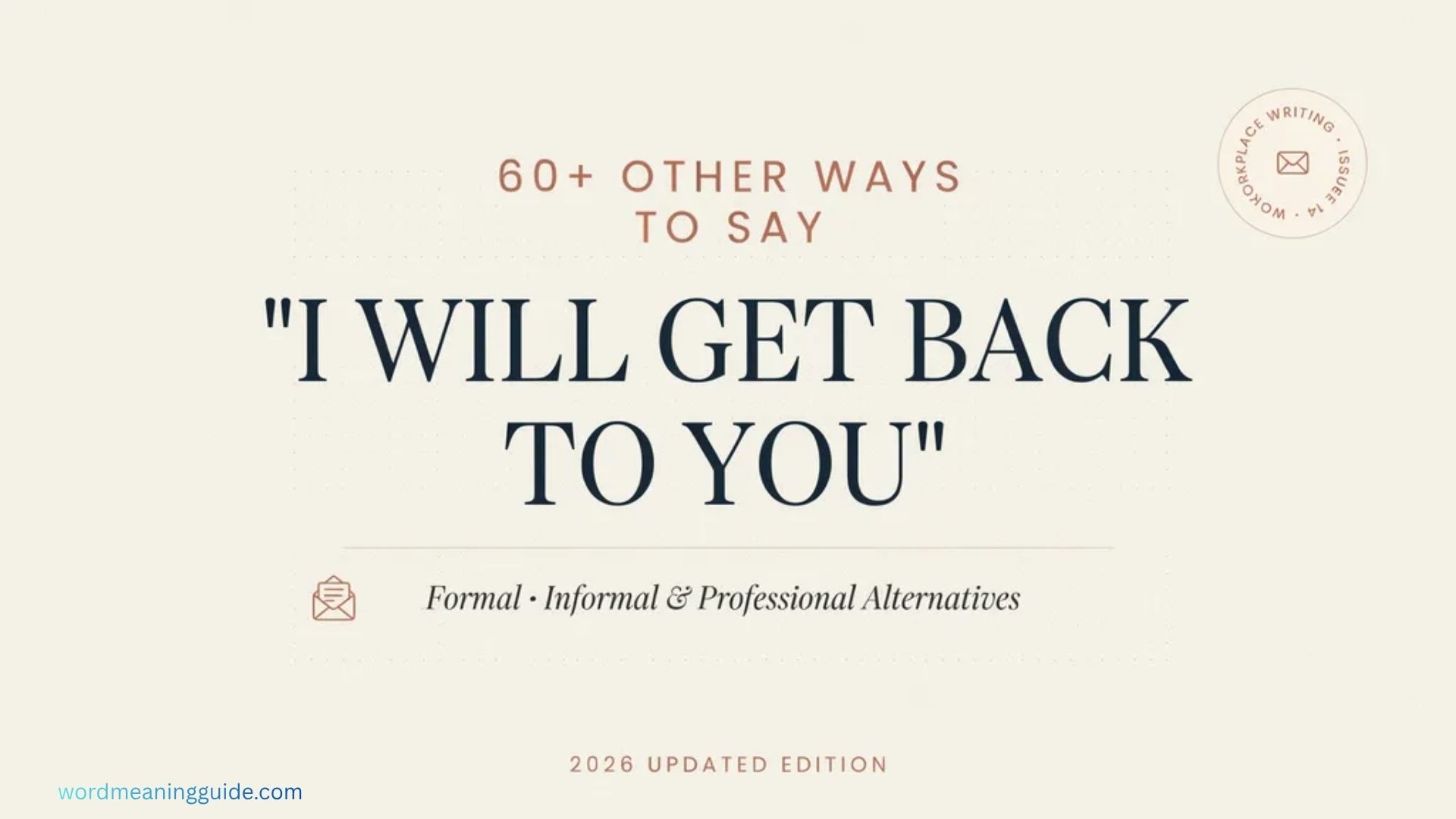
This guide walks you through more than 60 alternatives to “I will get back to you,” broken down by tone, situation, and formality level. Whether you’re writing a formal business email, replying to a friend on WhatsApp, or trying to sound more polished in a job interview, you’ll find a phrase here that fits.
What Does “I Will Get Back to You” Mean?
At its core, “I will get back to you” is a polite way of saying: I don’t have the answer right now, but I will follow up once I do. It signals two things at once — acknowledgment of the request, and a commitment to respond later.
Linguistically, it’s what communication experts call a “deferral phrase.” It buys time without shutting the conversation down. Unlike “I don’t know” or “I can’t help,” it keeps the door open and shows the other person that their question or request hasn’t been ignored — just postponed for a good reason, such as needing to check facts, consult a colleague, or review documents.
It’s a small phrase, but it carries real weight in professional communication. Used well, it builds trust. Used carelessly or too often, it can sound vague, noncommittal, or even like an excuse to avoid answering.
When to Use “I Will Get Back to You”
This phrase fits naturally in situations where:
- You genuinely need more time, information, or approval before answering.
- A decision involves other stakeholders (a manager, a team, a client).
- You want to avoid giving an inaccurate or rushed response.
- The request requires research, calculation, or verification.
- You’re in a meeting and can’t address every question on the spot.
It’s especially useful in customer service, sales negotiations, HR conversations, and project management — basically anywhere precision matters more than speed. A doctor confirming test results, a recruiter checking with HR, or a manager awaiting budget approval are all classic scenarios where this phrase earns its keep.
Is “I Will Get Back to You” Polite or Professional?
Yes — generally speaking, it’s both polite and professional, provided it’s used sincerely and followed through on. It respects the other person’s question while giving you the space to respond accurately.
That said, context matters. In a formal email to a senior executive, it can sometimes feel slightly casual or vague compared to alternatives like “I will follow up with the relevant information shortly.” In texting or chat with a friend, it might come across as a bit stiff compared to “I’ll let you know!”
According to communication researchers, the perceived politeness of deferral phrases depends heavily on specificity. A vague “I’ll get back to you” without a timeframe can feel evasive, while adding a clear timeframe — “I’ll get back to you by Thursday” — significantly increases perceived reliability and professionalism. The phrase itself isn’t the problem; the absence of a follow-up plan is.
Pros & Cons of Using “I Will Get Back to You”
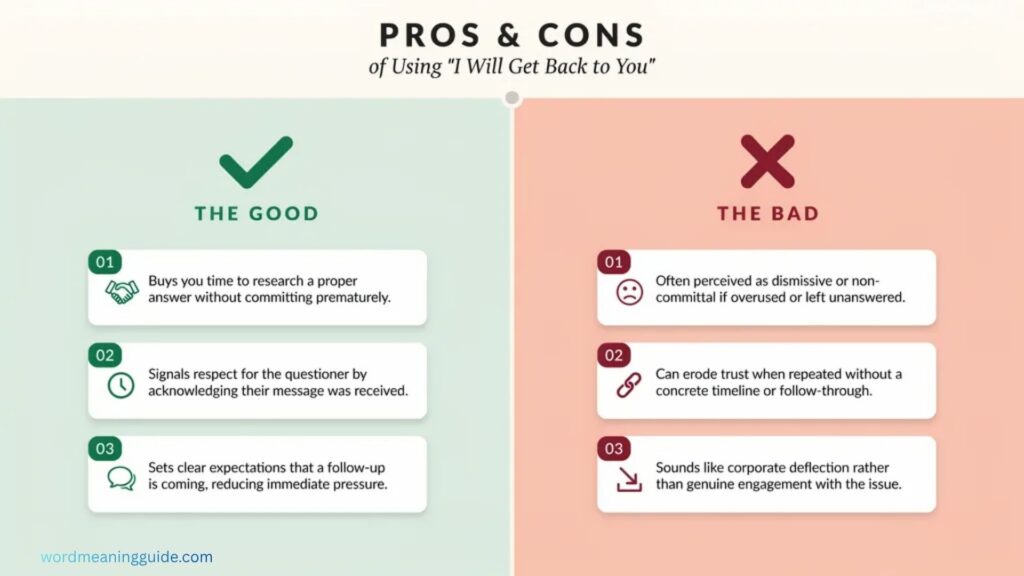
Pros:
- Buys time to give an accurate, thoughtful answer
- Sounds courteous and non-dismissive
- Works across nearly every professional context
- Easy to understand internationally, even for non-native English speakers
Cons:
- Can sound repetitive if overused in the same conversation or email thread
- Feels vague without a specific timeframe attached
- May come across as a stalling tactic if not followed through
- Lacks personality or warmth in customer-facing communication
This is exactly why building a small vocabulary of alternatives is worth the effort — it keeps your communication accurate, varied, and trustworthy.
Main Body: 15 Versatile Alternatives
1. I’ll Follow Up Shortly
A clean, professional choice that implies action is already in motion. Great for emails where you want to sound proactive rather than passive.
2. I’ll Check and Let You Know
Friendly and transparent — this works well when the answer depends on checking a file, schedule, or someone else’s input.
3. I’ll Get Back to You by [Time/Day]
Adding a specific deadline instantly boosts credibility. This is one of the most trusted variations because it sets a clear expectation.
4. Let Me Review and Reply
Ideal for situations involving documents, contracts, or proposals. It signals careful consideration rather than a quick brush-off.
5. I’ll Circle Back
A popular phrase in corporate culture, especially in meetings. It suggests you’ll revisit the topic once you have more clarity.
6. I’ll Touch Base Later
Slightly informal but still professional — commonly used among colleagues who already have an established working relationship.
7. I’ll Update You Shortly
Works particularly well in project management contexts, where ongoing communication about status is expected.
8. I’ll Get in Touch
Simple, direct, and flexible enough for both formal and informal settings.
9. I’ll Reach Out Once I Have Info
This phrase emphasizes that the delay is due to a genuine information gap, not avoidance.
10. I’ll Consult and Reply
Useful when a decision isn’t solely yours to make — for example, when you need a manager’s or team’s input.
11. I’ll Keep You Posted
Casual yet professional, this phrase works beautifully in ongoing projects or ongoing customer interactions.
12. I’ll Follow Up with Details
Signals that your next message will be substantive, not just a placeholder reply.
13. I’ll Look into It and Respond
Conveys diligence — perfect for technical or investigative requests, such as IT support or troubleshooting.
14. I’ll Confirm and Let You Know
Best used when something needs verification, such as availability, pricing, or scheduling.
15. I’ll Respond Once I Have Answers
Honest and straightforward, ideal when multiple unresolved questions are still pending.
35+ More Formal Ways to Say “I Will Get Back to You”
For business emails, client correspondence, and formal documentation, here are dozens of polished, professional variations to keep your writing fresh:
- I will follow up with you
- I will respond shortly
- I will revert with an update
- I will provide an update soon
- I will get back to you with the information
- I will respond once I have reviewed the matter
- I will follow up as soon as possible
- I will get in touch shortly
- I will provide a response shortly
- I will update you accordingly
- I will communicate further details soon
- I will follow up once I have confirmation
- I will get back to you with a decision
- I will provide further information shortly
- I will respond after reviewing your request
- I will be in touch soon
- I will follow up with the relevant information
- I will get back to you once I have additional details
- I will respond with the required information
- I will provide a formal response shortly
- I will get back to you at the earliest
- I will follow up with a detailed response
- I will reach out once I have more clarity
- I will get back to you after consultation
- I will provide a comprehensive response shortly
- I will follow up with my feedback
- I will respond after assessing the details
- I will get back to you as soon as I can
- I will provide the necessary feedback shortly
- I will follow up with the next steps
- I will respond after further review
- I will get back to you once finalized
- I will follow up promptly
- I will provide updates as they become available
- I will get back to you with confirmation
- I will respond in due course
Notice how many of these pair naturally with a timeframe (“shortly,” “as soon as possible,” “at the earliest”). Adding that small detail transforms a vague promise into a reliable commitment — something hiring managers, clients, and executives consistently respond to with more trust.
Mini Dialogue Examples
Workplace Email Client: “Can you confirm if the revised contract terms work for your team?” You: “Thank you for sending this over. I will review the terms internally and follow up with a detailed response by Friday.”
Casual Chat Friend: “Are you free for dinner this weekend?” You: “Not sure yet — let me check my schedule and I’ll keep you posted!”
Customer Service Customer: “Why was my order delayed?” Agent: “I understand your concern. Let me look into it and respond with an accurate update within the hour.”
Job Interview Interviewer: “Do you have experience with this specific software?” Candidate: “Not extensively, but I will follow up with examples of similar tools I’ve used, if that’s helpful.”
These examples show how tone shifts dramatically depending on audience — formal precision for clients, warmth for friends, empathy for customer service, and confidence in interviews.
Mistakes to Avoid
Even a well-intentioned phrase can backfire if used carelessly. Here are common pitfalls:
- Vagueness without a timeframe — “I’ll get back to you” with no deadline often reads as a polite brush-off.
- Overusing the same phrase repeatedly — in a single thread, this can feel robotic or insincere.
- Failing to follow through — nothing damages credibility faster than promising a follow-up and never delivering one.
- Mismatched tone — using overly formal phrasing in casual chats (or vice versa) can feel awkward or out of place.
- Using it as a stalling tactic — people can sense when “I’ll get back to you” really means “I’m avoiding this question.”
A simple rule of thumb: only say it when you intend to actually follow up, and always attach a realistic timeframe whenever possible.
Cultural & Tone Tips
Communication norms vary widely across cultures and industries, and “I will get back to you” is no exception.
In many Western corporate environments, brevity and directness are valued — a quick “I’ll follow up shortly” is perfectly acceptable. In contrast, some Asian and Middle Eastern business cultures place greater emphasis on relationship-building language, where a slightly more elaborate phrase like “I will consult with my team and provide a comprehensive response shortly” feels more respectful.
Tone should also shift based on hierarchy. Responding to a senior executive often calls for more formal phrasing (“I will provide a formal response shortly”), while messaging a peer allows for more relaxed alternatives (“I’ll touch base later”).
Digital communication adds another layer. Email tends to favor fuller, more polished phrasing, while chat tools like Slack or WhatsApp lean toward shorter, conversational alternatives such as “I’ll keep you posted!” — sometimes even paired with an emoji to soften the tone.
The unifying principle across cultures: clarity and sincerity matter more than the exact wording. A genuine commitment to follow up, expressed respectfully, will almost always land well.
Comparison Table of 7 Best Alternatives
| Phrase | Tone | Best Used For |
| I’ll follow up shortly | Professional | Business emails, client communication |
| I’ll get back to you by [day] | Formal & precise | Deadlines, commitments |
| I’ll circle back | Corporate/casual | Meetings, internal discussions |
| I’ll keep you posted | Friendly | Ongoing projects, casual updates |
| Let me review and reply | Formal | Contracts, proposals, documents |
| I’ll touch base later | Semi-formal | Colleague check-ins |
| I’ll look into it and respond | Investigative | Technical or support queries |
This table is a quick-reference cheat sheet for choosing the right phrase based on tone and situation, without overthinking it every time.
Is “I Will Get Back to You” Professional?
In short: yes, it’s professional — but it’s not the only professional option, and relying on it exclusively can make your communication feel less dynamic over time. The phrase works best as one tool among many, deployed thoughtfully alongside its many alternatives depending on audience, urgency, and relationship.
Professionalism isn’t really about which exact words you choose; it’s about pairing your words with follow-through, specificity, and respect for the other person’s time. A phrase as simple as “I will provide an update soon” can sound just as professional — or even more so — when it’s backed by a clear timeframe and an actual follow-up message a day or two later.
Frequently Asked Questions
Is it rude to say “I will get back to you” without giving a reason?
It’s not inherently rude, but adding a brief reason — such as needing to check with a colleague or review a document — makes the phrase feel more transparent and considerate. People generally respond better when they understand why there’s a delay, rather than just being told to wait.
What’s the most professional alternative to “I will get back to you”?
Phrases like “I will follow up with the relevant information shortly” or “I will provide a formal response shortly” tend to sound the most polished in formal business settings, especially in written correspondence with clients or executives.
How do I say “I will get back to you” in a casual conversation?
Casual alternatives include “I’ll keep you posted,” “I’ll let you know,” or “I’ll touch base later.” These feel natural in texts, chats, or conversations with friends and close colleagues.
Should I always include a timeframe when using this phrase?
Wherever possible, yes. Adding a specific timeframe — even an approximate one like “by the end of the week” — significantly increases the perceived reliability of your message and reduces the chance of follow-up confusion.
What should I avoid when using deferral phrases like this one?
Avoid using them repeatedly without follow-through, attaching them to topics you’re simply trying to avoid, or using overly formal language in casual settings where it feels out of place.
Is “I will revert” the same as “I will get back to you”?
They’re very similar in meaning, though “I will revert” is more commonly used in South Asian and certain international business English contexts, while “I will get back to you” is more universally recognized, particularly in American and British English.
Conclusion
“I will get back to you” is a small phrase that carries a surprisingly large responsibility — it’s a promise, however brief, that someone is trusting you to keep. The words you choose to make that promise can shift how confident, warm, or credible you sound, whether you’re closing a business deal, replying to a curious friend, or reassuring a frustrated customer.
The goal isn’t to abandon this phrase altogether — it’s reliable for a reason — but to build a flexible vocabulary around it, so your communication never feels stale or evasive. Pair any of these 60-plus alternatives with a clear timeframe and a genuine intention to follow through, and you’ll come across as exactly what every good communicator strives to be: dependable, clear, and easy to trust.

Mr. Yaseen is a passionate content creator and language enthusiast dedicated to making words simple and meaningful for everyone. As the author behind WordMeaningGuide.com, he focuses on delivering clear, accurate, and easy-to-understand definitions that help readers improve their vocabulary and communication skills. With a keen eye for detail and a love for language, Mr. Yaseen ensures every piece of content is user-friendly, informative, and valuable for learners of all levels.