Language repeats itself more than we realize. Open any email, essay, or report, and you’ll likely spot the phrase “not only” doing heavy lifting again and again. It’s a useful connector, but overusing it makes writing feel flat and predictable. The good news? English offers dozens of fresh, natural alternatives that keep your writing sharp, persuasive, and engaging.
Whether you’re drafting a business proposal, writing a school essay, crafting social media captions, or simply trying to sound more articulate in conversation, this guide gives you everything you need. We’ll explore the meaning of “not only,” when to use it, whether it’s professional enough for formal writing, and more than 39 alternatives you can start using today.
What Does “Not Only” Mean?
“Not only” is a correlative conjunction phrase, almost always paired with “but also.” It signals that something exceeds a single expectation — there’s more to the story than what was just stated. For example: “She is not only talented but also hardworking.” The phrase emphasizes addition, surprise, or emphasis, drawing the reader’s attention to a second, often more impressive, point.
Linguists classify this as an additive discourse marker — a tool that links ideas while building emphasis. According to communication researchers, additive markers like this help readers track logical relationships between ideas, which improves comprehension and retention of written content.
When to Use “Not Only”
“Not only” works best when you want to highlight two related facts, with the second one adding weight or surprise to the first. It’s common in:
- Persuasive writing (marketing copy, op-eds, speeches)
- Academic writing (research papers, essays)
- Business communication (reports, pitches, performance reviews)
- Everyday conversation (storytelling, casual emphasis)
For instance, a marketer might write: “Our software not only saves time but also reduces costs by 40%.” This structure builds toward a stronger claim, making the second point land with more impact.
Is “Not Only” Polite or Professional?
Yes — “not only” is grammatically neutral and works comfortably across formal and informal contexts. It doesn’t carry rudeness or casualness on its own. However, professional writing often benefits from variety. Using the same connector repeatedly across a document — a report, a resume, or a presentation — can make your writing sound mechanical rather than thoughtful.
Business communication coaches frequently note that varied sentence structure signals stronger command of language and keeps readers engaged longer. So while “not only” is perfectly polite, professionals often rotate it with synonyms to maintain a polished, dynamic tone.
Pros & Cons of Using “Not Only”
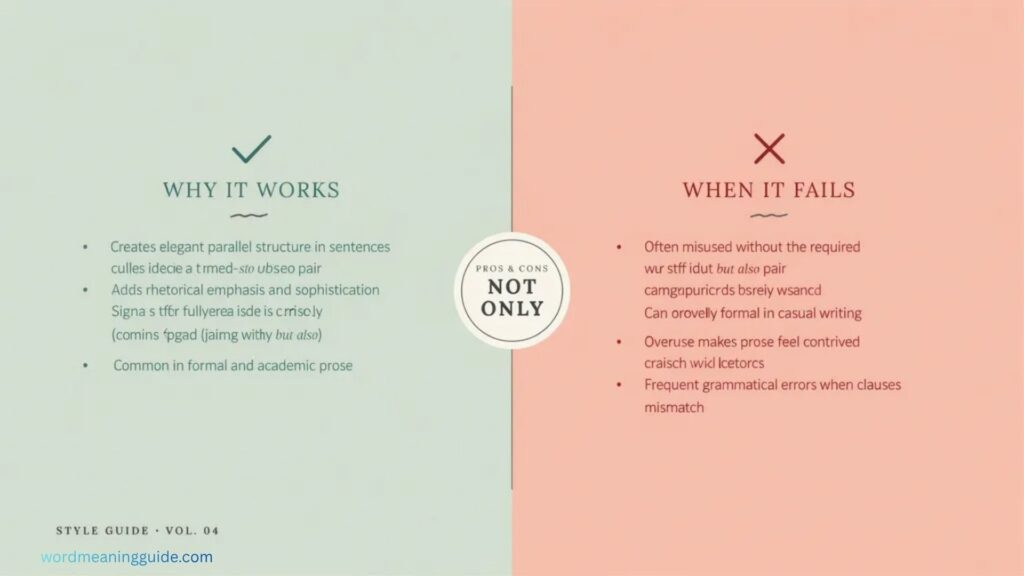
Pros:
- Clear and widely understood
- Builds emphasis effectively
- Works in both spoken and written English
- Pairs naturally with “but also” for rhythm
Cons:
- Overused in formal and SEO writing
- Can sound repetitive in long documents
- Sometimes feels like a filler transition rather than a precise one
- Limited tonal range (doesn’t shift easily between casual and formal registers)
Quick Alternatives (One-Line Phrases)
Before diving deep, here’s a fast-reference list: in addition to, besides, as well as, moreover, along with, coupled with, added to, on top of that, beyond, over and above, plus, with, not just, not merely, not simply, more than, what’s more, additionally, furthermore, not to mention, together with, added to that, not only that, even, as if that weren’t enough, let alone, including, at the same time, and equally important.
Main Alternatives to “Not Only”
1. In Addition To
This is one of the most formal and versatile alternatives. “In addition to managing the budget, she trained six new employees.” It works beautifully in reports, cover letters, and academic writing because it signals structure without sounding dramatic.
2. Besides
A slightly more conversational option. “Besides cooking dinner, he cleaned the entire kitchen.” It’s great for everyday speech and informal writing, though it can occasionally sound dismissive in very formal contexts, so use it carefully in business writing.
3. As Well As
This phrase smoothly links two ideas of similar weight. “The course covers grammar as well as vocabulary.” It’s widely used in academic and professional writing because it sounds neutral and precise.
4. Moreover
A strong, formal transition word often used to begin a new sentence. “The product is affordable. Moreover, it’s environmentally friendly.” Moreover works particularly well in essays, reports, and persuasive arguments where you want to build a case point by point.
5. Along With
A warmer, more relational alternative. “Along with her team, she launched the new campaign.” This phrase emphasizes collaboration and is ideal for storytelling or descriptive writing.
6. Coupled With
Often used in technical or analytical writing. “Low rainfall, coupled with rising temperatures, led to the drought.” It suggests that two factors combine to create a stronger effect — useful in scientific, financial, or analytical contexts.
7. Added To
A simple, direct alternative. “Added to her natural talent was years of disciplined practice.” This phrasing works well in storytelling and biographical writing.
8. On Top Of That
A casual, conversational phrase that adds emphasis with a touch of informality. “He finished the project early. On top of that, he helped his colleague too.” Perfect for blogs, social captions, and spoken English.
9. Beyond
Concise and powerful. “Beyond the financial gains, the merger improved company morale.” This word works well when you want to pivot from a tangible benefit to a less obvious, often more meaningful one.
10. Over and Above
A formal phrase common in business and legal writing. “Over and above his salary, he receives quarterly bonuses.” It conveys precision and is often used when discussing compensation, contracts, or obligations.
11. Plus
Highly informal and conversational. “She’s smart, plus she’s incredibly kind.” Best reserved for casual writing, social media, or relaxed dialogue — avoid in formal business documents.
12. With
The simplest alternative of all. “With her experience, she quickly earned the team’s trust.” Minimalist and effective, especially in concise, punchy writing styles.
23+ Other Ways to Say “Not Only”
1. “Not just”
A casual cousin of “not only.” “She’s not just a manager — she’s a mentor.” Great for emphasis in speeches and informal writing.
2. “Not merely”
A more elevated, literary alternative. “He was not merely successful; he was transformative.” Common in essays, academic critiques, and formal speeches.
3. “Not simply”
Similar to “not merely” but slightly softer. “This isn’t simply a business decision — it’s a values decision.”
4. “More than”
Versatile and widely used. “This job is more than a paycheck; it’s a passion.” Works in both casual and professional tones.
9. “What’s more”
A conversational transition that adds emphasis. “The hotel was affordable. What’s more, the staff were incredibly welcoming.” Common in travel writing, blogs, and reviews.
10. “Additionally”
A formal, neutral connector frequently used in academic and business writing. “Additionally, the report highlights a 15% increase in efficiency.”
11. “Furthermore”
One of the most formal transition words in English, often used to introduce a stronger or more significant point. “Furthermore, the data suggests long-term growth potential.”
15. “Not to mention”
Casual and expressive, often used for emphasis or even mild exaggeration. “The view was stunning, not to mention the food was incredible.”
16. “Over and above”
Reiterated here as a standalone phrase for formal writing — useful when listing benefits or obligations beyond the baseline expectation.
18. “Together with”
Neutral and professional. “Together with the marketing team, sales increased by 20%.” Common in collaborative or team-based reporting.
19. “Coupled with”
Already explored above — particularly strong in analytical and scientific writing where two factors interact.
20. “Added to that”
A natural spoken-English transition. “The flight was delayed. Added to that, our luggage was lost.”
21. “Not only that”
A direct, conversational continuation. “The restaurant was affordable. Not only that, the service was outstanding.”
22. “Even”
Short and powerful for emphasis. “She mastered three languages, even taught herself coding.” Works well in storytelling to build surprise.
23. “As if that weren’t enough”
Highly expressive, often used humorously or dramatically. “He won the award. As if that weren’t enough, he got promoted the same week.” Best for blogs, creative writing, and casual storytelling.
24. “Let alone”
Used to emphasize an even more extreme or unlikely scenario. “I can barely cook breakfast, let alone a five-course meal.” Common in both spoken and written English for contrast and emphasis.
25. “Including”
A practical, neutral connector. “The package includes premium support, including 24/7 live chat.” Frequently used in marketing and product descriptions.
26. “At the same time”
Suggests simultaneity alongside addition. “The policy reduces costs. At the same time, it improves customer satisfaction.”
27. “Equally important”
A formal phrase that signals balance between two points of value. “Equally important, the new system reduces processing time by half.” Common in reports, presentations, and structured arguments.
Bonus Section: Formal Alternatives to “Not Only”
For academic papers, official reports, and corporate communication, the strongest formal alternatives are: in addition to, furthermore, moreover, additionally, equally important, over and above, and together with. These phrases maintain professional tone while avoiding repetition and signaling logical structure clearly to the reader.
Mini Dialogue Examples
Casual conversation:
“This place is great, plus the coffee is amazing.”
“Not just amazing — it’s the best I’ve had all year.”
Business email:
“In addition to completing the quarterly report, our team identified three areas for cost reduction. Furthermore, we’ve already begun implementing two of them.”
Storytelling:
“She wasn’t merely brave — she was the kind of brave that inspired everyone around her. Beyond her courage, there was a quiet kindness that people never forgot.”
Mistakes to Avoid
One common mistake is forgetting the “but also” pairing when using the original phrase — “not only” without a matching second clause can feel grammatically incomplete. Another frequent error is mismatching tone, such as using “plus” in a formal report or “over and above” in a casual text message. Writers should also avoid stacking too many transition phrases in a single paragraph, which can overwhelm readers rather than clarify ideas. Finally, repeating the same alternative throughout a long document defeats the purpose of finding synonyms in the first place — rotate naturally based on context.
Cultural & Tone Tips
English speakers across regions lean toward different alternatives. British English often favors “moreover” and “furthermore” in formal writing, while American business communication frequently uses “additionally” and “on top of that” in semi-formal emails. In conversational or social media contexts globally, “plus,” “not to mention,” and “let alone” dominate because they sound natural and expressive. When writing for international or professional audiences, formal connectors like “in addition to” and “equally important” tend to translate most clearly across cultures and reduce ambiguity.
Comparison Table of Best Alternatives
| Alternative | Tone | Best Used In |
| In addition to | Formal | Reports, essays, cover letters |
| Besides | Informal | Conversations, casual writing |
| As well as | Neutral | Academic, professional writing |
| Moreover | Formal | Essays, persuasive writing |
| Along with | Neutral | Storytelling, descriptive writing |
| Coupled with | Formal/Technical | Scientific, analytical writing |
| On top of that | Informal | Blogs, social captions |
| Over and above | Formal | Legal, business writing |
| Plus | Informal | Casual speech, social media |
| Not just | Informal | Speeches, conversation |
| Furthermore | Formal | Academic, corporate writing |
| Not to mention | Informal | Reviews, travel writing |
| Equally important | Formal | Reports, presentations |
Frequently Asked Questions
What is the most formal alternative to “not only”?
“In addition to” and “furthermore” are widely considered the most formal alternatives, commonly used in academic papers, official reports, and corporate communication.
Can “not only” be used without “but also”?
Grammatically, “not only” is designed to pair with “but also” for balanced sentence structure. Omitting the second clause can make a sentence feel incomplete, though casual speech sometimes drops it for stylistic effect.
Is “plus” appropriate for professional emails?
“Plus” is generally too casual for formal business emails. It works better in friendly, informal workplace communication or social media content rather than official reports or client correspondence.
What’s a good alternative for academic essays?
“Moreover,” “furthermore,” and “additionally” are excellent choices for academic writing because they signal logical progression while maintaining a scholarly tone.
Why should writers avoid repeating “not only” too often?
Repetition can make writing feel mechanical and reduce reader engagement. Varying transition phrases keeps content fresh, demonstrates strong language command, and improves overall readability.
Conclusion
“Not only” is a reliable phrase, but English offers a rich toolbox of alternatives that can elevate your writing from ordinary to memorable. Whether you’re crafting a formal report, telling a story, or chatting casually online, choosing the right synonym — based on tone, audience, and context — makes all the difference. Start experimenting with these 39+ alternatives, and watch your writing become more dynamic, persuasive, and unmistakably your own.

Mr. Yaseen is a passionate content creator and language enthusiast dedicated to making words simple and meaningful for everyone. As the author behind WordMeaningGuide.com, he focuses on delivering clear, accurate, and easy-to-understand definitions that help readers improve their vocabulary and communication skills. With a keen eye for detail and a love for language, Mr. Yaseen ensures every piece of content is user-friendly, informative, and valuable for learners of all levels.