You hit send on an important email. Minutes later — sometimes seconds — a reply lands in your inbox. That feeling of relief, of being heard, of momentum continuing without interruption? It’s surprisingly powerful.
But here’s a problem most professionals quietly face: they respond with the same robotic phrase every single time. “Thank you for your quick response.” Over and over. In every email thread, every Slack message, every client follow-up.
Language is one of the most underrated tools in professional relationship-building. The words you choose signal attentiveness, warmth, and intelligence. Repeating the same phrase — no matter how polite — dulls that signal over time. It becomes invisible, like elevator music nobody actually listens to.
According to communication researchers, expressions of gratitude in professional settings increase relationship satisfaction, cooperation, and trust. A 2023 study published in the Journal of Applied Communication found that employees who regularly received personalized acknowledgment from colleagues reported 34% higher engagement levels. Gratitude, when expressed well, is not just courteous — it’s strategic.
This article is your complete guide to expressing appreciation for someone’s promptness in ways that feel fresh, professional, contextually appropriate, and genuinely human. Whether you’re writing to a client, a manager, a colleague, or a vendor, you’ll find exactly the right phrase for every situation — along with the nuance to know when and how to use it.
What Does “Thank You for Your Quick Response” Mean?
At its core, “thank you for your quick response” is an expression of gratitude specifically tied to speed. It acknowledges not just that someone replied, but that they replied promptly — faster than expected or sooner than required.
It has two essential components working together:
The gratitude element — “thank you” — expresses appreciation, which is a social and emotional acknowledgment.
The speed element — “quick response” — specifies what you’re grateful for. You’re not just thanking someone for their reply; you’re recognizing the effort and respect implied in their timeliness.
In professional contexts, time is one of the most valuable commodities. When someone prioritizes your request — despite their own workload, competing demands, and limited hours — they’re giving you something genuinely precious. Acknowledging that gift directly is both socially intelligent and professionally wise.
The phrase also serves a subtle relational function: it signals that you noticed. And being noticed — having your effort seen and appreciated — is a fundamental human need that transcends professional settings.
When to Use “Thank You for Your Quick Response”
Knowing when to use this phrase (or its alternatives) is just as important as knowing how. Context shapes meaning, and the right expression at the right moment lands far more powerfully than a generic acknowledgment.
After an urgent request is handled. If you flagged something as time-sensitive and the other person responded accordingly, naming that promptness in your reply validates their effort and reinforces the behavior you appreciate.
In client or vendor communication. Business relationships are built on reliability. When a client or vendor responds quickly, acknowledging it openly signals that you value responsiveness — and sets a positive precedent for future communication.
When someone replies outside business hours. If a colleague or collaborator responds to your email at 9 PM or on a weekend, a simple acknowledgment of their promptness shows that you don’t take that sacrifice lightly.
After receiving a quick resolution to a problem. Customer service, technical support, or internal IT — whenever someone resolves your issue faster than expected, a prompt acknowledgment creates goodwill and leaves a positive impression.
In formal email chains with multiple stakeholders. When responses need to move quickly through several people, acknowledging each person’s promptness keeps morale high and momentum strong.
Discover More 55+ Creative Alternatives to Say Happy Birthday in English In 2026
The moments when you shouldn’t overuse it? When the response wasn’t actually particularly fast, or when it’s tacked on reflexively without sincerity. Gratitude loses its power when it becomes automatic noise.
Is It Professional and Polite to Say “Thank You for Your Quick Response”?
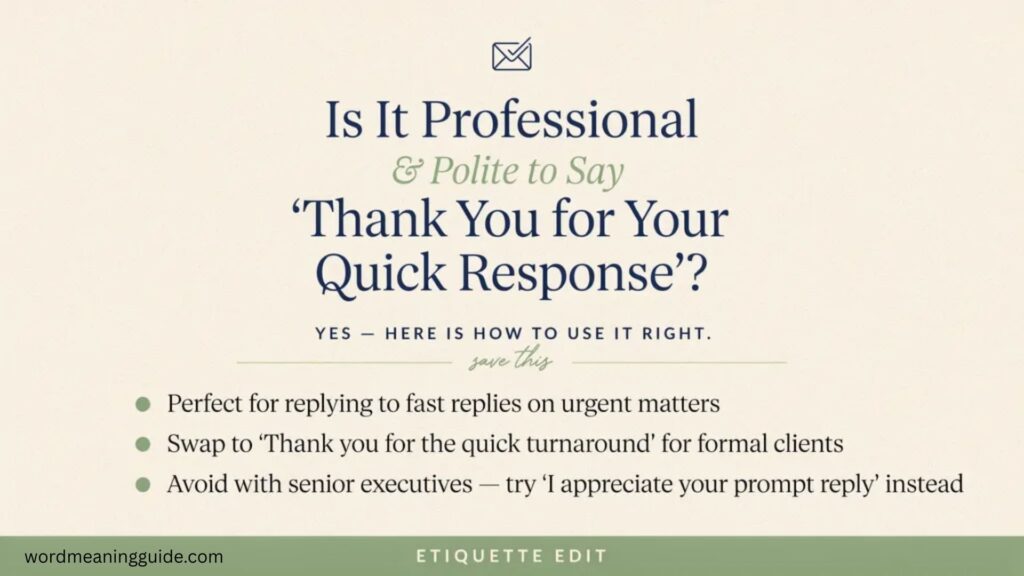
Absolutely — and unambiguously so. The phrase is professional, polite, and widely accepted across industries, cultures, and communication styles.
That said, communication coaches and business writing experts suggest being intentional rather than reflexive. Dr. Susan Krauss Whitbourne, a professor of psychological and brain sciences, writes extensively about the impact of authentic appreciation. She notes that generic phrases, repeated without variation, eventually register as nothing more than social filler — well-intentioned white noise.
The phrase is perfectly appropriate in:
- Formal business emails to clients, executives, or external partners
- Internal workplace communication with managers, HR, or cross-departmental teams
- Customer service or support interactions where quick resolution matters
- Academic or administrative correspondence with professors, advisors, or institutional contacts
It’s slightly less ideal in very casual digital communication — a quick Slack message between close colleagues, for example, might feel more natural with a simpler “Thanks for the fast reply!” or even just a thumbs-up emoji.
The bottom line: the phrase is always polite. The goal is simply to expand your vocabulary so that your gratitude feels specific, sincere, and situationally appropriate — rather than templated.
The Top Alternatives: Ways to Say “Thank You for Your Quick Response”
Group 1: Direct and Professional Alternatives
These alternatives maintain a formal tone while expressing gratitude for promptness. They’re ideal for client emails, manager communications, or any context where professionalism is paramount.
1. “Thank you for getting back to me so quickly.”
This version feels slightly more conversational than the original while remaining fully professional. The phrase “getting back to me” adds a relational warmth — it positions the exchange as a two-way connection rather than a transactional response. Use this when you want to feel approachable while still being polished.
2. “I appreciate your prompt reply.”
“Prompt” is a more formal synonym for “quick,” making this phrase particularly well-suited for business correspondence, legal communication, or any context where a formal register is expected. It’s crisp, concise, and impossible to misread.
3. “Thank you for responding so promptly.”
A slight variation that emphasizes the act of responding rather than the reply itself. This subtle difference makes it feel more personal — you’re acknowledging the human action, not just the digital artifact of an email.
4. “Thank you for your timely response.”
“Timely” is a powerful word in professional communication. It implies not just speed, but appropriateness of timing — the response came exactly when it was needed. This phrase is ideal in project management, legal, and deadline-driven contexts.
5. “I appreciate your swift response.”
“Swift” carries a slightly elevated, formal connotation. It’s appropriate in executive-level communication or formal written documents where you want to avoid anything that sounds too casual.
Group 2: Warm and Relationship-Focused Alternatives
These options balance professionalism with human warmth. They’re perfect for ongoing professional relationships where you want to maintain genuine rapport.
Explore More 66+ Better Ways to Say “Please Be Patient” (With Examples) In 2026
6. “Thanks for the quick reply.”
The contraction “thanks” softens the tone slightly without making it casual. This is the go-to phrase for mid-level professional emails — friendly but never overly familiar.
7. “I appreciate you getting back to me quickly.”
The use of “you” makes this feel directed and personal. It’s not just the reply you’re appreciating — it’s the person’s effort. Small word, significant difference.
8. “Thank you for the quick follow-up.”
Best used when someone follows up on an existing thread or ongoing matter. “Follow-up” implies continuity and reminds both parties that this is part of a larger, productive working relationship.
9. “Thanks for responding right away.”
“Right away” suggests immediacy — they didn’t put your message on the back burner or schedule it for later. This phrase works especially well when someone truly responded within minutes.
10. “I appreciate how quickly you responded.”
This phrasing puts the focus on admiration rather than simple thanks. It’s a shade more expressive and works well in situations where you want to genuinely impress upon the person how much their speed mattered.
11. “Thank you for your fast reply.”
Simple, clean, and universally applicable. “Fast” is more informal than “swift” or “prompt,” so this phrase sits comfortably in the middle register — professional enough for business emails, human enough to feel genuine.
12. “Thanks for being so responsive.”
This is a character acknowledgment rather than a task acknowledgment. You’re not just thanking them for this specific reply — you’re recognizing their overall responsiveness as a quality you appreciate. Use this in ongoing relationships or at the end of a collaborative project.
Group 3: Contextually Specific Alternatives
These alternatives work best in particular situations — problem-solving, urgent requests, or cases where you want to acknowledge the impact of the quick response.
13. “Thank you for addressing this so quickly.”
Use this when the response included action, not just information. If someone didn’t just reply but actually solved your problem or moved something forward, “addressing this” captures that effort more accurately.
14. “Thanks for the speedy response.”
“Speedy” adds a slightly energetic, almost enthusiastic quality. It’s less formal than “swift” or “prompt” but more polished than something like “super fast reply.” Good for creative industries, startups, or client relationships with an informal culture.
15. “Thank you for responding at such short notice.”
This one is uniquely appropriate when you made a last-minute or urgent request. It acknowledges the imposition of your own timing while expressing sincere gratitude for the person’s flexibility and speed.
16. “Thanks for the quick clarification.”
When someone’s quick reply didn’t just acknowledge your message but actually clarified something confusing or uncertain, this phrase specifically honors that contribution. It’s precise, appreciative, and signals that you actually understood what they said.
17. “Thank you for the immediate response.”
“Immediate” implies zero delay — the response came almost as soon as the message was sent. Reserve this for situations where that’s genuinely true. Overusing it when the reply came four hours later dilutes its impact.
18. “Thank you for the quick update.”
Perfect for ongoing projects or status checks. When someone gives you a rapid status update that keeps a project moving, “update” is more situationally accurate than “reply” or “response.”
19. “Thanks for the prompt follow-up.”
Ideal in situations where you were waiting on a second communication — a report, a decision, or a piece of information that was promised. Acknowledging that they followed up promptly reinforces the trustworthiness of the relationship.
20. “I appreciate the fast response.”
A streamlined version of the classic. Slightly less formal, entirely professional, and very natural in speech or casual written communication like Slack or Teams.
Also Read This TIA Meaning in Text: What It Really Means in Chats, Social Media, and Daily Conversations
Group 4: Elevated and Formal Alternatives
For executive communications, formal letters, legal correspondence, or any situation that calls for elevated language.
21. “Thank you for your expeditious reply.”
“Expeditious” — meaning done with speed and efficiency — is a formal, sophisticated word choice. This phrase signals a high level of professional polish and is best reserved for formal written documents, legal communications, or executive-level exchanges.
22. “Much obliged for your immediate response.”
“Much obliged” carries a classic, slightly old-fashioned formality that still works in very formal written communication. It implies a deeper sense of indebtedness — you’re not just pleased, you feel genuinely beholden to their promptness.
23. “I value your prompt response.”
The verb “value” elevates this beyond simple thanks. It positions the person’s responsiveness as something genuinely important to you — a professional quality you recognize and appreciate, not just a courtesy you’re acknowledging.
24. “Thank you for your responsiveness.”
By naming responsiveness as an abstract quality, this phrase acknowledges the person’s general professional character, not just this single instance. It’s broad, meaningful, and deeply complimentary — especially effective at the end of a long collaboration.
25. “Grateful for your speedy response.”
Starting with “grateful” rather than “thank you” shifts the emotional register slightly. Gratitude implies a deeper feeling than a simple thank-you — it’s more personal, more felt. This phrase works beautifully in situations where the quick response genuinely relieved pressure or solved a meaningful problem.
26. “Appreciate your swift reply.”
A concise, slightly informal version that still communicates respect and formality. The missing subject (“I”) makes it feel direct and confident — a style that works well for fast-paced professional communication.
Group 5: Additional Synonyms and Creative Alternatives
27. “Thanks for your rapid feedback.”
Particularly useful in creative or collaborative contexts — design reviews, content edits, code reviews. “Feedback” is more specific than “response” and signals that you’re in an iterative, collaborative relationship.
28. “Thank you for your quick action.”
When the response involved more than words — when the person actually did something — “action” honors that effort specifically. This is excellent in project management contexts where responses often need to include deliverables.
29. “I appreciate your timely attention to this.”
“Attention” implies not just a reply but genuine focus and care. This phrase works beautifully in situations where the issue required thought, analysis, or consideration — not just a quick acknowledgment.
30. “Thanks for your quick attention.”
A shorter version of the above. Clean, professional, and widely applicable.
31. “Thank you for your rapid response.”
“Rapid” occupies the space between “fast” and “swift” — slightly more formal than the former, slightly less elevated than the latter. It’s versatile and works across most professional contexts.
32. “Appreciate your quick feedback.”
Another feedback-specific option, best used in collaborative or review-based interactions. Dropping “I” makes it feel more direct and less formal — suitable for internal communication.
33. “Thanks for your timely attention.”
A slight variation on “attention to this.” Slightly more formal and appropriate for situations where you want to acknowledge that the person attended to your matter promptly within their own busy schedule.
34. “Thank you for your immediate reply.”
When the reply genuinely came immediately, this phrase does justice to the timing. A strong choice for time-sensitive client or partner communication.
35. “Thanks for your expeditious response.”
A more elevated synonym that pairs well with formal business correspondence. Like its “expeditious reply” counterpart, this word choice signals a high degree of professional formality.
36. “Appreciate your speedy reply.”
Casual-yet-professional and perfect for everyday internal emails where you want to acknowledge speed without being too effusive.
37. “Grateful for your prompt attention.”
This combination — “grateful” plus “prompt attention” — creates a warm but formal expression that works particularly well in client relations or when addressing someone senior to you.
38. “Thank you for your speedy reply.”
A timeless, versatile phrase. “Speedy” has an energetic, positive quality that keeps the communication feeling upbeat and forward-moving.
Also see This Other Ways to Say “Thank You for Your Patience” In 2026
How to Choose the Right Alternative: A Quick Decision Framework
With so many options available, how do you choose the right one in the moment? Think through these three questions:
1. What’s the formality level of the relationship? For executive stakeholders, legal professionals, or formal institutional contacts — choose elevated vocabulary: “expeditious,” “prompt,” “timely,” “swift.” For colleagues or creative collaborators — “speedy,” “fast,” “quick,” and contractions like “thanks” all feel natural.
2. What exactly are you grateful for? Did they reply? Use “response” or “reply.” Did they act on something? Use “action” or “attention.” Did they provide useful information? Try “clarification,” “feedback,” or “update.” Specificity makes gratitude more meaningful.
3. What tone are you aiming for? Warm and human? Lead with “I appreciate” or “Grateful for.” Crisp and professional? Use “Thank you for your [adjective] response.” Relationship-building over time? Acknowledge their character: “Thank you for your responsiveness” or “Thanks for being so responsive.”
Real-World Examples in Context
Here’s how these alternatives play out across different professional scenarios:
Scenario 1: Client confirms project scope changes quickly “I appreciate your prompt reply confirming the scope updates. We’ll move forward on the revised timeline immediately.”
Scenario 2: Manager approves a budget request faster than expected “Thank you for your timely response on the budget request — your quick decision keeps us on track for the Q3 launch.”
Scenario 3: Vendor responds to an urgent supply issue over the weekend “I’m grateful for your speedy response at such short notice. It really helped us manage the situation effectively.”
Scenario 4: Colleague clarifies a confusing brief the same afternoon “Thanks for the quick clarification — I now have a much clearer picture of what’s needed and can get started right away.”
Scenario 5: Legal contact provides a fast turnaround on contract review “Thank you for your expeditious reply on the contract review. Your thoroughness under such time constraints is truly appreciated.”
The Psychology Behind Thanking Someone for Responding Quickly
Why does acknowledging speed specifically matter so much?
Research in organizational psychology consistently shows that people who feel their time and effort are noticed perform better, cooperate more readily, and report higher job satisfaction. Dr. Adam Grant, organizational psychologist at Wharton and author of Give and Take, has documented extensively how small acts of gratitude in professional settings create powerful ripple effects of goodwill and reciprocity.
When you specifically acknowledge promptness, you’re reinforcing a behavior you want to see repeated. Behavioral psychology calls this positive reinforcement — the acknowledged behavior is more likely to recur. In a professional ecosystem, this means your colleagues, clients, and partners are subtly incentivized to respond quickly to you in the future.
There’s also a deeper signal embedded in this acknowledgment: I noticed your effort, not just your output. That distinction matters enormously. Most professional communication focuses on information exchange. Gratitude for promptness takes a moment to recognize the human effort behind that information — and that recognition is the foundation of genuine professional relationships.
Common Mistakes to Avoid
Even well-intentioned expressions of gratitude can miss the mark. Here are the pitfalls to watch out for:
Saying it when the response wasn’t actually quick. Using “thank you for your quick response” when someone replied three days later feels hollow — or worse, passive-aggressive. Reserve speed-specific gratitude for situations where promptness was genuinely notable.
Tacking it on automatically. If “thank you for your quick response” is the first line of every single email you send, it becomes invisible. Vary your expressions, and your gratitude will stay meaningful.
Using an elevated phrase in a casual context. Writing “much obliged for your expeditious reply” to your friend who also happens to be a coworker feels stiff and strange. Match your language to the relationship.
Forgetting to continue the actual message. Gratitude is an opener, not a substitute for substance. Always follow it with something useful, actionable, or informative.
Simple Ways to Say Thanks for Your Fast Reply
- Thanks for your quick reply.
- Thank you for responding so quickly.
- I appreciate your fast response.
- Thanks for getting back to me so soon.
- Thank you for the prompt reply.
Professional Ways to Say Thanks for Your Fast Reply
- Thank you for your prompt response.
- I appreciate your timely reply.
- Thank you for your swift attention to this matter.
- Your quick response is greatly appreciated.
- Thank you for responding at your earliest convenience.
Casual Ways to Say Thanks for Your Fast Reply
- Thanks for getting back to me so fast.
- Appreciate the speedy reply!
- Thanks for the quick response.
- You’re quick—thanks!
- Thanks for replying so fast.
Funny Ways to Say Thanks for Your Fast Reply
- Wow, that was lightning fast—thanks!
- Did you reply before I hit send? Thanks!
- You’re faster than my Wi-Fi—thanks!
- Thanks for the superhero-speed response.
- Blink and you replied—thank you!
Email Ways to Say Thanks for Your Fast Reply
- Thank you for your prompt email response.
- I appreciate your quick feedback.
- Thanks for responding so promptly.
- Thank you for your swift email reply.
- Your timely response is much appreciated.
Ways to Say Thanks for Your Fast Reply to a Colleague
- Thanks for getting back to me so quickly.
- I appreciate your prompt assistance.
- Thanks for the speedy update.
- Thank you for the quick turnaround.
- Appreciate your fast response as always.
Ways to Say Thanks for Your Fast Reply to a Client
- Thank you for your prompt reply.
- We appreciate your quick response.
- Thank you for getting back to us so quickly.
- Your timely feedback is greatly valued.
- Thanks for your swift communication.
Ways to Say Thanks for Your Fast Reply in Text
- Thx for the quick reply!
- Appreciate the fast response 😊
- Thanks for replying so quickly!
- Got it, thanks for the speedy response.
- Thanks for the quick comeback!
Ways to Say Thanks for Your Fast Reply on WhatsApp
- Thanks for the instant reply!
- Appreciate the quick message.
- Thanks for getting back so fast.
- Wow, quick response—thanks!
- Thanks for replying right away.
Short and Sweet Ways to Say Thanks for Your Fast Reply
- Thanks for the quick reply.
- Much appreciated.
- Thanks for responding promptly.
- Appreciate it!
- Thanks a lot.
Creative Ways to Say Thanks for Your Fast Reply
- Thanks for being so responsive.
- Your quick reply saved the day.
- Appreciate your lightning-fast response.
- Thanks for your rapid-fire reply.
- You answered in record time—thank you!
Ways to Say Thanks for Your Fast Reply Politely
- Thank you kindly for your prompt response.
- I sincerely appreciate your quick reply.
- Many thanks for your timely response.
- Thank you for your immediate attention.
- I am grateful for your swift reply.
Ways to Say Thanks for Your Fast Reply in Business Emails
- Thank you for your prompt attention to this matter.
- We appreciate your timely response.
- Thank you for the quick clarification.
- Your prompt feedback is appreciated.
- Thank you for your efficient communication.
Friendly Ways to Say Thanks for Your Fast Reply
- Thanks so much for getting back to me quickly.
- Really appreciate the fast reply.
- You’re awesome—thanks for replying so quickly.
- Thanks for the speedy response, friend.
- Appreciate you getting back so fast.
Ways to Say Thanks for Your Fast Reply in Formal Writing
- Thank you for your expeditious response.
- Your prompt reply is sincerely appreciated.
- I am thankful for your timely correspondence.
- Thank you for responding without delay.
- Your swift response is highly valued.
Ways to Say Thanks for Your Fast Reply in Informal Writing
- Thanks for the super-fast reply.
- Appreciate the quick response!
- Thanks for answering so fast.
- Thanks for getting back right away.
- Cheers for the speedy reply.
Ways to Say Thanks for Your Fast Reply with Gratitude
- I’m truly grateful for your quick response.
- Thank you so much for replying promptly.
- I deeply appreciate your timely reply.
- Your quick response means a lot.
- Many thanks for your fast assistance.
Ways to Say Thanks for Your Fast Reply in Text Messages
- Thanks for the quick text back!
- Appreciate the speedy response 👍
- Thanks for replying ASAP.
- Thanks for the fast update.
- Appreciate the quick message.
Ways to Say Thanks for Your Fast Reply in Customer Support
- Thank you for your prompt assistance.
- I appreciate your quick support.
- Thanks for addressing my concern so quickly.
- Thank you for the fast resolution.
- Your prompt help is greatly appreciated.
Ways to Say Thanks for Your Fast Reply in Professional Chat
- Thanks for the prompt response.
- Appreciate the quick update.
- Thank you for your rapid reply.
- Thanks for the timely response.
- I appreciate your swift feedback.
Frequently Asked Questions
Is “thank you for your quick response” appropriate for formal emails?
Yes, it is fully appropriate for formal emails. However, if you want to add a slightly more formal register, consider alternatives like “thank you for your prompt reply” or “I appreciate your timely response,” which use vocabulary that skews slightly more formal than “quick.”
What’s the difference between “prompt” and “quick” in professional communication?
“Prompt” carries a slightly more formal connotation and implies that the response came exactly when needed — on time, not just fast. “Quick” focuses more purely on speed. Both are professional, but “prompt” fits formal business or legal communication more naturally, while “quick” suits everyday professional exchanges.
Can I use these phrases in emails to my boss or senior colleagues?
Absolutely. Acknowledging a manager’s or senior colleague’s promptness is entirely appropriate and can strengthen your professional relationship. Phrases like “I appreciate your timely response” or “thank you for getting back to me so quickly” work particularly well in upward communication.
How do I avoid sounding repetitive when I send lots of emails?
The simplest solution is rotation. Keep three to five alternatives in mind and vary them across conversations. You can also drop the speed-specific acknowledgment entirely in some cases and focus instead on the content of the reply: “Your insights on this were exactly what I needed — thank you.”
What’s the best way to thank someone for a quick response in a text or instant message?
In casual digital contexts like text, Slack, or Teams, very short phrases work best: “Thanks for the fast reply!” or “Appreciate the quick response!” Even a simple “Thanks, got it!” acknowledges the reply without any awkward formality. Save the more elaborate expressions for email.
Are these phrases suitable for non-native English speakers to use?
Yes, most of these phrases are standard English expressions that are widely recognized and used globally. Phrases like “thank you for your prompt reply” or “I appreciate your quick response” are clear, unambiguous, and professionally universally understood in international business communication.
Should I mention why their quick response mattered?
Whenever possible, yes. Adding a brief reason makes your gratitude more specific and memorable. For example: “Thank you for your timely response — it allowed us to finalize the proposal before the deadline.” Contextualizing your thanks transforms it from a formality into a genuine acknowledgment of impact.
Conclusion:
Every email you write is a micro-moment in an ongoing professional relationship. The phrases you use — even the seemingly small courtesy expressions — accumulate over time to create an impression: of attentiveness, of warmth, of genuine respect for the people you work with.
“Thank you for your quick response” is a good phrase. But it’s just the beginning of what’s possible. With dozens of alternatives at your disposal — from the crisp formality of “I appreciate your expeditious reply” to the human warmth of “thanks for being so responsive” — you have the vocabulary to express gratitude in ways that feel genuinely tailored to the moment, the relationship, and the person.
The next time someone prioritizes your request and gets back to you promptly, take three extra seconds to choose a phrase that fits the situation specifically. You’ll be surprised how often people notice — and how powerfully that small acknowledgment deepens the trust, rapport, and momentum of your professional relationships.
Words matter. Use them well.

Mr. Yaseen is a passionate content creator and language enthusiast dedicated to making words simple and meaningful for everyone. As the author behind WordMeaningGuide.com, he focuses on delivering clear, accurate, and easy-to-understand definitions that help readers improve their vocabulary and communication skills. With a keen eye for detail and a love for language, Mr. Yaseen ensures every piece of content is user-friendly, informative, and valuable for learners of all levels.