You’re sitting at home on a Friday evening. Your phone buzzes. You unlock it and see a three-letter message from your best friend: “WYA?” No punctuation. No context. Just those three letters hanging in the blue bubble on your screen.
If you already know what it means, your fingers are probably already typing a reply. But if you’re new to internet slang, digital communication, or simply catching up with the ever-evolving language of texting, you might pause for a second and wonder — what exactly does WYA mean?
You’re not alone. As social media platforms like Instagram, TikTok, Snapchat, and WhatsApp continue to shape how people communicate, shorthand expressions like WYA have become a natural part of everyday digital conversation. Understanding these abbreviations isn’t just about keeping up with trends — it’s about understanding how modern human connection works.
In this comprehensive guide, we’ll break down the full meaning of WYA, explore where and how it’s used, look at real-life conversation examples, uncover its emotional underpinnings, and give you everything you need to use it confidently and correctly.
WYA – Quick Meaning
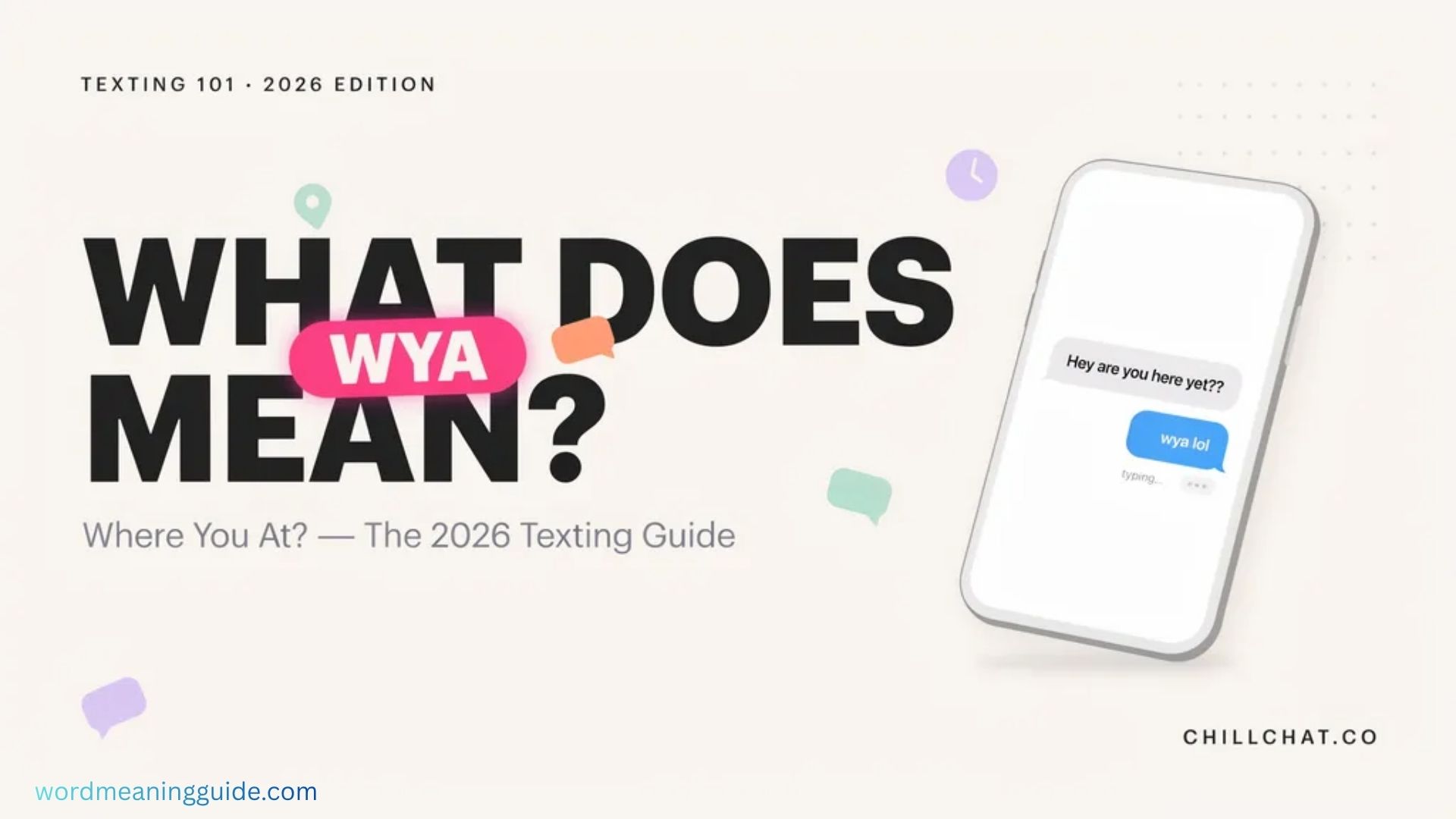
WYA stands for “Where You At” — a casual, informal way of asking someone about their current location or availability. It’s the digital-age equivalent of knocking on someone’s door and asking, “Hey, are you home?”
Unlike a formal “Where are you?” — which might be used in a professional email or a serious conversation — WYA is relaxed, low-pressure, and designed for quick exchanges. It fits perfectly into the fast-paced rhythm of modern messaging culture.
What Does WYA Mean in Text?
In text messaging, WYA is one of the most commonly used location-based check-in phrases. When someone sends you “WYA”, they are typically asking one or more of the following:
- Where are you right now?
- Are you free or available to meet up?
- Are you on your way?
- Can we connect soon?
The beauty of WYA lies in its simplicity. It’s a three-letter question that can carry a world of meaning depending on context, tone, and relationship. Between close friends, it can feel warm and spontaneous. From a crush, it can feel loaded with intention. From a group chat, it might just be logistical coordination.
According to digital communication researcher Naomi Baron, author of Always On: Language in an Online and Mobile World, abbreviated messaging isn’t laziness — it’s efficiency. Young people in particular have developed a “compressed language” that conveys meaning, tone, and intent in minimal characters. WYA is a perfect example of this phenomenon.
📱 Where Is WYA Commonly Used?
WYA shows up across virtually every modern messaging and social media platform. Here’s a breakdown of where you’ll most likely encounter it:
- Text Messages (SMS/iMessage): The most classic home of WYA. Used between friends, romantic partners, and family members to check in or plan meetups.
- Instagram DMs: Often seen in direct messages when friends are trying to coordinate plans or check if someone is watching a live stream.
- Snapchat: Extremely common here due to the platform’s location-sharing features and the spontaneous, real-time nature of snapping.
- WhatsApp: Popular in group chats and personal messages, especially among younger users coordinating outings.
- TikTok Comments: Sometimes used humorously or rhetorically in comment sections, often meaning “where are you when I need you” or used as a meme format.
- Twitter / X: Occasionally appears in casual tweets or reply threads.
A 2023 survey by Statista found that over 3.6 billion people use messaging apps globally, and informal abbreviations like WYA have become a core component of how these billions connect daily.
Simple Examples
Here are a few quick, everyday examples of WYA in a sentence:
- “WYA? We’re all at the park already!”
- “Hey WYA? I’ve been waiting outside for 10 minutes lol”
- “WYA tonight? Thinking of grabbing food”
- “WYA rn? Need to talk to you”
- “WYA bro, the game already started”
Each of these shows WYA operating slightly differently — from frustration, to casual planning, to urgent connection. The core meaning stays the same, but the surrounding words and context shift the emotional flavor.
Origin & Background of WYA
Like most internet slang, WYA grew organically from African American Vernacular English (AAVE) and urban American speech patterns, particularly the phrase “Where you at?” — a grammatically non-standard but widely used form of “Where are you?”
The phrase gained traction in hip-hop culture and Black American vernacular during the late 1990s and early 2000s, where the dropped verb and restructured grammar were stylistic markers of authenticity and community belonging. As text messaging became the dominant mode of communication for younger generations in the mid-2000s, “Where you at?” was naturally compressed into the three-letter shorthand WYA.
By the time smartphones went mainstream in the early 2010s, WYA had already established itself as a fixture of informal digital communication. The rise of platforms like Snapchat — which was literally built around location and real-time sharing — only accelerated its adoption.
Today, WYA has transcended its cultural origins and is used by people of all backgrounds across the world, though its AAVE roots are an important part of understanding why it resonates so strongly in casual speech.
Real-Life Conversations
WhatsApp Conversation
Marcus: WYA? We’re literally all downstairs
Priya: omg sorry give me 2 mins still getting ready
Marcus: lol hurry up the food’s gonna get cold
This quick exchange illustrates how WYA functions as a low-stakes but urgent prompt. It’s not rude — it’s just real-time communication.
Instagram DM Conversation
Chloe: wya?? you said you were coming to the concert
Destiny: I’m literally in the parking lot rn lmao
Chloe: OMG hurry we’re at gate B
Here WYA is used to locate someone in a shared physical experience — the urgency is mild, and the tone is excited.
TikTok Comment Section
TikTok Creator: posts video about finding good coffee shops in NYC
Comment: WYA when I need you 😭☕
In this context, WYA has taken on a more expressive, emotional meaning — “where were you when I needed this?” — common in TikTok’s meme-friendly culture.
Text Message Conversation
Jake: wya bro
Sam: Still at work, why?
Jake: Need help moving this couch lol
Sam: Give me an hour 😭
This is a practical, logistical use of WYA. It’s quick, efficient, and totally human.
Relationship Chat Example
Aria: wya?
Liam: Just left the office, heading home. Why?
Aria: Just missed you 🥺
In romantic relationships, WYA can carry a whole layer of emotional meaning that goes far beyond geography. It’s a way of saying, “I’m thinking about you.”
Emotional & Psychological Meaning
Language researchers and psychologists have noted that short-form digital expressions often carry outsized emotional weight. WYA is a fascinating case study in compressed communication.
What WYA Often Reflects
1. Desire for Connection
More than a location inquiry, WYA is often an emotional signal. When someone texts you WYA, they’re expressing a desire to connect, whether physically or emotionally. Studies in digital psychology suggest that spontaneous check-in messages like WYA contribute significantly to feelings of social belonging and intimacy in friendships.
2. Digital Closeness
Dr. Sherry Turkle, a psychologist and author of Alone Together, argues that brief, frequent digital check-ins help people maintain a sense of closeness even when physically apart. WYA is precisely this kind of micro-connection — a tiny digital bridge between two people.
3. Fear of Being Ignored
Sometimes WYA is sent when someone is anxious. “WYA??? You haven’t replied” can reflect worry, insecurity, or frustration. The punctuation and repetition often do the emotional heavy lifting in these cases.
4. Social Inclusion
In group settings, WYA serves as an invitation. It’s a signal that you’re wanted, that your presence matters, and that the group is incomplete without you. It’s one of the simplest expressions of social inclusion in the digital lexicon.
Usage in Different Contexts
Social Media Usage
On social media, WYA often becomes rhetorical. “WYA when I’m feeling like this” on an Instagram story isn’t asking for a physical location — it’s expressing longing for emotional support or connection. The phrase becomes a mood, a vibe, a caption that invites relatability.
Friends & Relationships
Between close friends and romantic partners, WYA is about presence. It’s warm, it’s spontaneous, and it rarely requires deep thought. The fact that it takes three seconds to type and send is part of its social function — it keeps relationships fluid and alive without demanding significant effort.
Work or Professional Settings
WYA is generally considered too casual for professional environments. In a work email or a formal Slack message, you’d want to stick with “Are you available?” or “What is your current location?” Using WYA with a manager or client could come across as disrespectful or unprofessional.
However, in very casual team cultures — especially remote-first startups or creative agencies — WYA might pop up in internal channels between colleagues who are close. Context always determines appropriateness.
Casual vs Serious Tone
A single “wya” is casual. Multiple question marks — “WYA???” — communicate urgency or frustration. In all caps — “WHERE YOU AT” — conveys heightened emotional intensity. The same three letters can shift from playful to panicked depending on how they’re styled.
Common Misunderstandings
1. It Doesn’t Always Mean Physical Location
Many people assume WYA is purely about geography. It often isn’t. “WYA mentally?” or “WYA emotionally?” asks about someone’s headspace, not their coordinates. Always read the context.
2. Tone Changes the Meaning
A calm “wya” from a friend is different from an angry “WYA?!” from someone who’s been waiting. Tone isn’t always visible in text, but punctuation, capitalization, and context provide crucial clues.
3. Not Everyone Likes Constant Check-Ins
Some people find frequent WYA messages intrusive or anxious-feeling. What feels caring to one person may feel like surveillance to another. Understanding your recipient’s communication style matters.
4. It’s Not Ideal in Formal Situations
As noted earlier, WYA belongs in informal communication. Using it in a professional setting can undermine your credibility or create misunderstandings.
5. Cultural Interpretation Varies
Not everyone has the same relationship with internet slang. Older adults, non-native English speakers, or people who rarely use social media may not recognize WYA at all. In cross-cultural conversations, clarity always wins over cleverness.
Comparison Table: WYA vs. Similar Expressions
| Slang / Expression | Full Form | Tone | Context |
| WYA | Where You At | Casual / Curious | Texts, DMs, group chats |
| WYD | What You Doing | Conversational | Checking in on activity |
| HMU | Hit Me Up | Inviting / Open | When available to meet |
| WYO | What You On | Casual / Planning | Weekend or evening plans |
| U UP? | Are You Awake? | Late-night / Flirty | Late night check-ins |
| IRL | In Real Life | Descriptive | Separating online vs offline |
Opposite-Type Expressions
While WYA pulls someone toward you, expressions like “TTYL” (Talk To You Later) or “GTG” (Got To Go) push the conversation outward. Understanding these opposites helps you see WYA’s role in the social ecosystem of messaging.
Key Insight
WYA is an initiator — it opens a dialogue, bridges a gap, and signals availability and interest. Its opposites are conversation enders or distance-makers. This makes WYA fundamentally connective in nature.
Variations & Types of WYA
1. “WYA rn”
“WYA rn” means “Where you at right now?” The addition of “rn” (right now) adds urgency. This is used when someone needs an immediate response — they’re waiting, planning, or trying to coordinate something in real time.
2. “WYA tonight”
A planning-oriented phrase. It’s an invitation thinly disguised as a question. The sender is really asking, “Are you free, and can we hang out tonight?” This is one of the most common social uses of WYA.
3. “WYA bro”
Adding “bro” gives WYA a distinctly masculine, friendly flavor. Common among male friends, it strips away any romantic undertones and positions the question as purely social and casual.
4. “WYA babe”
The opposite of “WYA bro” in tone. “WYA babe” is intimate, used between romantic partners or very close friends. It carries warmth, care, and sometimes a hint of playful impatience.
5. “WYA lol”
The “lol” softens the question and signals that the sender isn’t upset or in a rush — they’re just casually curious. It’s a way of asking without pressure.
6. “WYA???”
Multiple question marks raise the emotional stakes. The sender is either anxious, frustrated, or genuinely worried. This variation is common when someone has been kept waiting or hasn’t received a response.
7. “WYA everyone?”
Used in group chats to do a collective location check. Often part of coordinating meetups or getting a sense of who’s available for plans.
8. “WYA mentally”
A more introspective, empathetic variation. This isn’t about physical location at all — it’s asking about someone’s emotional or mental state. Common in close friendships and emotional support conversations.
9. “WYA these days”
A nostalgic, reconnecting variation. This phrase is often sent to someone you haven’t spoken to in a while. It’s warm, casual, and expresses genuine curiosity about where someone’s life has taken them.
10. “WYA squad”
Used to address a group of friends collectively. It’s energetic, inclusive, and signals that the sender wants to know where the whole group is — typically to join them.
How to Respond When Someone Uses It
Casual Replies
- “At home, what’s up?”
- “Just got to the mall, wbu?”
- “Leaving now, be there in 10”
- “In bed lol, why?”
Funny Replies
- “Mentally? Somewhere in 2019. Physically? My couch.”
- “Nowhere interesting enough to talk about 😂”
- “Wya? I should be asking you that”
- “Between my bedroom and the fridge tbh”
Mature & Confident Replies
- “I’m available after 6 if you want to meet up”
- “Working right now — can connect around 8?”
- “I’m in the area, what did you have in mind?”
Private or Respectful Replies
- “I’m somewhere personal right now, but I’ll reach out later”
- “Not up for sharing my location at the moment, but I’m good”
- “I’d rather not say, but I can chat later”
There’s no rule that says you have to reveal your location when someone sends WYA. Responding honestly but with boundaries is always valid.
Regional & Cultural Usage
Western Culture
In North America, the UK, and Australia, WYA is extremely common among teens and young adults. It’s considered part of everyday digital vocabulary. The informality is a feature, not a bug — it signals closeness and ease between people.
In American culture specifically, WYA carries traces of its AAVE origins, and while it’s been widely adopted across racial and cultural lines, it’s worth acknowledging its roots as a form of cultural respect.
Asian Culture
In countries like India, the Philippines, and parts of Southeast Asia, WYA has gained significant traction alongside the spread of Western social media platforms. However, it’s often mixed with local languages or modified to suit cultural norms around directness.
In more collectivist cultures, asking “WYA” in a group context is especially natural — group coordination and communal presence are highly valued, making WYA a perfect social tool.
Middle Eastern Culture
WhatsApp is the dominant communication platform across much of the Middle East, and WYA has made its way into the messaging habits of younger generations here as well. However, context matters significantly. Using WYA with elders or in more formal relationships would be considered disrespectful, while among peers it’s perfectly acceptable.
Global Internet Usage
The global reach of TikTok, Instagram, and YouTube has accelerated the spread of English internet slang — including WYA — to virtually every corner of the world. Research by the Oxford Internet Institute suggests that English-origin digital slang is being adopted and adapted across dozens of languages, creating a new form of global internet vernacular.
WYA is no longer just American slang. It belongs to the internet now — and by extension, to anyone who uses it.
Frequently Asked Questions
What does WYA stand for?
WYA stands for “Where You At” — a casual abbreviation used in text messages, DMs, and social media to ask someone about their current location or availability.
Is WYA rude or inappropriate?
WYA is not inherently rude. In casual contexts between friends or peers, it’s friendly and spontaneous. However, it can feel too informal in professional settings or when used with people you don’t know well. Always consider your relationship with the recipient.
Can WYA be used romantically?
Absolutely. Between romantic partners, WYA often implies emotional longing more than a literal location inquiry. Phrases like “WYA babe” carry warmth and intimacy. Like most communication, the meaning deepens depending on the relationship.
What is the difference between WYA and WYD?
WYA means “Where You At” (asking about location or availability), while WYD means “What You Doing” (asking about current activity). Both are casual check-in phrases, but WYA is more location-focused while WYD is activity-focused. They’re often used together.
Is WYA used only in English?
WYA originated in English — specifically American English and AAVE — but it’s now used globally on platforms like Instagram, TikTok, and WhatsApp. Non-English speakers, particularly younger ones active on social media, frequently use it as part of their digital vocabulary.
What does it mean when someone sends WYA with lots of question marks?
“WYA???” signals urgency, anxiety, or mild frustration. The extra punctuation typically means the sender has been waiting, is worried, or needs an answer quickly. It’s a way of amplifying the emotional weight of the question without using extra words.
How should I respond to WYA if I don’t want to share my location?
You don’t have to share your exact location. A simple, honest response like “I’m tied up right now but can connect later” or “Not somewhere I can chat, but I’ll reach out soon” is perfectly acceptable and respects your own boundaries.
When did WYA become popular?
WYA gained popularity in the mid-2000s as text messaging became widespread among younger generations. It grew from spoken AAVE slang into a texting abbreviation and was widely adopted by the early 2010s alongside the rise of smartphones and social media platforms.
Is WYA informal or formal?
WYA is entirely informal. It belongs in casual digital conversations — texts, DMs, group chats — not in emails, professional communication, or formal writing. In any context requiring formality, you should use the full phrase: “Where are you?” or “Could you let me know your location?”
What are some alternatives to WYA?
Common alternatives include: “Where are you?”, “WYD?” (What You Doing), “HMU” (Hit Me Up), “You around?”, “You free?”, or “What’s your ETA?” — each carrying slightly different tones and implications but serving similar social functions.
Conclusion
Three letters. Infinite contexts. That’s the magic of WYA.
What started as a shortened form of a spoken phrase has become one of the most versatile, emotionally rich expressions in the modern digital lexicon. It’s been used to plan parties, express longing, check in on friends, and keep relationships alive across distances. It lives in text threads, DM inboxes, comment sections, and TikTok captions — and every time someone sends it, they’re reaching out, even if they don’t realize it.
Understanding WYA isn’t just about learning an abbreviation. It’s about understanding how people communicate in the digital age — quickly, expressively, and with a lot packed into a little. In a world where attention is scarce and connection is everything, WYA does exactly what great language is supposed to do: it brings people closer together with the minimum amount of effort required.
So the next time your phone buzzes with a simple “WYA?”, you’ll know it’s more than a question about your zip code. It’s an invitation. A check-in. A tiny bridge between two people who want to be in each other’s world, even if just for a moment.
Now you know. Go reply.

Mr. Yaseen is a passionate content creator and language enthusiast dedicated to making words simple and meaningful for everyone. As the author behind WordMeaningGuide.com, he focuses on delivering clear, accurate, and easy-to-understand definitions that help readers improve their vocabulary and communication skills. With a keen eye for detail and a love for language, Mr. Yaseen ensures every piece of content is user-friendly, informative, and valuable for learners of all levels.