Picture this: a colleague pings you thirty seconds before a client call to mention the budget numbers changed overnight. You dodge an embarrassing mistake in front of the client. Your fingers move to type the same three words you always type — “thanks for the heads up” — and you pause. You’ve used that exact phrase in four emails this week alone.
If that scenario feels familiar, you’re not alone. “Thanks for the heads up” is one of the most overused acknowledgments in modern workplace communication. It’s friendly, it’s quick, and it gets the job done — but repetition dulls its impact. Said too often, it starts to sound like autopilot rather than genuine appreciation.
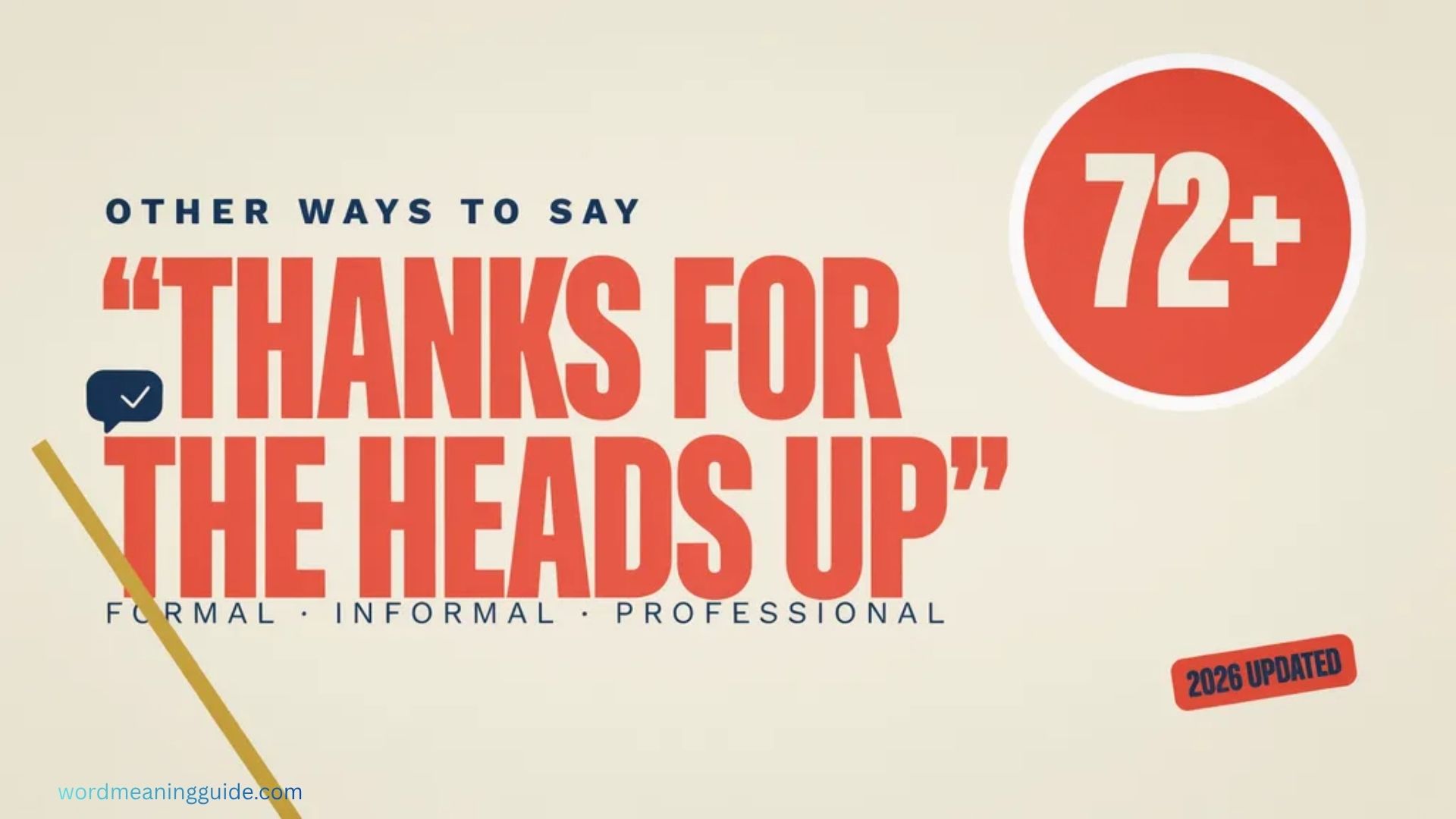
This guide breaks down everything you need to know about the phrase: what it actually means, when it fits (and when it doesn’t), and more than seventy alternatives you can use depending on your audience, tone, and medium. Whether you’re writing a formal email to a client, replying to a teammate on Slack, or simply want to sound less repetitive in conversation, you’ll find a fitting replacement here.
What Does “Thanks for the Heads Up” Mean?
At its core, “thanks for the heads up” is a casual way of acknowledging that someone has warned or informed you about something useful, often before it becomes a problem. The phrase “heads up” itself comes from sports and military contexts, where it meant literally keeping your head raised and alert to incoming danger. Over time, it evolved into shorthand for any advance notice — a schedule change, a risk, a piece of gossip, or simply useful information shared ahead of time.
When someone says “thanks for the heads up,” they’re expressing gratitude for being kept in the loop, usually about something time-sensitive. It implies the information arrived early enough to be useful, which is part of why it carries a slightly more appreciative tone than a flat “thanks for telling me.”
When to Use the Phrase
Context matters enormously with this expression. It reads differently depending on where and how it’s used.
Spoken English
In everyday conversation, “thanks for the heads up” sounds natural and warm. It’s commonly used among friends, family, and coworkers who have an easy rapport. Saying it out loud rarely raises eyebrows because tone of voice softens or sharpens its meaning instantly.
Business English
In a business setting, the phrase works fine in casual internal communication — a quick Slack message to a teammate, for instance. But it can feel too informal in client-facing communication, board updates, or anything that will be archived as a formal record.
Emails / Messages
Email is where the phrase gets the most mileage, and also where it risks becoming repetitive fastest. Many professionals default to it because it’s short and polite, but using it in every reply can make your writing feel templated rather than thoughtful.
Social Media
On platforms like X, LinkedIn, or Instagram, “thanks for the heads up” is perfectly natural, especially in public replies or comment threads where brevity is expected and appreciated.
Academic Writing
This is one place the phrase should generally be avoided. Academic writing favors more formal, precise language — phrases like “I appreciate the clarification” or “I am grateful for this information” fit the register far better.
Professional Meetings
In live meetings, a quick “thanks for flagging that” or “good catch, thank you” tends to land better than the more casual “heads up” phrasing, especially in front of senior stakeholders or clients.
Is “Thanks for the Heads Up” Polite or Professional?
It’s polite — there’s no question about that. The phrase signals genuine appreciation and rarely comes across as rude. Professionalism, though, is a different measure. According to communication researchers, workplace language is judged not just on politeness but on register — how well it matches the formality of the situation. A 2023 LinkedIn workplace communication survey found that nearly 68% of professionals believe overly casual phrasing in emails can undermine perceived competence, even when the sentiment behind it is positive.
In short: the phrase is friendly and considerate, but it sits closer to casual register than formal register. Using it with a close colleague is fine. Using it in a message to your CEO or an important external client might benefit from a more polished alternative.
Pros and Cons of Using the Phrase
Pros:
- Quick, easy, and instantly understood
- Conveys warmth and approachability
- Works well in fast-paced digital communication
- Universally recognized across English-speaking workplaces
Cons:
- Can feel repetitive if overused
- Slightly too casual for formal or executive communication
- Doesn’t always convey the weight or urgency of more serious updates
- Risks sounding generic rather than genuinely appreciative
Quick Alternatives List
Before diving into the full breakdown, here’s a fast-reference list you can scan and pick from immediately:
- I appreciate the update.
- Thanks for letting me know.
- Thank you for informing me.
- I appreciate the notice.
- Thank you for the advance notice.
- Thanks for the warning.
- Thank you for bringing this to my attention.
- I’m grateful for the information.
- Thanks for keeping me posted.
- Thank you for notifying me.
- That’s good to know — thanks!
- I value the information.
- Many thanks for the notice.
- Great — thanks for saying something.
- I appreciate you telling me.
18+ Strong Alternatives to “Thanks for the Heads Up”

These alternatives strike a balance between warmth and professionalism, suitable for most day-to-day workplace exchanges.
1. I appreciate the update. A clean, neutral way to acknowledge new information without sounding stiff.
2. Thanks for letting me know. Simple, direct, and works in nearly any context.
3. Thank you for informing me. Slightly more formal, useful for emails to managers or clients.
4. I appreciate the notice. Works especially well when the information involves a schedule or deadline change.
5. Thank you for the advance notice. Highlights that the information arrived with helpful lead time.
6. Thanks for the warning. Best used when the update involves a potential risk or problem.
7. Thank you for bringing this to my attention. A polished, professional standard that fits almost every business scenario.
8. I’m grateful for the information. Adds a touch of sincerity, useful in more personal or sensitive exchanges.
9. Thanks for keeping me posted. Implies an ongoing relationship of updates, not just a one-off message.
10. Thank you for notifying me. A more formal register, fitting for official correspondence.
11. That’s good to know — thanks! Casual and conversational, ideal for chat platforms like Slack or Teams.
12. I value the information. Conveys that the update genuinely matters to you.
13. Many thanks for the notice. A slightly more traditional, almost British-leaning phrase that feels courteous.
14. Great — thanks for saying something. Friendly and approachable, great for peer-to-peer exchanges.
15. I appreciate you telling me. Personal and warm, good for one-on-one conversations.
16. Thanks, I’ll keep that in mind. Useful when the update affects your future actions or decisions.
17. Appreciate the tip-off. Casual and slightly playful, suited to informal team chats.
18. Thanks for the early warning. Works well when timing was the most valuable part of the update.
36+ More Formal Ways to Say “Thanks for the Heads Up”
When you need polished, professional language — for emails to executives, clients, or external partners — these formal alternatives deliver the same gratitude with a more polished tone.
- Thank you for bringing this to my attention.
- I appreciate you informing me.
- Thank you for letting me know.
- I appreciate the update.
- Thank you for alerting me.
- I’m grateful for the notice.
- Thank you for the advance notice.
- Thank you for keeping me informed.
- I appreciate your timely communication.
- Thank you for notifying me.
- I appreciate you flagging this.
- Thank you for the information.
- I appreciate your proactive update.
- Thank you for making me aware.
- I’m grateful for the update you provided.
- Thank you for pointing this out.
- I appreciate your diligence in informing me.
- Thank you for the early notice.
- Thank you for highlighting this.
- I appreciate your attention to this matter.
- Thank you for the timely heads-up.
- I appreciate the advance information.
- Thank you for providing this update.
- I value you keeping me in the loop.
- Thank you for sharing this with me.
- I appreciate your prompt notification.
- Thank you for advising me.
- I’m grateful you brought this forward.
- Thank you for the advisory.
- I appreciate your swift communication.
- Thank you for raising this to my attention.
- Thank you for making me aware of this matter.
- Thank you for the clarification and update.
- Your notification is much appreciated.
- Thank you for your thoughtful communication.
- I appreciate your effort in keeping me updated.
- Thank you for calling this to my attention.
These formal variations are particularly useful in industries where written communication is closely scrutinized — legal, finance, healthcare administration, and corporate governance, to name a few. Business communication experts often note that small shifts in phrasing can shape how competent and detail-oriented a writer appears, even when the underlying message is identical.
Mini Dialogue Examples
Workplace Slack Message Colleague: “Heads up, the client meeting got pushed to 3 PM.” You: “Thanks for letting me know — I’ll adjust my schedule.”
Formal Email Reply Client: “Please note our office will be closed next Friday.” You: “Thank you for the advance notice. We’ll plan accordingly.”
In-Person Conversation Coworker: “Just so you know, the printer on the third floor is down again.” You: “Appreciate the tip-off, I’ll use the one downstairs.”
Executive Communication Manager: “Wanted to flag that the budget review moved up a week.” You: “Thank you for bringing this to my attention. I’ll have the figures ready early.”
These small examples illustrate how tone should shift naturally based on who you’re speaking with and the medium you’re using.
Mistakes to Avoid
Using overly casual phrases in formal settings. Saying “thanks for the heads up” to a senior executive or in a legal document can come across as unpolished.
Repeating the same phrase too often. Variety keeps your communication feeling genuine rather than scripted.
Ignoring tone mismatches. A serious warning (like a safety issue) deserves a more weighted response than a cheerful “thanks!”
Forgetting cultural context. Some cultures value more elaborate expressions of gratitude, while others prefer brevity. Misjudging this can come across as either overly formal or dismissive.
Skipping acknowledgment altogether. Even a short reply matters — silence after someone shares useful information can feel like the update wasn’t valued.
Cultural and Tone Tips
Communication norms vary significantly across cultures and industries. In American workplace culture, brief and casual replies like “thanks for the heads up” are common and well received. In more formal business cultures — parts of Europe, East Asia, and traditional corporate environments — slightly more elaborate gratitude, such as “I sincerely appreciate you bringing this to my attention,” tends to be better received.
A useful rule of thumb: match the formality of your reply to the formality of the original message. If someone writes a detailed, polished update, respond with similarly polished language. If they send a quick, casual note, a relaxed reply fits naturally.
Comparison Table
| Alternative Phrase | Tone | Best Used In |
| Thanks for letting me know | Casual | Chat, everyday conversation |
| Thank you for informing me | Neutral-formal | Emails, official messages |
| Thank you for the advance notice | Formal | Client and executive communication |
| Thanks for the warning | Casual | Risk-related updates |
| I appreciate your proactive update | Formal | Performance reviews, reports |
| Thank you for bringing this to my attention | Formal | Business correspondence |
| Appreciate the tip-off | Informal | Peer-to-peer chats |
| I’m grateful for the notice | Semi-formal | Personal or sensitive updates |
Frequently Asked Questions
Is it unprofessional to say “thanks for the heads up” in an email?
It’s not inherently unprofessional, but it leans casual. In informal internal emails, it’s perfectly acceptable. For client-facing or executive communication, a more formal alternative like “thank you for the advance notice” is usually a safer choice.
What’s a more formal way to say “thanks for the heads up” in a business email?
“Thank you for bringing this to my attention” and “I appreciate the advance notice” are both excellent formal substitutes that maintain professionalism while still conveying genuine gratitude.
Can I use “thanks for the heads up” with my boss?
It depends on your workplace culture. If your manager communicates casually, it’s likely fine. If your workplace leans formal, opt for something like “I appreciate you informing me” instead.
Why do people overuse “thanks for the heads up”?
Because it’s short, familiar, and gets the point across instantly. Most people default to it out of habit rather than intentional word choice, which is exactly why building a small library of alternatives helps communication feel more genuine.
Are there alternatives suitable for academic or formal writing?
Yes. Phrases like “I am grateful for this clarification” or “thank you for providing this information” are far better suited to academic and highly formal contexts than the original casual phrase.
Does the phrase work well on social media?
Generally, yes. Social platforms favor brevity and casual tone, so “thanks for the heads up” fits naturally in comments, replies, and direct messages.
Conclusion
Language shapes perception, and even small, everyday phrases like “thanks for the heads up” carry tone, intention, and professionalism within them. While the phrase itself is friendly and widely understood, leaning on it too often can make your communication feel repetitive or mismatched to the situation at hand.
The good news is that you now have more than seventy alternatives — casual, formal, and everything in between — to choose from depending on who you’re speaking to and the medium you’re using. The next time someone gives you a useful update, you won’t have to reach for the same worn-out phrase. Instead, you can respond with language that feels intentional, polished, and genuinely appreciative — exactly the kind of small detail that makes communication memorable rather than forgettable.

Mr. Yaseen is a passionate content creator and language enthusiast dedicated to making words simple and meaningful for everyone. As the author behind WordMeaningGuide.com, he focuses on delivering clear, accurate, and easy-to-understand definitions that help readers improve their vocabulary and communication skills. With a keen eye for detail and a love for language, Mr. Yaseen ensures every piece of content is user-friendly, informative, and valuable for learners of all levels.