We’ve all typed it without thinking: “I apologize for the confusion.” It slides out of our fingers in emails, customer service replies, and group chats whenever something gets muddled. But here’s the thing — when you use the same phrase over and over, it starts to feel hollow, almost robotic, like a customer service script rather than a genuine human response.
The good news? Language is flexible, and there are dozens of fresh, sincere, and context-appropriate ways to express the same sentiment. Whether you’re writing a formal business apology, smoothing things over with a coworker, or just clearing the air with a friend, this guide gives you 57+ alternatives — plus the nuance, tone, and timing behind each one.
By the end of this article, you’ll know exactly when to use which phrase, how to sound polished instead of robotic, and how to avoid the common mistakes that make apologies feel insincere.
What Does “I Apologize for the Confusion” Mean?
At its core, this phrase is an acknowledgment that something you said, wrote, or did led to a misunderstanding. It’s not necessarily admitting fault for a mistake — it’s recognizing that the communication wasn’t clear enough, and that lack of clarity caused friction, delay, or frustration for the other person.
Think of it as a bridge phrase. It doesn’t dive into blame or detailed explanation; it simply pauses the conversation to say, “I see this didn’t land the way it should have, and I want to fix that.” It’s commonly used in customer service, workplace emails, technical support, and even casual conversations when plans or instructions get tangled.
When to Use “I Apologize for the Confusion”
This phrase works best in situations like:
- A customer misunderstood pricing, policy, or instructions because of unclear communication
- An email thread got crossed with conflicting information
- A schedule, deadline, or meeting time was miscommunicated
- Technical instructions were too vague or jargon-heavy
- A previous message contradicted a later one
It’s a versatile, low-stakes way to acknowledge friction without over-explaining or escalating the situation. However, using it too often — especially in the same conversation — can make it feel mechanical rather than meaningful.
Is “I Apologize for the Confusion” Polite or Professional?
Yes, generally speaking, it’s both polite and professional. It strikes a neutral, respectful tone that works in most workplace and customer-facing situations. It doesn’t assign blame, doesn’t sound defensive, and gets straight to resolving the issue.
That said, professionalism isn’t just about politeness — it’s also about precision and sincerity. Repeating the same stock phrase across every email or support ticket can come across as scripted, especially to customers or colleagues who interact with you regularly. That’s exactly why having a range of alternatives matters: it keeps your communication feeling authentic and tailored to the actual situation.
Pros & Cons of Using “I Apologize for the Confusion”
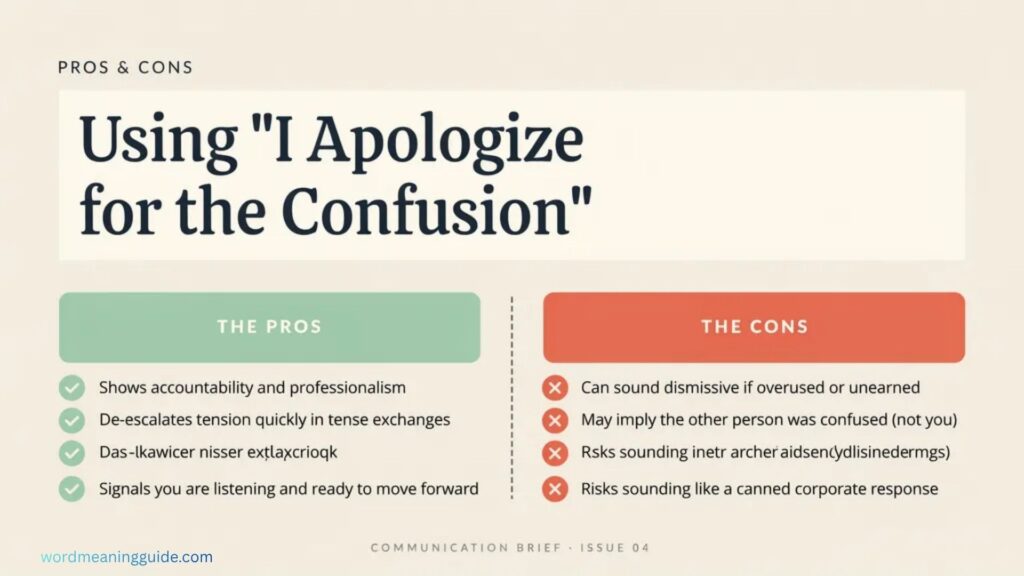
Pros:
- Universally understood and safe for almost any professional context
- Doesn’t admit fault for an actual error, just acknowledges unclear communication
- Quick, polite, and easy to insert into any message
- Sets a respectful tone for resolving the issue
Cons:
- Overused, especially in customer service and corporate emails
- Can sound impersonal or scripted if repeated often
- Doesn’t always address the root cause of the confusion
- May feel vague when the situation calls for a more specific or heartfelt response
Quick Alternatives List
Here’s a fast-reference list before we dive deeper:
Sorry for the mix-up, my apologies for the misunderstanding, I regret the confusion, excuse the confusion, pardon the mix-up, I hope this clarifies things, sorry if that was unclear, apologies for any confusion caused, please forgive the misunderstanding, I didn’t explain that well, thanks for your patience, let me clarify, and dozens more formal variations covered below.
Main Alternatives
1. Sorry for the Mix-Up
A casual, friendly way to acknowledge a scheduling or informational error. Great for everyday workplace chats or texts with colleagues you know well.
2. My Apologies for the Misunderstanding
Slightly more formal than “sorry,” this works well in emails where you want to sound respectful but not overly stiff.
3. I Regret the Confusion
This phrase carries a touch more weight and sincerity, often used in more serious professional contexts like client communications.
4. Excuse the Confusion
A lighter, breezier option, useful in quick replies or chat-based customer support.
5. Pardon the Mix-Up
Polite and slightly old-fashioned in tone, this works nicely in formal written correspondence.
6. I Hope This Clarifies Things
Rather than apologizing outright, this phrase pivots toward resolution — useful when you want to move the conversation forward quickly.
7. Sorry if That Was Unclear
A humble, conversational way to take responsibility for unclear wording without overdoing the apology.
8. Apologies for Any Confusion Caused
A safe, professional staple often used in formal business emails and official statements.
9. Please Forgive the Misunderstanding
Warmer and more personal, ideal for situations involving a closer relationship, like a long-term client or teammate.
10. I Didn’t Explain That Well
This one shows accountability by owning the communication gap directly, which can build trust.
11. Thanks for Your Patience
Instead of dwelling on the confusion, this redirects attention to appreciation, which can soften frustration.
12. Let Me Clarify
Action-oriented and confident, this phrase works well when you want to immediately follow up with the correct information.
36+ More Formal Alternatives to Say “I Apologize for the Confusion”
When the stakes are higher — a client relationship, a formal complaint, or an official company communication — your wording needs to carry more polish and intention. Here are 25+ formal-grade alternatives:
- Thank you for your patience as we clarify this
- I appreciate your understanding regarding this matter
- Thank you for bringing this to my attention
- Allow me to clarify the details
- Let me correct the information provided earlier
- I understand how this may have been unclear
- I realize the previous message may have caused uncertainty
- Thank you for pointing out the discrepancy
- I see how the information may have been misunderstood
- Let me provide additional clarification
- Thank you for your patience while we sorted this out
- I appreciate your bringing this to my attention
- I understand the mix-up and would like to clarify
- Thank you for helping us identify the misunderstanding
- I recognize the confusion this may have caused
- I can see where the misinterpretation happened
- Let me help clear up any uncertainties
- I understand how this may have caused questions
- I appreciate your patience as we resolve this matter
- Thank you for your understanding as we clarify the situation
- Thank you for giving us the opportunity to clarify
- I appreciate your diligence in identifying this issue
- I see there may have been mixed information shared
- Let me update the information to avoid further confusion
- Thank you for allowing us to clarify the mistake
- I realize more clarity was needed
- I understand there may have been a misunderstanding
- Let me offer a clearer explanation
- I can see how the previous message may have been misinterpreted
- I appreciate the opportunity to correct this
- Thank you for catching that oversight
- I understand this may not have been fully clear earlier
- Let me restate the information for clarity
- I appreciate your patience as we sort through this
- I recognize that the earlier communication may have been unclear
- Thank you for giving me the chance to clarify my earlier message
What makes this list valuable isn’t just variety — it’s the subtle shift in focus. Notice how several phrases lead with gratitude (“thank you for your patience,” “thank you for pointing this out”) rather than apology. Communication experts often note that gratitude-forward language tends to de-escalate tension faster than repeated apologies, because it reframes the other person’s frustration as helpful feedback rather than a complaint to be managed.
Mini Dialogue Examples
Customer Support Scenario:
Customer: “Wait, I thought you said the refund would be processed in 3 days, not 10?”
Support Agent: “Thank you for pointing that out — I can see how that earlier message may have been unclear. Let me confirm the correct timeline for you right now.”
Workplace Scenario:
Colleague: “I thought the meeting was at 2 PM, not 3?”
You: “Sorry for the mix-up — I sent the wrong time earlier. It’s at 3 PM, my mistake.”
Client Email Scenario:
Client: “Your last email said the project deadline moved up, but now you’re saying it didn’t?”
You: “I appreciate your patience as we clarify this. The deadline remains as originally scheduled — I regret any uncertainty my earlier message may have caused.”
These small examples show how tone shifts based on relationship and context. A close colleague gets something casual and quick. A client gets something polished and reassuring.
Mistakes to Avoid
Over-apologizing. Saying “sorry” multiple times in one message can come across as insecure or excessive rather than sincere.
Being vague about the fix. An apology without a clear next step leaves the other person still confused. Always pair your phrase with the actual clarification.
Sounding scripted. If your wording feels copy-pasted from a template, readers notice. Vary your language based on the relationship and stakes involved.
Ignoring tone mismatch. Using an overly formal phrase in a casual Slack message (or vice versa) can feel jarring and out of place.
Skipping accountability. Some phrases (like “I hope this clarifies things”) avoid ownership entirely. In situations where you made an actual error, it’s important to acknowledge that directly rather than only focusing on clarification.
Cultural & Tone Tips
Apology language isn’t universal — it shifts depending on culture, industry, and even generational communication style. In many Western business contexts, a brief, solution-focused apology is preferred over a lengthy explanation. In contrast, some cultures place higher value on extended, formal apologies that show deeper acknowledgment of the inconvenience caused.
Within professional settings, customer-facing teams (support, sales, hospitality) tend to lean toward warmer, gratitude-forward phrasing, while legal, financial, or technical industries often favor precise, neutral language that avoids emotional framing altogether.
A useful rule of thumb: match the formality of your apology to the formality of the original communication. A casual text deserves a casual fix. A formal client email deserves formal, structured language.
Comparison Table: 5 Best Alternatives
| Phrase | Tone | Best Used For |
| Sorry for the mix-up | Casual | Quick chats, internal team messages |
| My apologies for the misunderstanding | Semi-formal | Client emails, professional follow-ups |
| I appreciate your patience as we clarify this | Formal | Customer service, official communications |
| Let me clarify | Neutral/Direct | Technical explanations, instructions |
| Thank you for bringing this to my attention | Formal/Gracious | Complaint resolution, escalations |
FAQs
What can I say instead of “I apologize for the confusion”?
You can use alternatives like “sorry for the mix-up,” “let me clarify,” “thank you for your patience,” or “I appreciate your understanding regarding this matter,” depending on how formal or casual the situation calls for.
Is it unprofessional to say “sorry for the confusion” too often?
Not unprofessional, but it can start to feel repetitive or insincere if used in every message. Mixing in alternatives keeps your communication feeling genuine rather than scripted.
What’s a more formal way to apologize for confusion in a business email?
Phrases like “I appreciate your patience as we resolve this matter” or “thank you for bringing this to my attention” tend to sound more polished and professional than a simple “sorry.”
How do I apologize without saying sorry?
Focus on gratitude and resolution instead of the word “sorry.” Try phrases like “thank you for your patience,” “let me clarify,” or “I appreciate the opportunity to correct this.”
Should I explain why the confusion happened?
In most cases, yes — briefly. A short explanation paired with your apology phrase reassures the other person that the issue won’t repeat, without turning into a lengthy justification.
Conclusion
Apologizing for confusion isn’t about finding the “perfect” sentence — it’s about matching sincerity with clarity. The right phrase depends on who you’re speaking to, how serious the misunderstanding was, and what kind of relationship you’re maintaining. Whether you choose something casual like “sorry for the mix-up” or something polished like “I appreciate your patience as we clarify this,” what matters most is following up with real clarity and a genuine effort to make things right.
The next time confusion creeps into a conversation, you won’t need to default to the same tired phrase. With 57+ alternatives in your back pocket, you can choose words that feel honest, fitting, and human — every single time.

Mr. Yaseen is a passionate content creator and language enthusiast dedicated to making words simple and meaningful for everyone. As the author behind WordMeaningGuide.com, he focuses on delivering clear, accurate, and easy-to-understand definitions that help readers improve their vocabulary and communication skills. With a keen eye for detail and a love for language, Mr. Yaseen ensures every piece of content is user-friendly, informative, and valuable for learners of all levels.