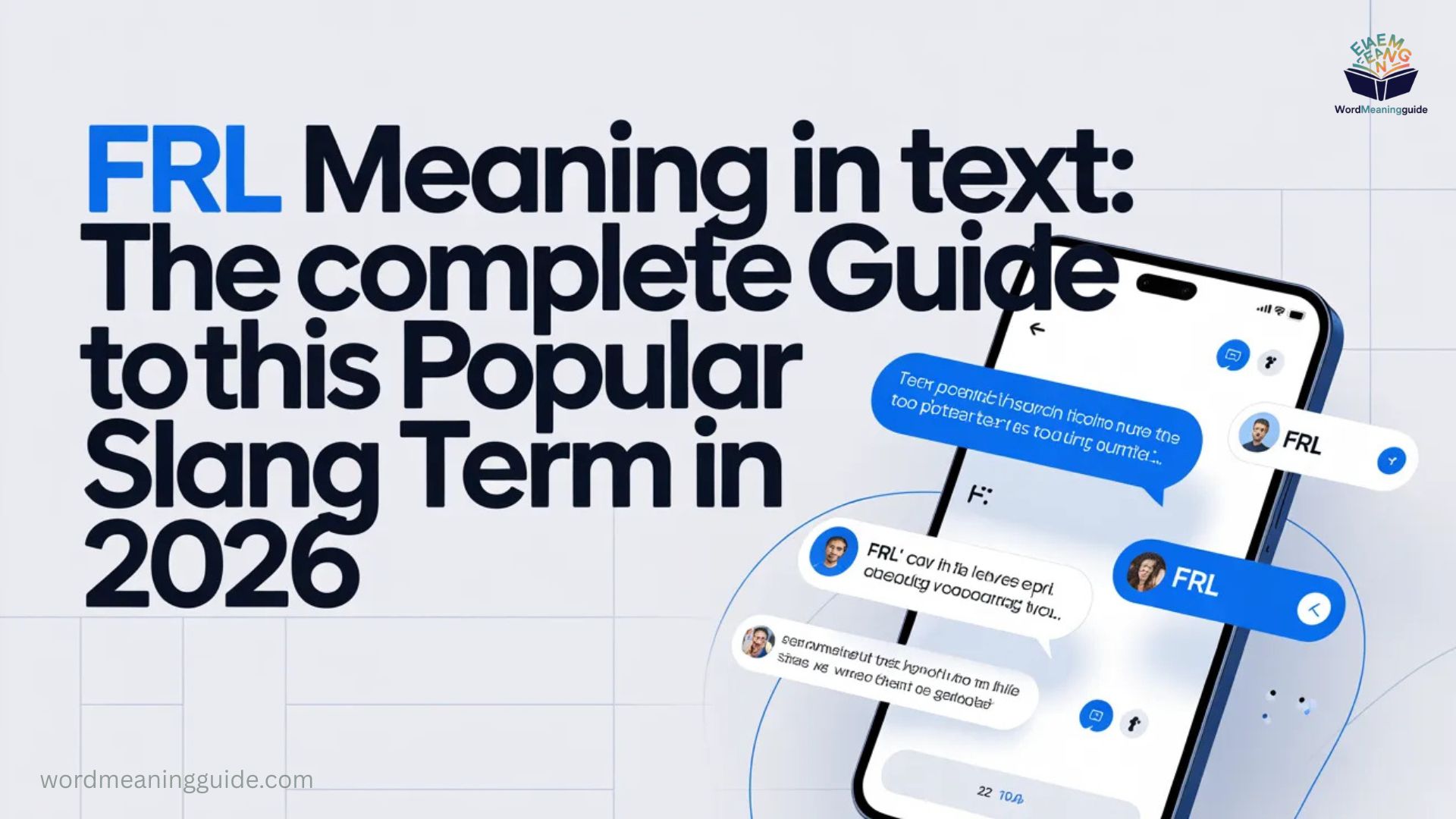
Ever seen someone text “FRL??” and paused for a second trying to figure it out? You’re not the only one. It pops up in chats all the time, and many people instantly search what it means. From friends joking in group chats to quick reactions on social media, FRL has become a common part of everyday texting.
This is how internet slang works—it moves fast, changes often, and keeps conversations short and expressive. FRL is one of those small abbreviations that shows up in messages, comments, and DMs without much explanation. In this guide, you’ll clearly understand what FRL means, how people use it, and why it’s so popular in online conversations today.
FRL Meaning in Text (Simple Definition)
Let’s cut straight to the point. FRL stands for “For Real” in text messaging and online conversations. It’s used to express sincerity, emphasize a statement, express disbelief, or seek confirmation from someone else. Think of it as a digital version of saying “seriously” or “honestly” out loud.
At its most basic level, FRL does what “for real” has always done in spoken English — it adds weight and authenticity to whatever is being said. When someone says “FRL, that was the best pizza I’ve ever had,” they’re not just making small talk. They’re telling you that they genuinely, deeply mean what they’re saying.
FRL belongs to a broader category of internet abbreviations known as “shorthand slang.” These are words or phrases that have been stripped down to their initial letters for the sake of speed and convenience in digital messaging. Other members of this family include LOL (Laugh Out Loud), BRB (Be Right Back), and IMO (In My Opinion).
Discover More OTS Meaning in Text (2026) Explained – Real Meaning & Facts
What makes FRL slightly different is its emotional versatility. It can be assertive (“FRL, you need to hear this”), questioning (“FRL?”), or even sarcastic depending on the tone of the conversation. That flexibility is a big part of why it has become so widely adopted.
How FRL Is Used in Everyday Texting
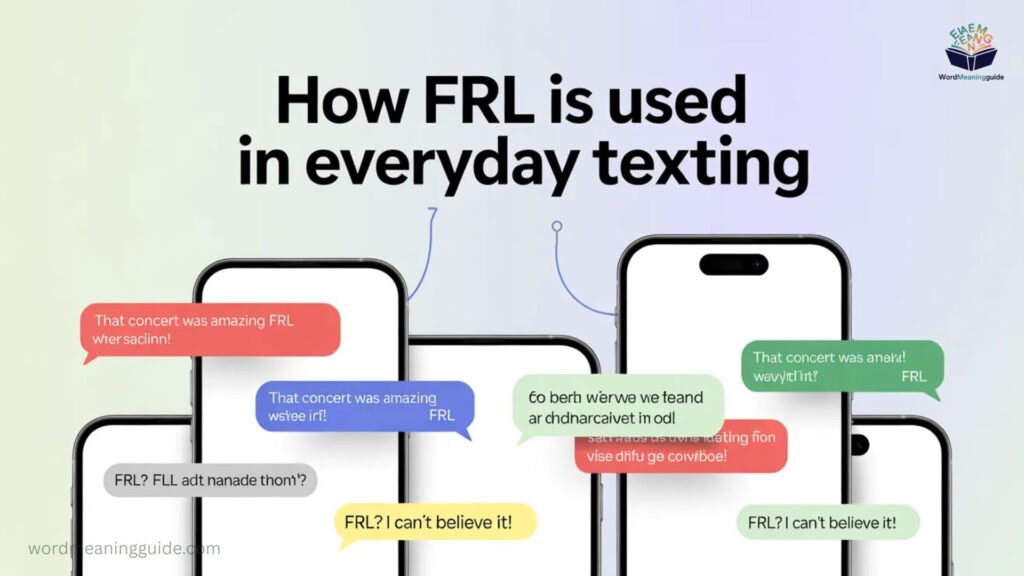
In day-to-day texting, FRL shows up in three distinct ways: as an affirmation, as a question, and as a response to something surprising or unbelievable.
As an affirmation: When someone wants to stress that they’re being completely honest, they’ll drop FRL into their message. “FRL, I didn’t know she was going to be there” communicates genuine innocence or surprise. The abbreviation acts as a credibility booster — a quick way of saying “trust me on this.”
As a question: When someone reads or hears something that seems too wild to be true, they might respond with simply “FRL?” — using it the same way they’d say “Are you serious right now?” or “No way, really?” It’s a request for confirmation packed into three letters.
As a reaction: Sometimes FRL functions as a standalone exclamation. If a friend texts you about something shocking, your entire response might just be “FRL 😱” — expressing awe, disbelief, or shock all at once.
Read More 111 Meaning in Love – (2026) Simple Definition, Signs, and Real-Life Examples
According to digital communication researchers, abbreviated language like FRL reduces cognitive load in casual conversations. When people are messaging quickly on their phones, every saved keystroke contributes to a smoother, more fluid exchange. Slang like FRL fits naturally into this pattern.
Origin & History of FRL
The phrase “for real” itself has deep roots in American English, particularly in African American Vernacular English (AAVE), where it was used as early as the 1960s to emphasize sincerity or authenticity. The spoken phrase carried cultural weight long before the internet existed.
When the era of text messaging arrived in the 1990s and early 2000s, users began abbreviating common phrases to work within the constraints of SMS messaging — early texts often had character limits and tiny keyboards made typing exhausting. “For real” became “frl” as naturally as “laugh out loud” became “lol.”
By the mid-2000s, as platforms like AIM (AOL Instant Messenger), MySpace, and early Facebook emerged, FRL began to appear more regularly in digital conversations. The rise of smartphones and touchscreen keyboards in the late 2000s and early 2010s accelerated the adoption of shorthand language across demographics.
The explosion of social media platforms — particularly Twitter, with its famous character limit — further entrenched abbreviations like FRL into everyday digital language. Younger generations who grew up texting adopted FRL as a natural part of their communication style, and it spread organically from there.
Today, FRL is a well-established piece of internet vocabulary with documented usage across virtually every digital platform on the planet.
FRL Meaning Across Different Platforms
While the core meaning of FRL stays consistent, the way it’s deployed can shift subtly depending on the platform you’re using.
Text Messaging (SMS/iMessage/WhatsApp): This is FRL’s home territory. In one-on-one or group chats, FRL flows freely and naturally. It’s casual, conversational, and perfectly at home alongside other texting slang.
Also Read This MYB Meaning in Text (2026): Complete Guide, Real Meaning & Hidden Truth Explained
Twitter/X: On Twitter, where brevity is prized and character counts still matter, FRL fits right in. Users drop it into tweets to add authenticity to their takes or to express genuine reaction to trending news. You’ll often see it used alongside hashtags or in reply threads.
Instagram: In Instagram comments and DMs, FRL often accompanies compliments or reactions to content. “FRL you look amazing in this” is a warm, genuine-sounding comment that feels more personal than a simple “wow.”
TikTok: TikTok’s comment culture is heavily slang-driven. FRL appears constantly in comment sections, often as a response to something surprising in a video. It’s also used in TikTok captions to create a sense of authenticity and relatability.
Snapchat: Given Snapchat’s inherently casual and ephemeral nature, FRL is extremely common here. Snap conversations tend to mirror real-time verbal exchanges, making FRL feel especially natural.
Discord: In gaming and community server conversations, FRL shows up during discussions, reactions to game moments, or in debate channels where people want to stress that their opinion is genuine.
Reddit: Less commonly but still present, FRL appears in casual subreddits and comment sections, particularly in communities with younger demographics.
The unifying thread across all these platforms is authenticity. Wherever someone wants to stress that they genuinely mean what they’re saying, FRL follows.
Real-Life Examples of FRL (With Explanations)
Nothing teaches slang better than seeing it in action. Here are real-world style examples with breakdowns of exactly what’s being communicated.
Example 1: “FRL that movie was so scary I had to sleep with the lights on.” Explanation: The speaker is emphasizing how genuinely frightening they found the movie. They’re not exaggerating for effect — they want you to know this is their honest experience.
Example 2: “She got accepted to Harvard? FRL??” Explanation: This is FRL used as a question. The speaker is shocked and is seeking confirmation that what they just heard is true.
Example 3: “I’m so tired of fake people, FRL.” Explanation: Here, FRL acts as a closing emphasis, reinforcing that the frustration being expressed is real and sincere — not just venting for attention.
Example 4: “FRL I don’t care what anyone thinks anymore.” Explanation: Used at the beginning of a sentence, FRL here signals a confident, genuine declaration. The speaker wants you to take this seriously.
Looking for the perfect Rigger Meaning in Bed? Explore our full collection here.”
Example 5: “That food was FRL the best thing I’ve eaten in years.” Explanation: Mid-sentence FRL acts as an intensifier, giving extra weight to the superlative claim being made.
Short Dialogues Using FRL
Dialogue 1 — The Shocking News:
Alex: “Did you hear Jake quit his job without another one lined up?” Morgan: “FRL?? That’s wild.” Alex: “FRL, I couldn’t believe it either.”
Dialogue 2 — Expressing Genuine Feelings:
Sam: “Are you actually upset or just being dramatic?” Jordan: “FRL I’m upset. This isn’t a joke.”
Dialogue 3 — Sharing a Strong Opinion:
Casey: “Was the concert good?” Riley: “FRL it was the best night of my life. No exaggeration.”
Dialogue 4 — Reacting to Something Unbelievable:
Taylor: “They cancelled the show after one season.” Devon: “FRL?? I just started watching it 😭”
Dialogue 5 — Sarcastic Use:
Friend 1: “I’m definitely going to wake up at 5am and work out tomorrow.” Friend 2: “FRL though? Or FRL for tonight?” (Here FRL is used playfully to question whether the commitment is sincere.)
Personality Traits of People Who Use FRL
Linguists and social media researchers have observed that heavy users of conversational slang like FRL tend to share certain communication tendencies, though of course these are general patterns rather than rules.
People who frequently use FRL tend to value authenticity in their relationships. They’re often expressive communicators who want their words to land with emotional weight. Rather than being satisfied with vague or neutral replies, they lean into emphasis — using language that signals they’re being real with you.
They also tend to be digitally fluent — comfortable navigating the constantly shifting landscape of internet culture. Staying current with slang is, for many people, a social skill that signals belonging to a particular community or generation.
Interestingly, many adults who adopt FRL after initially learning it from younger people do so because it feels warmer and more casual than more formal affirmations. Saying “FRL, that was incredible” lands differently than “I genuinely found that to be incredible” — even though they mean the same thing.
“Want more inspiration? Check out our top DSL Slang Meaning suggestions.”
Research in digital communication suggests that shared slang strengthens in-group bonds. When two people both understand and use FRL naturally, it creates a small but meaningful sense of connection and belonging.
When Should You Use FRL? (Usage Context)
FRL is a casual, informal expression. That means context matters enormously when deciding whether to use it.
Appropriate contexts include: Texting friends and family, social media posts in personal accounts, comment sections on entertainment platforms, gaming chats, and DMs with people you have an established casual relationship with.
Contexts where FRL is inappropriate: Professional emails, job applications, formal reports, academic writing, business communications, or any conversation where professional tone is expected.
Imagine sending an email to your boss that says “FRL, I think this project needs more resources.” That would almost certainly come across as unprofessional or confusing to anyone unfamiliar with the abbreviation. In formal settings, always opt for “honestly,” “sincerely,” or “to be clear.”
A good rule of thumb: if you’d feel comfortable saying “lol” in that context, FRL probably works too. If you’d feel the need to suppress the “lol,” leave FRL out as well.
FRL vs Similar Slang Words
The internet has no shortage of slang terms that carry similar meanings to FRL. Here’s how it compares to its closest cousins.
FRL vs. FR (For Real): FR is simply a slightly shorter version of FRL. Both mean the same thing, and usage is interchangeable. FR may feel more casual or rushed; FRL is slightly more emphatic in some communities.
FRL vs. NGL (Not Gonna Lie): NGL sets up a confession or honest admission, often something the speaker might not normally say. FRL emphasizes the truth of what’s being said without necessarily implying it’s a confession. “NGL, I liked the movie” vs. “FRL, that movie was great” — both honest, but subtly different.
FRL vs. TBH (To Be Honest): TBH, like NGL, introduces a potentially unexpected or candid remark. FRL is more of a blanket sincerity stamp on everything being said. TBH tends to precede a specific admission; FRL can reinforce any kind of statement.
FRL vs. ONG (On God): ONG is a stronger oath-like affirmation, implying the speaker would stake their reputation or integrity on what they’re saying. FRL is softer and more conversational; ONG carries more intensity and is more common in certain communities.
FRL vs. ISTG (I Swear to God): Like ONG, ISTG is more intense. It’s used when someone is desperate to be believed or is expressing exasperation. FRL is lighter and more versatile in everyday use.
How to Respond to “FRL”
Knowing what FRL means is half the battle — knowing how to respond to it is the other half. Here are the most natural ways to reply depending on the context.
If someone uses FRL to confirm something shocking: Respond in kind with your own reaction. “FRL? That’s insane!” or “FRL, I would’ve never guessed” both work well. You can also mirror the energy: if they seem excited, match that; if they seem upset, acknowledge it.
If someone uses FRL to emphasize they’re being serious: Take them at their word. The most respectful response is to engage with the content of what they said, not the abbreviation. “Oh wow, I didn’t know that was bothering you that much” acknowledges that you heard their sincerity.
Read More IDTS Meaning in Text: The Complete Guide to This Popular Slang Term In 2026
If someone asks “FRL?” as a question: Confirm or deny what they’re reacting to. “FRL, it really happened.” Or if they’ve misunderstood: “No lol, I was joking!” Keep it simple and direct.
If you’re not sure whether they’re using FRL seriously or sarcastically: Context clues in the rest of their message will usually tell you. If in doubt, it’s perfectly fine to ask: “Wait, are you being serious?” — and yes, you can use FRL to ask that too.
Alternative Meanings of “FRL” and Their Contexts
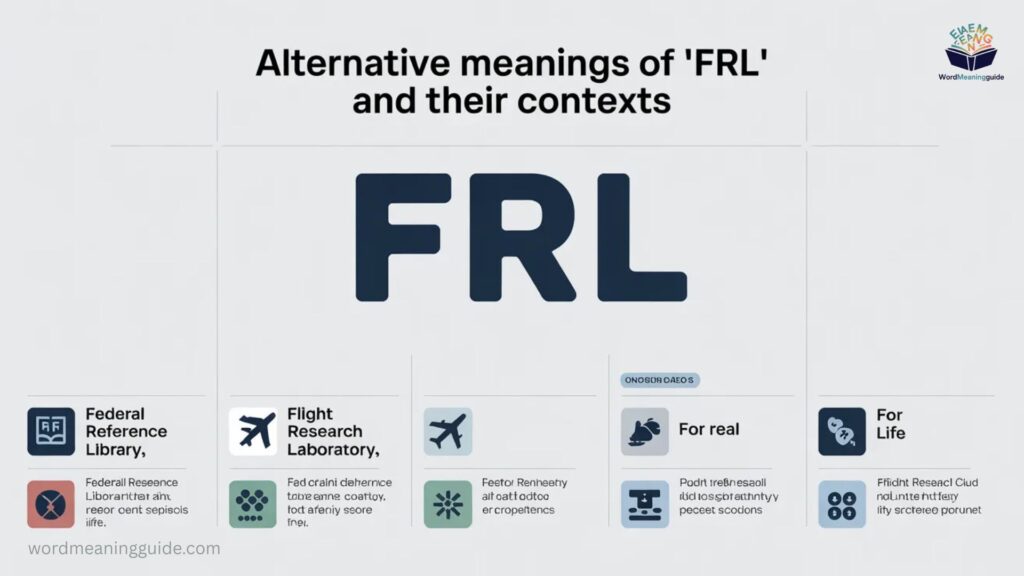
While “For Real” is by far the most common meaning of FRL in casual digital communication, the abbreviation does carry alternative meanings in different professional or specialized contexts.
FRL — Federal Register of Legislation: In legal and governmental contexts, particularly in Australia, FRL refers to the Federal Register of Legislation, the official government repository for Commonwealth laws and legislative instruments.
FRL — Full Rated Load: In engineering and electrical contexts, FRL stands for Full Rated Load, a term used in power systems and equipment specifications.
FRL — Fire Resistance Level: In construction and building codes, particularly in Australian standards, FRL refers to Fire Resistance Level — a metric used to rate how long a building element can withstand fire.
FRL — Functional Residual Lung capacity: In some medical and physiological texts, FRL can appear as an abbreviation related to lung capacity measurements.
If you ever see FRL in a professional, technical, or governmental document, do not assume it means “For Real.” Context will always be your best guide to interpretation.
Variations and Related Popular Slang Words
Language never stops evolving, and FRL has inspired or exists alongside a rich ecosystem of related slang.
FR: The shorter cousin of FRL, used identically but with a slightly more rapid-fire feel. “FR though, why would anyone do that?”
Frfr (For Real For Real): A doubled-up version for extra emphasis. When FRL isn’t enough, frfr signals absolute sincerity. “I’m done with drama, frfr.”
Deadass: A New York-originating slang term meaning “seriously” or “for real.” Often used in similar contexts to FRL. “Deadass, that was the funniest thing I’ve seen all year.”
Lowkey / Highkey: Used to indicate degree of sincerity or intensity. “Lowkey love that song” vs. “Highkey obsessed with this show.”
No Cap: Another term meaning “no lie” or “for real.” Hugely popular on TikTok and among Gen Z. “No cap, this is the best season yet.”
On God (ONG): A stronger version of for real, invoking honesty on a serious level. Often used when someone wants to be absolutely believed.
Legit: More informal English but functions similarly — “Legit though, that was amazing.”
All of these words live in the same emotional neighborhood as FRL, offering slightly different textures and intensities to the speaker’s message.
Modern & Relatable Examples (Updated for 2026)
Slang evolves alongside culture, and FRL has kept pace. Here are fresh, 2026-style examples of how FRL shows up in today’s digital conversations.
“FRL the new season of that show is not it. I’m pressing skip every episode.”
“My Wi-Fi went out during the final boss battle. FRL I’m about to return this router.”
“That AI-generated art literally cannot compare to handmade stuff, FRL.”
“FRL the coffee prices at this café are getting out of hand. Five dollars for a latte??”
“She apologized after a week and wanted everything to be fine. FRL??”
“The gym has been life-changing, FRL. I don’t even recognize myself from a year ago.”
“FRL my cat acts like I’m personally responsible for everything wrong in the world.”
“This new update ruined the app. FRL they need to roll it back.”
These examples reflect the natural, spontaneous way FRL gets woven into real 2026 digital conversation — reacting to everything from streaming shows and tech frustrations to personal growth and everyday humor.
Common Mistakes & Misconceptions
Despite being a simple three-letter abbreviation, FRL is sometimes misused or misunderstood. Here are the most common errors and how to avoid them.
Mistake 1: Thinking FRL is exclusive to teenagers. While FRL is certainly popular among Gen Z, it’s used across age groups. Millennials, and increasingly even older demographics, have adopted it as digital communication has become universal.
Mistake 2: Using FRL in formal communication. This is a context error. FRL belongs in casual conversations. Dropping it into a work email or a professional message can come across as unprofessional or confusing.
Mistake 3: Confusing FRL with FL or FR. FL doesn’t have a standard internet slang meaning. FR (For Real) and FRL are interchangeable, but be careful not to type one when you mean the other if the distinction matters to you.
Mistake 4: Assuming FRL is always sincere. Like most slang, FRL can be used sarcastically. Tone and context determine whether it’s genuine. “Oh FRL, you’re such a great friend” can be sincere or biting depending on the relationship and situation.
Mistake 5: Overusing it. Any word loses impact when it’s used in every sentence. FRL carries weight because it marks emphasis — use it constantly and that emphasis disappears.
Is FRL Safe for Kids and Teens?
Parents and educators are often curious about internet slang, and FRL is one of the more benign examples. As an abbreviation of “For Real,” it doesn’t carry any inherently offensive, sexual, or violent connotations.
That said, like all language, context matters. FRL can be used sarcastically or in conversation about topics that might not be age-appropriate — but the abbreviation itself is neutral.
From a digital literacy standpoint, children and teenagers understanding slang like FRL is actually healthy. It means they’re engaged in the evolving landscape of their peers’ communication and are learning to navigate social cues in digital spaces. Researchers who study adolescent online behavior note that fluency in peer slang is often a marker of social integration.
Parents who are curious about what their children are saying online should feel reassured that FRL is firmly in the “harmless” category. It’s the kind of slang that adults might find confusing but that poses no risk in itself.
That said, it’s always worth maintaining open communication with young people about how and where certain language is appropriate. Learning that “FRL” belongs in texts but not in essays is a valuable lesson in code-switching and context-awareness.
Why People Search “FRL Meaning in Text”
It might seem like a simple question, but “FRL meaning in text” is one of the most searched slang queries on the internet. Why?
The answer reveals something interesting about the gap between generations and the speed of digital language change. Unlike traditional language evolution, which happens over decades, internet slang can become widely used within weeks or months. FRL might appear in someone’s message today having never been part of their vocabulary yesterday.
This creates what linguists sometimes call a “comprehension gap” — where two people are communicating in the same language but not fully understanding each other because of differing familiarity with slang.
People search “FRL meaning in text” because they want to respond appropriately without embarrassing themselves by asking. Nobody wants to admit they didn’t understand what was said, so they quietly search for the answer instead.
There’s also a practical dimension. Parents want to understand what their kids are saying. Employers see it in messages from younger staff. Educators encounter it in student submissions. The curiosity is universal and entirely reasonable.
The popularity of this search also reflects something heartening: people genuinely want to connect and communicate well with each other. Understanding language, even digital slang, is ultimately about building better relationships.
Frequently Asked Questions
What does FRL mean in texting?
FRL stands for “For Real” in texting. It’s used to express sincerity, confirm something is true, or react to something surprising or unbelievable.
Is FRL the same as FR?
Yes, FR and FRL both stand for “For Real” and are used interchangeably. FRL may feel slightly more emphatic in some usage patterns, but there’s no meaningful difference in meaning.
Can FRL be used sarcastically?
Absolutely. Like most slang, context determines whether FRL is sincere or sarcastic. “FRL, that was so helpful” can be genuine or ironic depending on tone and relationship.
Is FRL appropriate for professional settings?
No. FRL is casual internet slang and should be reserved for informal conversations — texting, social media, and messaging apps with friends or peers. It’s not appropriate for emails, professional reports, or formal written communication.
Where did FRL come from?
FRL evolved from the phrase “for real,” which has roots in American spoken English, particularly African American Vernacular English. As text messaging became widespread in the early 2000s, the phrase was abbreviated to FRL.
Does FRL have any other meanings?
Yes. In professional and specialized contexts, FRL can stand for Federal Register of Legislation (legal), Full Rated Load (engineering), or Fire Resistance Level (construction). Always rely on context to determine which meaning applies.
What’s stronger than FRL?
If someone wants to express even greater sincerity or urgency, they might use “frfr” (For Real For Real), “ONG” (On God), or “ISTG” (I Swear to God) — all of which carry a heightened sense of seriousness.
What’s the difference between FRL and No Cap?
Both mean something similar — asserting that you’re being truthful. “No Cap” specifically means “no lie” and is used to deny exaggeration. FRL is a broader sincerity marker and can also function as a question or reaction, giving it more flexibility.
Is FRL used globally or just in the US?
While FRL originated in American digital culture, it’s widely used globally wherever English-language texting and social media are common. Its meaning is broadly understood across English-speaking communities worldwide.
How do I respond when someone texts me FRL?
The best response depends on how they’re using it. If it’s a question (“FRL??”), confirm or clarify. If it’s used for emphasis, engage with the content of their message. You can also use FRL yourself in response to mirror their casual tone.
Conclusion
Language has always been a living, breathing thing — and FRL is proof that even in the age of digital communication, our need to express genuine feeling, sincerity, and connection remains deeply human.
Three small letters, one powerful message: I mean this. For real.
Understanding FRL isn’t just about cracking a code — it’s about staying connected in a world where conversations increasingly happen through screens. Whether you’re a parent trying to keep up with your teenager, a professional navigating a younger team, or simply someone who received a confusing text, knowing what FRL means puts you one step closer to communicating authentically in the digital age.
The beauty of slang is that it’s always changing, always evolving, always reflecting the moment we’re living in. FRL has earned its place in digital vocabulary because it fills a genuine need — a quick, expressive way to say “trust me, I really mean this.”
So the next time you receive an “FRL” in your message thread, you’ll know exactly what it means. And the next time something happens that genuinely surprises or moves you, maybe you’ll find yourself typing it too.
FRL — it’s more than slang. It’s a small but meaningful piece of how we speak to each other now.

Mr. Yaseen is a passionate content creator and language enthusiast dedicated to making words simple and meaningful for everyone. As the author behind WordMeaningGuide.com, he focuses on delivering clear, accurate, and easy-to-understand definitions that help readers improve their vocabulary and communication skills. With a keen eye for detail and a love for language, Mr. Yaseen ensures every piece of content is user-friendly, informative, and valuable for learners of all levels.