Picture this: You’ve just spent 20 minutes crafting a detailed email explaining a complex project update. Now you need to forward it to a colleague or reference it in a follow-up. You type the default phrase — “Please see the email below“ — hit send, and move on.
But here’s the thing: that phrase, while perfectly functional, may be doing your professional image a quiet disservice. It can sound robotic, dismissive, or even passive-aggressive depending on the context. And in a world where the average professional receives 120 emails per day (according to research by the Radicati Group), the language you use to direct someone’s attention matters more than ever.
Communication experts consistently emphasize that tone and word choice in written professional communication shape perception just as powerfully as face-to-face interaction. Dr. Albert Mehrabian’s classic research on communication reminds us that when words and tone conflict, tone wins — and in email, your word choices are your tone.
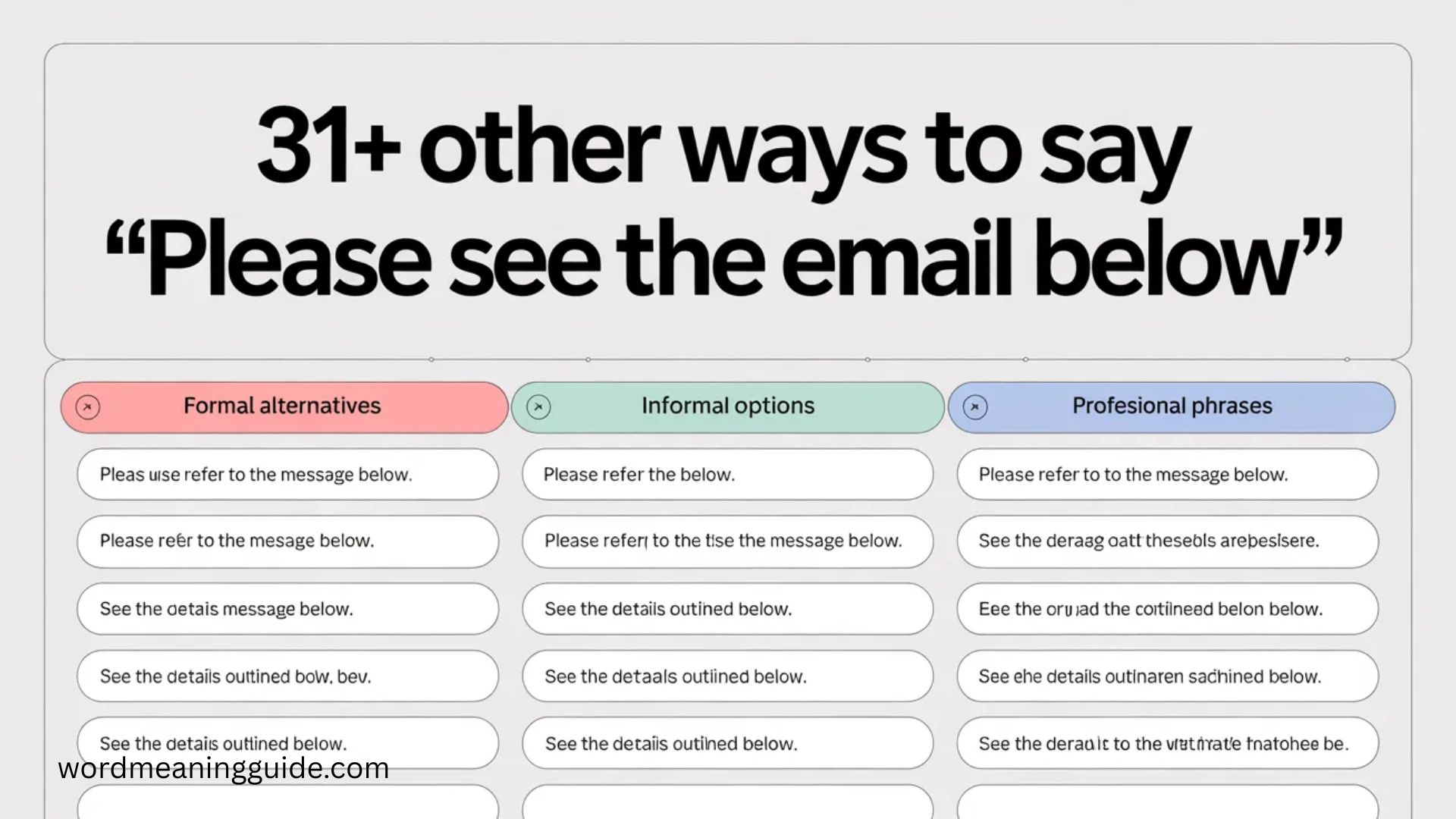
This comprehensive guide explores the best other ways to say “Please see the email below,” covering everything from casual check-ins to formal business communication. Whether you’re writing to a client, a manager, or a new team member, you’ll find the right phrase for every situation — along with real dialogue examples, cultural tips, and the mistakes to avoid.
Let’s dive in.
What Does “Please See the Email Below” Mean?
At its core, “Please see the email below” is a directional phrase. It tells the recipient that important information — whether context, data, instructions, or correspondence — exists in the body of an email that follows the current message or has been forwarded.
It’s widely used in three main scenarios:
Forwarding an email chain: When you forward a conversation to a new recipient and want to draw their attention to the thread below.
Following up: When you’re referencing a previous email that hasn’t received a response, reminding the reader that the details are already available.
Providing context: When a prior message contains background information that supports or explains the current communication.
The phrase acts as a pointer — a signpost guiding the reader’s eyes and attention downward. It is functional, but not always precise, warm, or professional in tone.
When to Use “Please See the Email Below”
There are absolutely situations where this phrase is appropriate and effective. Knowing when to use it — and when to replace it — is a critical communication skill.
Use it when:
- You’re forwarding an email internally within a familiar team.
- The communication is informal and speed matters more than polish.
- You’re writing to someone who will instantly understand the context.
- The phrase is part of a longer, well-composed email where your tone is already established.
Consider replacing it when:
- You’re emailing a client, senior executive, or external stakeholder.
- Your relationship with the recipient is new or requires careful impression management.
- The phrase is the entire message — with nothing added before or after it.
- You’ve already used it multiple times in recent correspondence with the same person.
Think of it this way: “Please see the email below” is the email equivalent of pointing silently at something without saying a word. Sometimes pointing is enough. But often, a few extra words make all the difference.
Is “Please See the Email Below” Polite or Professional?
This is one of the most frequently debated questions in professional communication circles, and the answer is nuanced.
On one hand, the phrase is technically polite — it uses “please,” which signals courtesy. It’s direct without being demanding. For internal emails, especially in fast-paced environments, it’s perfectly acceptable.
On the other hand, communication professionals and business writing coaches often flag it as professionally neutral at best — and potentially passive-aggressive at worst. When used as a standalone response (i.e., your entire reply is just “Please see the email below”), it can come across as curt, dismissive, or even sarcastic — particularly if the original email asked a question that the below email doesn’t directly answer.
Business writing coach Lynn Gaertner-Johnston, known for her work on professional email etiquette, has noted that messages that force readers to dig for context without explanation can create friction and frustration. The goal of any professional communication is clarity with warmth — and sometimes this phrase delivers clarity without warmth.
The verdict: It’s polite enough in the right context, but it’s rarely the most professional option available.
Pros and Cons of Using “Please See the Email Below”
Understanding both sides of this phrase helps you make smarter choices about when to use it and when to reach for something better.
Pros:
It’s universally understood — anyone reading it immediately knows what to do. It’s quick to write, saving time in high-volume email environments. It’s neutral, meaning it’s unlikely to offend anyone. It sets clear expectations for the reader to scroll down for more information.
Cons:
It can feel cold or impersonal, especially in client-facing or emotionally sensitive communications. Used alone, it provides no context, summary, or added value — the reader is entirely on their own. It can sound passive-aggressive in conflict situations or when following up on unanswered messages. It’s overused to the point of becoming almost invisible, meaning readers may skip past it without fully registering the call to action. It doesn’t help the reader understand why they should see the email below or what they should do with the information.
Quick Alternatives List
Before we dive deep, here’s a fast-reference list of alternative phrases you can use right now:
- Kindly refer to the email below
- Check my previous email
- See the message I sent earlier
- Please find the email attached
- Refer to my earlier message
- Forwarded for your reference
- Take a look at the email below
- As mentioned in my previous email
- FYI: See the email below
- Per my earlier message
- Attached below for your review
- Following up on my previous email
- Please see the conversation below
- Please see the note below
- I’ve included the email below for your review
- The information you need is below
- Below is the email with the details
- You can find the full message below
- Please check the email below
- The following email provides the details
- Below is the correspondence for your reference
- For your awareness, see the email below
Now, let’s explore the twelve most useful alternatives in detail.
12 Alternatives to “Please See the Email Below” — Explained in Full
1. Kindly Refer to the Email Below
Best for: Formal professional settings, client communication, international business correspondence.
“Kindly refer to the email below” takes the original phrase and elevates it significantly. The word “kindly” is a traditional marker of politeness widely used in British and South Asian professional communication styles. “Refer” is more active than “see” — it implies engagement, not just a glance.
This phrase works especially well when the email below contains important contractual, technical, or policy information that the reader genuinely needs to consult and act upon.
Example in use: “Kindly refer to the email below for the project scope document we discussed in Tuesday’s meeting.”
Tone: Formal, respectful, professional.
2. Check My Previous Email
Best for: Informal follow-ups, internal team communication, fast-paced work environments.
This is the casual cousin of the original phrase. It’s direct, human, and slightly more conversational. The word “check” feels active — it implies a quick action rather than a formal review. This phrase works best when you have an established rapport with the recipient and speed is a priority.
However, use it carefully with people you don’t know well, as it can come across as slightly abrupt.
Example in use: “Hi Jake — check my previous email from Thursday. It has the updated budget breakdown.”
Tone: Informal, direct, collegial.
3. See the Message I Sent Earlier
Best for: Clarifying follow-up situations, reducing confusion in long email threads.
This phrase adds a helpful time reference (“earlier”) that orients the reader. It’s particularly useful in active email threads where multiple messages have been exchanged and you need to point the reader to a specific earlier point in the conversation.
It’s slightly warmer than “Please see the email below” because “message” feels more personal than “email,” and the phrase reads more naturally in conversation.
Example in use: “See the message I sent earlier today — I’ve outlined three options for the proposal.”
Tone: Neutral to informal, clear, helpful.
4. Please Find the Email Attached / Below
Best for: Formal correspondence, document sharing, business-to-business communication.
“Please find” is a classic staple of formal business writing. While some modern communication experts consider it slightly old-fashioned, it remains widely used — particularly in legal, financial, and corporate environments where formality is expected.
This phrase signals care and deliberateness. Using it tells the recipient that you’ve intentionally included the email for a specific reason, rather than just forwarding reflexively.
Example in use: “Please find the original email below, which contains the terms discussed during our initial consultation.”
Tone: Formal, considered, professional.
5. Refer to My Earlier Message
Best for: Following up on action items, reminding recipients of previous instructions.
This is a slightly more assertive phrasing that works well when you’re following up on something that required a response or action. The use of “refer” implies that the message is a resource or reference point, not just something to glance at. “Earlier message” keeps it chronologically oriented without being overly specific.
Example in use: “Refer to my earlier message for the login credentials and onboarding steps.”
Tone: Neutral to slightly assertive, professional.
6. Forwarded for Your Reference
Best for: Sharing email chains with new stakeholders, looping in team members who weren’t part of the original conversation.
This phrase is perfect when you’re adding someone new to a conversation. It immediately signals that the email has been intentionally forwarded and that the content is being provided as background or reference material. It sets clear expectations: this is context, not necessarily an action item.
Example in use: “Hi Sarah — forwarded for your reference. This thread covers the client’s initial requirements.”
Tone: Professional, informative, neutral.
7. Take a Look at the Email Below
Best for: Collaborative team settings, friendly professional environments, creative industries.
“Take a look” is conversational and warm. It invites rather than instructs. This phrase works well in workplace cultures that value informality and collaboration — think startups, creative agencies, or close-knit teams. It softens the directive quality of the original phrase without sacrificing clarity.
Example in use: “Take a look at the email below — I think the client’s feedback will shape how we approach the next sprint.”
Tone: Friendly, collaborative, casual-professional.
8. As Mentioned in My Previous Email
Best for: Restating key points, summarizing key context, reducing confusion in ongoing conversations.
This phrase does double duty: it directs the reader to the earlier email and implies that you’re about to summarize or expand on something already discussed. It’s a bridge phrase — useful for connecting previous communication to the current message. It can sometimes carry a mildly assertive undertone (especially if overused), so deploy it thoughtfully.
Example in use: “As mentioned in my previous email, the deadline for submissions is Friday at noon.”
Tone: Professional, clear, slightly authoritative.
9. FYI: See the Email Below
Best for: Quick internal updates, informational forwards that require no action, team communication.
Adding “FYI” (For Your Information) is a powerful framing device. It immediately tells the reader that this is informational — no response required, no action needed. This reduces the cognitive load on the recipient and makes the email feel less demanding. It’s best suited to casual or semi-formal internal communication.
Example in use: “FYI: See the email below — the client confirmed their decision to extend the contract.”
Tone: Casual, informational, efficient.
10. Per My Earlier Message
Best for: Professional follow-ups, situations where previous instructions were not followed.
This phrase carries a distinct tone of emphasis. “Per” adds a formal, slightly legalistic quality that signals this is a restatement of something already communicated. It’s effective when following up on tasks or instructions that haven’t been completed. However, be mindful: in some workplace cultures, “per my earlier message” has developed a reputation as a passive-aggressive phrase. Use it when you need firmness, but soften it when the relationship matters more than the message.
Example in use: “Per my earlier message, the report is due by end of day today.”
Tone: Formal, firm, can be perceived as assertive or passive-aggressive depending on context.
11. Attached Below for Your Review
Best for: Document-heavy emails, formal submissions, professional review requests.
This phrase works well when the forwarded email contains something that requires genuine review — a contract, a proposal, a report. The words “for your review” add weight and signal that the recipient’s attention and judgment are valued. It’s warmer than “please see” and more action-oriented than “for your reference.”
Example in use: “Attached below for your review is our full response to the client’s concerns.”
Tone: Professional, respectful, formal.
12. Following Up on My Previous Email
Best for: Unanswered messages, pending action items, overdue responses.
This is the gold standard for follow-up communications. Rather than vaguely directing the reader downward, it explicitly acknowledges that a previous email exists and hasn’t received a response. It’s transparent, professional, and human. It works across virtually every professional context without sounding aggressive.
Example in use: “Following up on my previous email from last Wednesday — I wanted to check in on where we stand with the vendor agreement.”
Tone: Professional, warm, persistent without being pushy.
More Alternatives Worth Knowing
Beyond the twelve above, here are additional phrases that round out your professional vocabulary:
“Please see the conversation below” — ideal when you’re forwarding an entire thread and want to distinguish it as an ongoing conversation rather than a single message.
“Please see the note below” — works well when the forwarded content is brief or informational in nature, giving it a lighter, less formal feel.
“I’ve included the email below for your review” — adds a personal touch (“I’ve included”) that makes the communication feel intentional and considerate.
“The information you need is below” — direct and reader-focused. It puts the reader’s needs at the center of the message, which is always a strong communication choice.
“Below is the email with the details” — clean, simple, and conversational. Good for internal use or when brevity matters.
“You can find the full message below” — emphasizes completeness (“full message”), which is helpful when the reader might be wondering whether they have the complete picture.
“Please check the email below” — a casual, action-oriented alternative. Works best in informal environments.
“The following email provides the details” — slightly formal but very clear. The phrase “provides the details” is respectful of the reader’s time.
“Below is the correspondence for your reference” — “correspondence” elevates the tone and is especially useful in legal, HR, or compliance-related communications.
“For your awareness, see the email below” — excellent for informational updates that don’t require action. It’s broader than “FYI” and feels slightly more considered.
Mini Dialogue Examples
Seeing these phrases in context makes them far easier to deploy confidently. Here are a few realistic examples:
Scenario 1: Following up with a client
Alex (Account Manager): “Hi Maria, I wanted to follow up on the contract update we discussed. Following up on my previous email — could you let me know if the terms look good on your end?”
Maria (Client): “Thanks, Alex. I’ll check my previous email and get back to you by tomorrow.”
Scenario 2: Looping in a colleague
Jordan: “Hi Priya — forwarded for your reference. This thread has all the background on the vendor dispute. No action needed from you right now — just wanted you to be in the loop.”
Priya: “Perfect, thank you. I’ll take a look at the email below and let you know if I have any questions.”
Scenario 3: Following up on an overdue task
Manager: “Hi Tom, per my earlier message, the Q3 summary was due this morning. I’ve included the email below for your review — please let me know your timeline.”
Tom: “Apologies for the delay. I’ll check the message I sent earlier with my draft and send the final version by 3 PM.”
Mistakes to Avoid
Even well-intentioned alternatives can go wrong. Here are the most common errors professionals make when directing readers to email content:
Using the phrase as your entire email. A message that says only “Please see the email below” with no context, greeting, or explanation is rarely professional. Always add something — even a single sentence summarizing why you’re sharing the email.
Overusing “per my earlier message.” As noted above, this phrase can quickly start to sound passive-aggressive. If you find yourself using it more than once with the same person in a short timeframe, consider picking up the phone instead.
Ignoring the tone of the recipient. Forwarding a detailed legal email to a colleague with “Take a look below!” signals a mismatch in tone. Match your phrase to the seriousness of the content.
Failing to summarize. Even when directing someone to a prior email, a one-sentence summary is a gift to your reader. “Kindly refer to the email below — it outlines the three approval stages” is far more useful than a bare directional phrase.
Using formal phrases in casual contexts. Sending “Kindly refer to the email below for your records” to your best work friend feels robotic. Read the room.
Cultural and Tone Tips
Professional communication doesn’t exist in a vacuum — it exists within cultures, industries, and relationships. Here’s how to navigate these contextual layers:
In British and South Asian professional contexts, phrases like “Kindly refer to” and “Please find enclosed” are standard and expected. They signal respect and formality. Using casual alternatives may come across as sloppy or overly familiar.
In American professional culture, directness is generally valued. Phrases like “Check my previous email” or “Take a look below” are well-received in most contexts, especially in tech, media, and startup environments.
In German or Northern European business culture, clarity and precision matter above warmth. “The following email provides the details” or “Below is the correspondence for your reference” aligns well with expectations for direct, information-focused communication.
In client-facing communication across all cultures, err on the side of formality until the relationship is established. It’s always easier to loosen a formal tone than to recover from an accidental casualness.
Emotional intelligence matters here too. If you’re following up on a sensitive topic — a missed deadline, a complaint, a difficult conversation — choosing a warmer, more empathetic phrase (“I’ve included the email below for your review”) signals care and reduces defensiveness in the reader.
Comparison Table of Best Alternatives
| Phrase | Tone | Best For | Formality Level |
| Please see the email below | Neutral | General use | Medium |
| Kindly refer to the email below | Formal | Client/executive comms | High |
| Check my previous email | Casual | Internal team emails | Low |
| See the message I sent earlier | Neutral | Follow-ups, clarifications | Medium |
| Please find the email below | Formal | Business/legal/finance | High |
| Refer to my earlier message | Assertive | Action reminders | Medium-High |
| Forwarded for your reference | Neutral | Looping in new recipients | Medium |
| Take a look at the email below | Friendly | Creative, collaborative teams | Low-Medium |
| As mentioned in my previous email | Assertive | Restating key points | Medium |
| FYI: See the email below | Casual | Informational updates | Low |
| Per my earlier message | Firm | Follow-up on action items | Medium-High |
| Attached below for your review | Formal | Document/proposal reviews | High |
| Following up on my previous email | Professional | Awaiting response | Medium |
| I’ve included the email below | Warm | Client relations, new contacts | Medium |
| The information you need is below | Reader-focused | All professional contexts | Medium |
| Below is the correspondence | Formal | HR, legal, compliance | High |
| For your awareness, see below | Informational | No-action-needed updates | Medium |
Frequently Asked Questions
What can I say instead of please see the email below?
You can say “Kindly refer to the email below.”
How do I politely say see email below?
Say “Please find the email below for your reference.”
What is a professional way to say see below email?
Use “Refer to the email below for details.”
How do I ask someone to check the email below?
Say “Kindly review the email below.”
What is a formal way to say please see below?
Say “Please see the information provided below.”
How do I direct someone to an email politely?
Say “Please refer to the following email for more information.”
What is another way to say see attached email?
Say “Please find the attached email for reference.”
How do I sound more professional in email requests?
Use polite phrases like “Kindly review” or “Please refer to below details.”
Conclusion
Using different ways to say “Please see the email below” makes your message sound more natural and clear. It helps avoid repeating the same phrase in professional writing. Simple alternatives can improve the tone of your communication. This makes your email easier and more pleasant to read.
Choosing the right wording depends on who you are writing to and the purpose of the email. Clear and polite expressions help maintain good professional communication. They also make your message more effective and easy to understand. Overall, it improves clarity and creates a better reading experience.

Mr. Yaseen is a passionate content creator and language enthusiast dedicated to making words simple and meaningful for everyone. As the author behind WordMeaningGuide.com, he focuses on delivering clear, accurate, and easy-to-understand definitions that help readers improve their vocabulary and communication skills. With a keen eye for detail and a love for language, Mr. Yaseen ensures every piece of content is user-friendly, informative, and valuable for learners of all levels.