Imagine this: It’s Monday morning. You’ve just realized a critical team meeting needs to happen — today. You stare at your screen, fingers hovering over the keyboard, wondering how to break the news without seeming inconsiderate or unprofessional. Sound familiar?
We’ve all been there. Life moves fast. Plans change. Deadlines shift. And sometimes, no matter how organized you are, you find yourself delivering news at the last possible moment. The way you communicate that urgency — the words you choose — can either preserve a relationship or quietly damage it.
“Sorry for the short notice” is a phrase most of us reach for instinctively. It’s familiar, quick, and gets the job done. But is it always the right choice? Is it professional enough for a boardroom email? Warm enough for a personal message? Clear enough for an international team?
In this complete guide, we’ll explore what this phrase really means, when and how to use it, and — most importantly — we’ll give you over 70 polished, context-ready alternatives that you can drop into any conversation, email, or message today. Whether you’re a manager, a student, a freelancer, or just someone trying to be more thoughtful in communication, this guide has you covered.
Let’s dive in.
What Does “Sorry for the Short Notice” Mean?
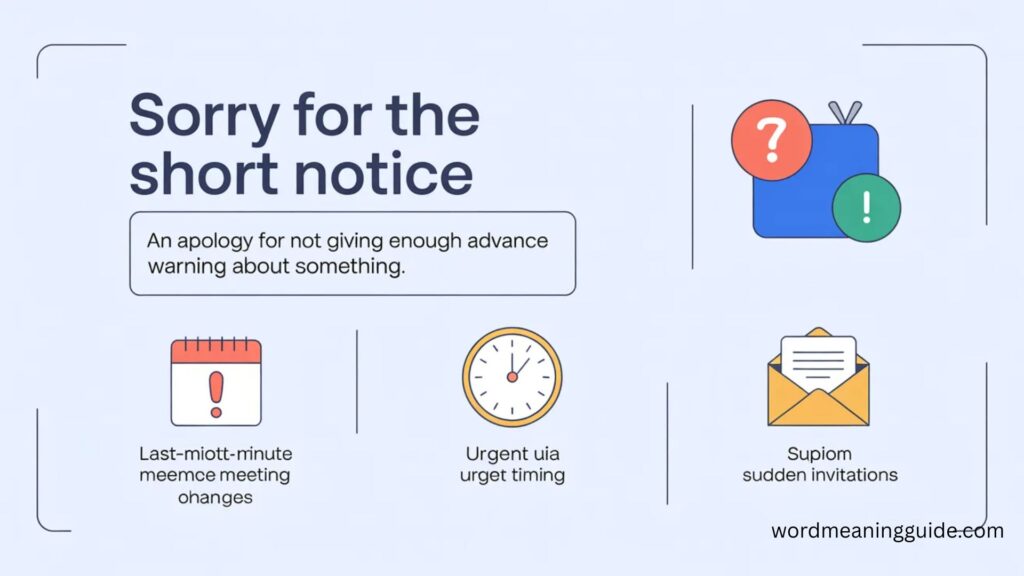
At its core, “sorry for the short notice” is an apology for not giving someone enough advance warning about something — a meeting, a change in plans, a request, or an update.
The phrase breaks down simply: “short notice” refers to a brief gap between when someone is informed and when they’re expected to act. When you say you’re “sorry” for it, you’re acknowledging that this limited window may have caused inconvenience, stress, or disruption to the other person’s schedule.
Linguistically, it’s a form of what communication experts call a “face-saving” expression — a phrase designed to protect the dignity of both speaker and listener. According to communication researchers Penelope Brown and Stephen Levinson, whose foundational work on politeness theory remains widely cited in linguistics, apologizing for an imposition is a cornerstone of maintaining positive social relationships.
In everyday terms: you’re telling someone, “I know this is sudden, and I recognize that it might not be ideal for you.”
That’s a powerful thing to acknowledge — and how you say it matters enormously.
When to Use This Phrase
Knowing when to pull out this phrase (or one of its alternatives) is just as important as knowing how. Here are the most common scenarios where it applies:
Professional settings — Last-minute meeting invitations, sudden deadline shifts, urgent project updates, or unexpected policy changes.
Personal situations — Canceling plans with a friend at the eleventh hour, inviting someone to an event with little lead time, or asking for a favor on short notice.
Academic contexts — Students informing professors of late submissions or absences; professors rescheduling classes unexpectedly.
Customer service — Informing clients about changes to appointments, product availability, or delivery timelines.
Event planning — Notifying attendees about venue changes, time adjustments, or last-minute additions to a program.
The key trigger is simple: if you’re delivering information that requires someone to adjust their plans or expectations with limited time to do so, an acknowledgment of that short timeline is not just courteous — it’s necessary.
Research from the Journal of Applied Communication Research suggests that apologies, even brief ones, significantly improve recipient satisfaction in professional communications. The simple act of acknowledging an inconvenience reduces perceived rudeness by up to 40% in workplace settings.
Is “Sorry for the Short Notice” Polite or Professional?
The short answer: it’s polite, but it walks a fine line in professional contexts.
“Sorry for the short notice” is conversational and warm. It works well in emails to colleagues you know well, in text messages, or in moderately formal situations. However, in highly formal communications — think executive correspondence, legal documents, or international business contexts — it can come across as slightly too casual or even as an empty filler phrase.
Language coach and business communication expert Dianna Booher, author of numerous books on workplace communication, has long advised professionals to make their apologies specific rather than generic. A vague “sorry” can feel automatic. A specific acknowledgment — “I apologize for giving you less than 24 hours to prepare” — demonstrates that you genuinely understand the impact of your timing.
So while the phrase is polite, its professionalism depends heavily on the context, the relationship, and the tone of the surrounding message.
Formal vs Informal
Understanding the register of your communication — formal, semi-formal, or informal — will help you choose the right expression every time.
Formal alternatives tend to use complete sentences, avoid contractions, and employ Latinate vocabulary. Examples include “I sincerely apologize for the insufficient notice” or “Please accept my apologies for the limited advance notice provided.”
Semi-formal alternatives are appropriate for most workplace emails and professional messages. They balance warmth with professionalism: “My apologies for informing you so late” or “I apologize for the short lead time.”
Informal alternatives work for friends, close colleagues, and casual digital communication: “Sorry to spring this on you!” or “I know this is super last-minute, but…”
A good rule of thumb: match the formality of your apology to the formality of the relationship and the stakes involved. A last-minute lunch cancellation between friends needs a very different tone than a last-minute deadline change communicated to a client.
Pros & Cons of Using This Phrase
Like any communication tool, “sorry for the short notice” has its strengths and its limitations.
Pros:
It is immediately understood across cultures and contexts. Its familiarity means recipients know exactly what you’re saying without any ambiguity. It’s brief, which is important when you’re already pressed for time. And it softens requests or changes that might otherwise come across as demanding or inconsiderate.
Cons:
Used too frequently, it can start to feel hollow — a verbal tic rather than a genuine acknowledgment. It’s also relatively passive; it tells someone you’re sorry but doesn’t tell them why the short notice was unavoidable or what you’re doing to prevent it from happening again. In some formal or international contexts, it may feel too casual. And perhaps most importantly, it doesn’t always convey the level of gratitude or respect the situation warrants.
The solution? Use it sparingly and supplement it — or replace it — with more specific, thoughtful alternatives that match the moment.
Quick Alternatives List (Short Replacements)
Sometimes you just need a fast swap. Here are the most popular short alternatives at a glance:
- Please excuse the late notice.
- My apologies for the last-minute update.
- I apologize for the limited lead time.
- Thank you for your flexibility.
- Forgive the short warning.
- Sorry to spring this on you.
- I appreciate your quick attention to this.
- Apologies for the tight timeframe.
- Thanks for bearing with me on this.
- I realize this is sudden — thank you.
Polite Alternatives to “Sorry for the Short Notice”
Now let’s explore each alternative in depth — with context, tone guidance, and example usage.
1. “Please excuse the late notice.”
Tone: Formal to semi-formal Best for: Professional emails, client communications, workplace announcements
This is one of the most polished replacements available. The word “please” adds courtesy without being obsequious, and “excuse” sounds slightly more formal than “sorry.” It’s direct, respectful, and works across a wide range of professional scenarios.
Example: “Please excuse the late notice — we’ve had to reschedule Friday’s presentation to Thursday at 2 PM.”
2. “My apologies for informing you so late.”
Tone: Formal Best for: Business correspondence, formal emails, written communications
This phrase is specific — it tells the reader exactly what you’re apologizing for (the timing of the information). It carries more weight than a casual “sorry” and reads well in written form.
Example: “My apologies for informing you so late about the change in venue. We hope this doesn’t cause significant disruption to your plans.”
3. “I apologize for the late update.”
Tone: Semi-formal Best for: Project management, team communications, client updates
This works particularly well in collaborative or project-based environments where “updates” are a regular part of the workflow. It’s clean, professional, and to the point.
Example: “I apologize for the late update on the project timeline — we’ve encountered some unexpected delays that pushed the delivery date to next Wednesday.”
4. “Thank you for your patience and understanding.”
Tone: Warm and professional Best for: Customer service, client-facing communications, follow-up messages
This alternative shifts the framing from apology to gratitude, which can actually be more powerful. Instead of dwelling on your shortcoming, you acknowledge the other person’s grace and flexibility. It leaves the recipient feeling valued rather than inconvenienced.
Example: “Thank you for your patience and understanding as we work through this unexpected scheduling change.”
5. “Apologies for the last-minute request.”
Tone: Semi-formal to informal Best for: Colleague emails, quick requests, favor-asking scenarios
When you need something done quickly and you know it’s a lot to ask, this phrase acknowledges the pressure you’re putting on someone without being overly dramatic about it.
Example: “Apologies for the last-minute request — would you be able to cover the Thursday briefing? I’ve just been pulled into an emergency meeting.”
6. “I realize this comes late.”
Tone: Conversational, semi-formal Best for: Internal emails, team messages, follow-up communications
This is a softer acknowledgment. Rather than a formal apology, it shows self-awareness and empathy without excessive formality. It’s a good choice when the situation is mildly inconvenient but not critically disruptive.
Example: “I realize this comes late, but I wanted to flag a potential issue with the budget report before it goes out tomorrow.”
7. “I hope this short notice is okay.”
Tone: Friendly, conversational Best for: Personal emails, informal workplace settings, messages to peers
This phrase invites the recipient to respond rather than simply absorbing the news. It’s gentle and considerate, leaving room for them to express if this genuinely doesn’t work for them.
Example: “The team is getting together for lunch on Friday — I hope this short notice is okay! Would love to have you join us.”
8. “Sorry for not letting you know sooner.”
Tone: Casual, warm Best for: Personal messages, friendly workplace communication, informal settings
This phrasing is honest and human. It doesn’t over-explain or over-apologize; it simply acknowledges that earlier communication would have been better.
Example: “Hey! Sorry for not letting you know sooner — I’ve had to cancel our plans this weekend. Let’s reschedule soon.”
9. “I regret not notifying you earlier.”
Tone: Formal Best for: Written professional communications, formal apologies, high-stakes situations
The word “regret” elevates the formality significantly. This is appropriate when the stakes are higher — a significant scheduling change, a policy update that affects people’s work, or a formal business notification.
Example: “I regret not notifying you earlier about the change in project ownership. We will ensure better communication going forward.”
10. “Thanks for responding on such short notice.”
Tone: Grateful, warm Best for: Follow-up messages, after the fact thank-yous, acknowledgment of someone’s flexibility
This one comes after the fact — it’s what you say when someone has already responded or shown up despite the limited notice. It acknowledges their effort and makes them feel appreciated.
Example: “Thanks for responding on such short notice — your help with the report was invaluable and we really appreciate your flexibility.”
11. “I appreciate your quick attention to this.”
Tone: Professional, appreciative Best for: Workplace emails, client communications, team updates
This phrase pivots the focus from your apology to their action. It’s forward-looking and professional, and it makes the recipient feel recognized for their responsiveness.
Example: “I appreciate your quick attention to this matter — please let me know if you need any additional information to proceed.”
12. “Sorry for the rushed request.”
Tone: Casual to semi-formal Best for: Internal teams, direct colleague communication, casual workplaces
This phrase is refreshingly honest. It admits the rushed nature of what you’re asking without excessive hand-wringing. People tend to respect directness.
Example: “Sorry for the rushed request — I need the updated figures by noon. Can you make that work?”
13. “Sorry to spring this on you.
Tone: Casual, friendly Best for: Personal communication, informal teams, close colleagues
This idiom has a warm, conversational feel. It acknowledges the surprise element of your communication without being overly formal. It’s a phrase you’d use with people you have a genuine rapport with.
Example: “Sorry to spring this on you, but we’re doing a team dinner tonight — can you make it?”
14. “Apologies for the last-minute update.”
Tone: Semi-formal Best for: Team Slack messages, email updates, project notifications
Similar to alternative #5, but framed as an “update” rather than a “request.” This works well when you’re delivering information (not asking for action) at the last minute.
Example: “Apologies for the last-minute update — the client has moved the kickoff meeting from Thursday to Wednesday.”
15. “Sorry for notifying you on short notice.”
Tone: Neutral, semi-formal Best for: Professional emails, formal written communication
This is a slightly more complete version of the original phrase, which makes it slightly more formal and deliberate. It reads well in written communications.
Example: “Sorry for notifying you on short notice — attached is the updated agenda for tomorrow’s board meeting.”
16. “My apologies for the late communication.”
Tone: Formal Best for: Business correspondence, client emails, formal notifications
“Late communication” is a clean, professional phrase that works especially well in organizations where timely communication is an expectation or standard.
Example: “My apologies for the late communication regarding the Q3 report — please find the updated document attached.”
17. “Sorry for the compressed timeline.”
Tone: Professional, modern Best for: Project management, agency settings, deadline-driven industries
This alternative acknowledges not just the timing, but the impact — a compressed timeline means less time to do the work well. It shows awareness of the practical consequences of short notice.
Example: “Sorry for the compressed timeline on this one — we’ve flagged to the client that expedited delivery may affect the level of detail in the final output.”
18. “Apologies for the tight timeframe.”
Tone: Semi-formal, professional Best for: Workplace communication, project updates, scheduling changes
Similar to “compressed timeline,” this phrase is realistic and empathetic. It acknowledges the pressure the other person is under.
Example: “Apologies for the tight timeframe — we’ve done everything we can to give you as much lead time as possible given the circumstances.”
19. “Sorry this is so last-minute.”
Tone: Casual, conversational Best for: Informal messages, texts, casual workplace settings
This is one of the most natural, human ways to say the same thing. It’s unpolished, which is exactly why it works well in casual contexts — it sounds like a real person talking.
Example: “Sorry this is so last-minute — can you meet for a quick coffee in 20 minutes to go over the proposal?”
20. “Forgive the short warning.”
Tone: Semi-formal, slightly literary Best for: Written correspondence, emails to individuals, situations where you want to sound a bit more thoughtful
“Forgive” carries a softer, slightly more personal weight than “sorry” or “apologies.” It implies humility and makes the request feel more human.
Example: “Forgive the short warning — I’ve just confirmed we need to push the deadline to end of day Friday.”
21. “Apologies for the short lead-in.”
Tone: Professional Best for: Event planning, training communications, organizational announcements
“Lead-in” is a term often used in events and media, making this a good fit for those industries specifically.
Example: “Apologies for the short lead-in to this training session — we’ll send all materials in advance so you can review them beforehand.”
22. “Sorry for the eleventh-hour notice.”
Tone: Semi-formal, idiomatic Best for: Professional emails, teammate communications, situation acknowledgment
“Eleventh hour” is a vivid idiom that immediately paints a picture — it’s clear, almost dramatic, which makes it memorable. Use it when the timing is genuinely at the very last moment.
Example: “Sorry for the eleventh-hour notice — we’ve just had a change in speakers and need to reshuffle the agenda entirely.”
23. “Apologies for the short advance.”
Tone: Formal, slightly unusual Best for: Formal written communication, notices, memos
“Short advance” is an uncommon but entirely correct phrase. Its slight formality and uniqueness can actually make it stand out in a professional context, signaling care and thoughtfulness in word choice.
Example: “Apologies for the short advance — please find the attached policy document for your review prior to tomorrow’s meeting.”
24. “Sorry for the urgent notice.”
Tone: Neutral, semi-formal Best for: Time-sensitive communications, workplace emergencies, operational updates
This phrase simultaneously apologizes and signals urgency — two birds, one stone. It sets expectations clearly while maintaining courtesy.
Example: “Sorry for the urgent notice, but we need all team members to review the security protocol update before end of business today.”
25. “Pardon the short heads-up.”
Tone: Casual to semi-formal Best for: Informal workplace settings, colleague communications, casual notes
“Pardon” is slightly more formal than “sorry” but still light in tone. “Heads-up” is informal but widely understood. The combination creates a friendly, approachable tone.
Example: “Pardon the short heads-up — just wanted to let you know the conference room has been changed to the third floor.”
26. “Sorry for the sudden request.”
Tone: Casual to semi-formal Best for: Favor requests, colleague asks, project-based communications
This phrase focuses specifically on the “suddenness” of the request, which is sometimes more accurate than just saying it’s short notice. It’s honest and direct.
Example: “Sorry for the sudden request — would you be available to join a client call at 3 PM today?”
27. “Apologies for the late heads-up.”
Tone: Semi-formal Best for: Team communications, operational updates, scheduling notifications
A slight step up in formality from “short heads-up,” this combines a genuine apology word with the casual “heads-up” idiom, making it versatile across semi-formal workplace settings.
Example: “Apologies for the late heads-up — the vendor has confirmed that the delivery will arrive a day earlier than expected.”
28. “Sorry for the unexpected notice.”
Tone: Neutral Best for: Changes in plans, unexpected developments, surprise announcements
This phrase acknowledges not just the timing but the unexpectedness of the communication — which is often what really causes inconvenience.
Example: “Sorry for the unexpected notice — due to unforeseen circumstances, we’ve had to postpone the launch event.”
29. “Apologies for the unplanned notice.”
Tone: Formal to semi-formal Best for: Business communications, organizational announcements
“Unplanned” carries a professional connotation — it implies that this deviation from the norm is being acknowledged and is not representative of standard practice.
Example: “Apologies for the unplanned notice regarding the system maintenance window scheduled for tonight.”
30. “Sorry for giving you little notice.”
Tone: Direct, warm Best for: Personal and professional settings alike
This phrase is refreshingly plain. There are no idioms or formal vocabulary — just a clear, honest acknowledgment. Sometimes simplicity is the most powerful tool.
Example: “Sorry for giving you little notice, but we’ll need the final draft submitted by noon tomorrow instead of Friday.”
31. “Apologies for the sudden adjustment” — Best for operational changes, process updates.
32. “I know this comes on short notice” — A conversational opener that acknowledges the situation without excessive apology.
33. “Sorry for the tight timing” — Useful in event planning or scheduling scenarios.
34. “Appreciate your prompt attention despite the timing” — Acknowledges the recipient’s responsiveness.
35. “Thanks for making this work on short notice” — A grateful, forward-looking acknowledgment.
36. “Apologies for the last-minute request” — Clean and versatile; fits most workplace contexts.
37. “Sorry for springing this on you” — Casual, warm, and human.
38. “I hope this doesn’t disrupt your schedule” — Shows consideration for the recipient’s time.
39. “Thank you for your quick consideration” — Elevates the recipient while acknowledging the urgency.
40. “Sorry for the unplanned request” — Professional and honest.
41. “I appreciate your understanding in this matter” — Formal and gracious.
42. “Apologies for the immediate request” — Works well in operational settings.
43. “Thanks for your adaptability on this” — Compliments the recipient’s flexibility.
44. “Sorry for the urgent notice” — Simultaneously apologizes and signals priority.
45. “I realize this is sudden” — Simple, human, self-aware.
46. “I apologize for catching you off guard” — Especially empathetic; ideal for high-stakes communications.
47. “I understand this may come as a surprise” — Formal and considerate.
48. “Thank you for accommodating this request” — Gracious and professional.
49. “I apologize for the abrupt change” — Best for reversals or cancellations.
50. “Sorry for the hasty notice” — Honest and direct.
51. “My apologies for the rushed communication” — Formal and accountable.
52. “I’m aware this doesn’t leave much time” — Empathetic and realistic.
53. “Sorry for any inconvenience this may cause” — Classic courtesy phrase.
54. “I know your schedule is busy, and I appreciate your flexibility” — Personal and respectful.
55. “Apologies for the quick turnaround request” — Common in creative and agency industries.
56. “I’m sorry for the lack of advance notice” — Clear and formal.
57. “Thank you for your promptness despite the short window” — Gracious acknowledgment.
58. “I realize this is less notice than you deserve” — Honest and humble.
59. “Forgive the urgency of this message” — Slightly literary, appropriate for formal correspondence.
60. “I apologize for not reaching out sooner” — Accountable and direct.
Dialogue Examples
Seeing these phrases in full context can help you understand when and how to deploy them naturally.
Example 1 — Professional Email:
Subject: Team Sync — Today at 3 PM
“Hi Sarah, please excuse the late notice, but I’d like to call a brief team sync this afternoon at 3 PM to align on the client deliverable before it goes out tomorrow. I appreciate your flexibility and will keep the meeting to 20 minutes. Please let me know if this time doesn’t work for you.”
Example 2 — Text to a Friend:
“Hey! Sorry to spring this on you, but I have an extra ticket to the concert tonight. Are you free? I know it’s super last-minute!”
Example 3 — Customer Service Communication:
“Dear Mr. Thompson, my apologies for the late communication regarding your appointment on Thursday. Due to an unexpected scheduling conflict on our end, we need to reschedule to Friday at the same time. We value your time and appreciate your understanding.”
Example 4 — Manager to Team:
“Hi everyone — apologies for the tight timeframe on this, but we need the Q3 reports submitted by EOD Wednesday rather than Friday. I know this compresses things significantly. Please reach out if you need support or resources to meet this updated deadline. Thank you for your adaptability.”
Example 5 — Academic Context:
“Dear Professor Miller, I apologize for not notifying you earlier, but I will be unable to attend tomorrow’s seminar due to a medical appointment. I will review the materials and follow up with a peer for notes. Thank you for your understanding.”
Mistakes to Avoid
Even with the best intentions, there are several pitfalls to watch for when apologizing for short notice.
Over-apologizing can actually undermine your message. When you spend three sentences apologizing before getting to the actual point, the recipient may feel your apology is performative rather than genuine. Keep it brief and purposeful.
Vague apologies don’t land well. “Sorry for any inconvenience” is so generic it barely registers. Be specific about what you’re apologizing for and why.
Apologizing and then ignoring the impact is a miss. If you know the short notice creates a genuine burden, acknowledge it specifically: “I realize this gives you only a few hours to prepare, and I want to make sure you have everything you need.”
Using the phrase as a filler depletes its value. If every email you send starts with “sorry for the short notice” regardless of actual urgency, people will stop registering it as meaningful.
Failing to offer a solution is a missed opportunity. After acknowledging the short notice, offer something practical — extended support, flexibility on your end, or a genuine explanation for the timing.
Cultural & Tone Tips
Communication styles vary enormously across cultures, and what reads as politely apologetic in one context can seem excessively self-deprecating — or insufficiently humble — in another.
In North American and many Western European business cultures, brief, direct acknowledgments are preferred. Over-explaining or excessive apologizing can actually reduce your perceived competence.
In East Asian business cultures — particularly Japanese and Korean professional contexts — more elaborate expressions of regret and deference are often expected and appropriate. A phrase like “I sincerely apologize for the inadequate notice I have provided” would not be considered excessive.
In British English, understatement is common. A simple “apologies for the late notice” with no further elaboration is often perfectly sufficient.
In Australian and New Zealand informal contexts, casual phrases like “sorry to spring this on you” or “I know this is last-minute” fit seamlessly into professional communication without seeming unprofessional.
When communicating across cultures, when in doubt, lean slightly more formal. A formal apology is rarely offensive; an overly casual one can be.
Tone is also shaped by medium. A Slack message allows for more casual phrasing than a formal email. A text to a friend allows for emoji and informality. A letter to a board of directors requires carefully chosen, formal language throughout.
Comparison Table — Popular Alternatives
| Phrase | Tone | Best Context | Formality Level |
| Please excuse the late notice | Polite | Professional emails | Semi-formal |
| My apologies for informing you so late | Apologetic | Business correspondence | Formal |
| Sorry to spring this on you | Friendly | Casual/team messages | Informal |
| Thank you for your patience and understanding | Grateful | Client-facing communication | Semi-formal |
| I apologize for catching you off guard | Empathetic | High-stakes situations | Formal |
| Apologies for the tight timeframe | Professional | Project/deadline contexts | Semi-formal |
| Forgive the short warning | Warm | Written personal/professional | Semi-formal |
| I realize this is sudden | Self-aware | Any context | Casual |
| Apologies for the last-minute update | Neutral | Team updates | Semi-formal |
| I regret not notifying you earlier | Formal | Official correspondence | Formal |
| Sorry for the compressed timeline | Modern | Agencies, projects | Semi-formal |
| Thanks for your adaptability on this | Complimentary | Team/colleague messages | Semi-formal |
FAQs
Is “sorry for the short notice” grammatically correct?
Yes, it is grammatically correct. “Short notice” is a noun phrase here, and the sentence is an elliptical form of “I am sorry for giving you short notice.” It’s widely accepted in both spoken and written English.
When is it too late to say sorry for the short notice?
There’s rarely a time when it’s “too late” to acknowledge your timing. Even after the fact, saying “thank you for responding on such short notice” or “I appreciate you accommodating that last-minute request” is always received positively. Acknowledgment — even delayed — is better than no acknowledgment at all.
Can I use these phrases in a formal business email?
Yes, many of these alternatives are well-suited for formal business emails. Phrases like “please accept my apologies for the insufficient notice,” “I regret not informing you sooner,” and “my apologies for the late communication” are all appropriately formal for professional correspondence.
What’s the difference between “short notice” and “last-minute”?
“Short notice” refers to a relatively limited amount of advance warning — this could be a few hours or even a couple of days depending on context. “Last-minute” implies an even tighter timeline, usually hours or less before something happens. “Last-minute” carries more urgency and is slightly more informal.
How do I apologize for short notice without seeming incompetent?
Keep your apology brief, specific, and solution-oriented. Acknowledge the short timeline, briefly explain why if appropriate, and then pivot quickly to what you need and how you’re going to support the other person. Lingering too long on the apology draws attention to the failure; moving forward professionally demonstrates competence.
Should I explain why the notice was short?
It depends on the context and your relationship with the recipient. In a close professional relationship, a brief, honest explanation can actually strengthen trust. In a formal context, a long explanation can seem like excuse-making. A one-sentence reason — “due to an unexpected development” or “circumstances changed late yesterday” — is usually sufficient if any explanation is warranted at all.
Are there times when you shouldn’t apologize for short notice?
Yes. In emergencies or genuinely urgent situations where speed is essential, lengthy apologies can actually impede communication. It’s more important to convey the urgent information clearly and quickly. You can acknowledge the timing briefly, but the priority is clarity and action.
Conclusion
The words you choose to acknowledge short notice say more about you than you might think. They reveal whether you’re considerate of others’ time, whether you communicate with intention, and whether you value the relationships you’re navigating.
“Sorry for the short notice” is a perfectly serviceable phrase — but it’s far from the only option, and in many situations, it’s not the best one. With over 70 alternatives at your disposal, ranging from the formally elegant to the warmly casual, you now have the vocabulary to handle any last-minute communication with grace, professionalism, and genuine consideration.
The next time life moves faster than your calendar, you’ll be ready. Choose your words with care, acknowledge the impact of your timing, and — whenever possible — follow your apology with action. That’s what truly separates a perfunctory “sorry” from a communication that builds trust, sustains relationships, and leaves a lasting positive impression.
Because at the end of the day, it’s not just about what you say. It’s about how the other person feels after you’ve said it.

Mr. Yaseen is a passionate content creator and language enthusiast dedicated to making words simple and meaningful for everyone. As the author behind WordMeaningGuide.com, he focuses on delivering clear, accurate, and easy-to-understand definitions that help readers improve their vocabulary and communication skills. With a keen eye for detail and a love for language, Mr. Yaseen ensures every piece of content is user-friendly, informative, and valuable for learners of all levels.