You’re scrolling through your messages and someone ends their request with “TIA.” You pause. You read it again. Is it a name? A typo? Or something everyone else already knows?
If you’ve ever been in that moment of quiet confusion, you’re not alone. Internet slang moves fast, and acronyms like TIA slip into everyday digital conversations so naturally that many people feel awkward asking what they mean.
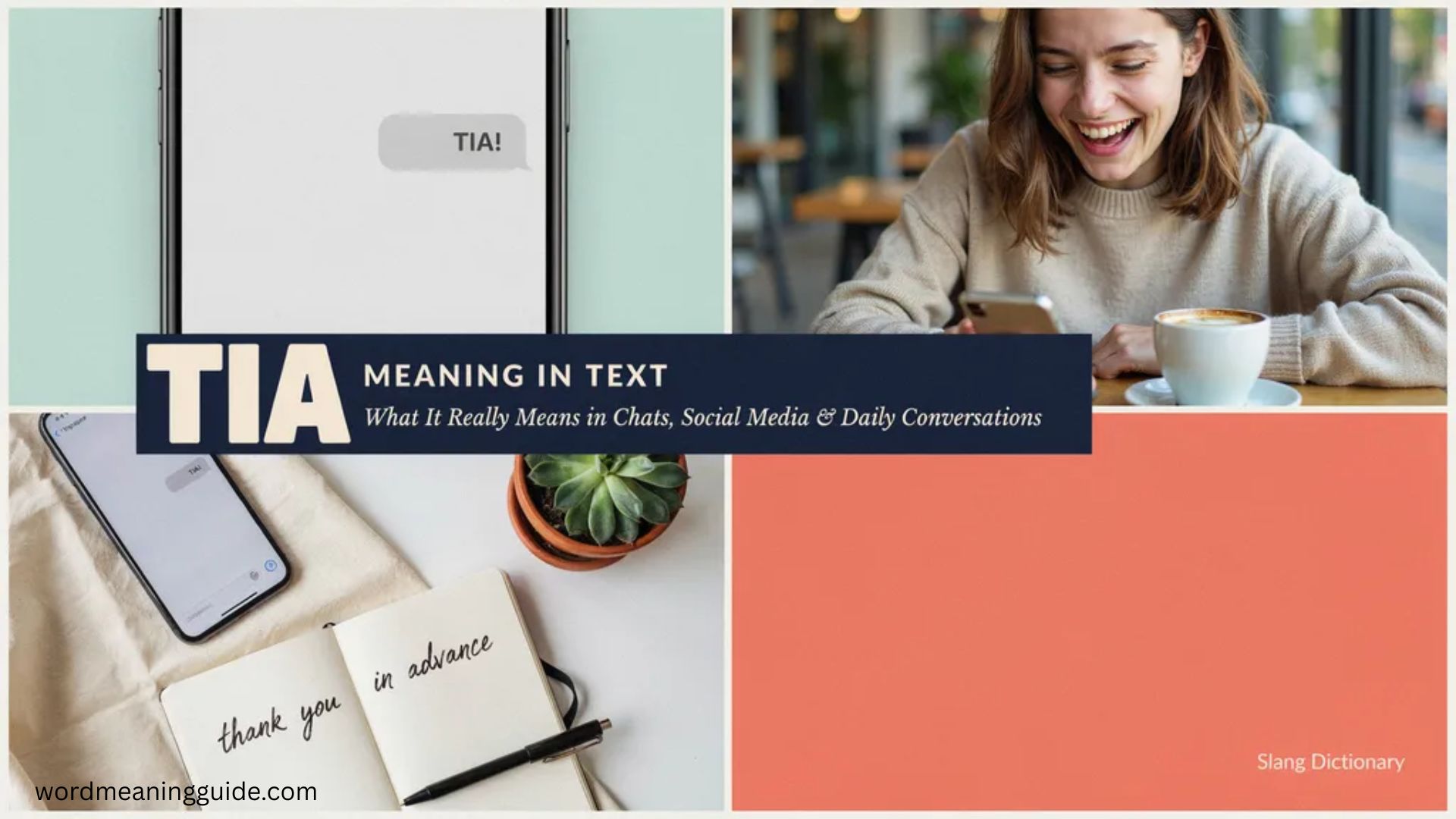
Here’s the short answer: TIA stands for “Thanks in Advance.” It’s a compact, casual expression of gratitude sent before a favor, question, or request has even been fulfilled. It’s the digital equivalent of saying “I already appreciate whatever you’re going to do for me.”
But there’s so much more to unpack behind those three letters. The emotional weight they carry, the social dynamics they create, the contexts where they work — and the ones where they definitely don’t. This article covers all of it.
Simple Definition
TIA = Thanks in Advance
It is used when someone wants to express gratitude proactively — before the other person has done what’s been asked. Think of it as a polite nudge wrapped in appreciation.
People use it in text messages, WhatsApp chats, Instagram DMs, work Slack channels, Reddit threads, email sign-offs, and almost every corner of digital communication.
Quick Examples
- “Can you send me the notes from today’s class? TIA!”
- “Does anyone know a good dentist in Lahore? TIA”
- “Hey, could you check if the parcel arrived? TIA 🙏”
What It Communicates
Using TIA sends several subtle signals at once. It tells the recipient that you’re expecting their help, that you’re grateful even before they act, and that you trust them enough to assume they’ll come through. It’s efficient, warm, and slightly presumptuous — in the best possible way.
Origin & Background of TIA
How TIA Evolved
The phrase “thanks in advance” is far older than the internet. It appeared in formal letter writing as far back as the 19th century, used by professionals who wanted to express preemptive gratitude in correspondence. Back then, it was considered a polished, business-like courtesy.
When email became mainstream in the 1990s, “thanks in advance” migrated naturally into digital communication. People still typed it out in full. It was clean, professional, and widely understood.
Then came instant messaging, SMS, and the explosion of social media platforms. Suddenly, brevity became a virtue. Typing on a flip phone taught a whole generation to compress language instinctively. By the early 2000s, TIA had emerged as a recognized shorthand across forums, chat rooms, and early social networks.
Today, TIA is listed in major slang dictionaries and is recognized globally across platforms ranging from professional tools like Microsoft Teams to casual apps like Snapchat and BeReal.
Linguists who study digital communication, such as Dr. Jannis Androutsopoulos, have noted how internet acronyms don’t just save time — they create a sense of in-group identity. When you use TIA casually, you’re signaling that you belong to the digital-native world where informal efficiency is a form of fluency.
Explore More Other Ways to Say “Thank You for Your Patience” In 2026
Meaning in Physics, Medical, and Aircraft Terminology
Here’s where things get interesting. TIA isn’t exclusively a texting term. In different professional fields, TIA stands for something entirely different.
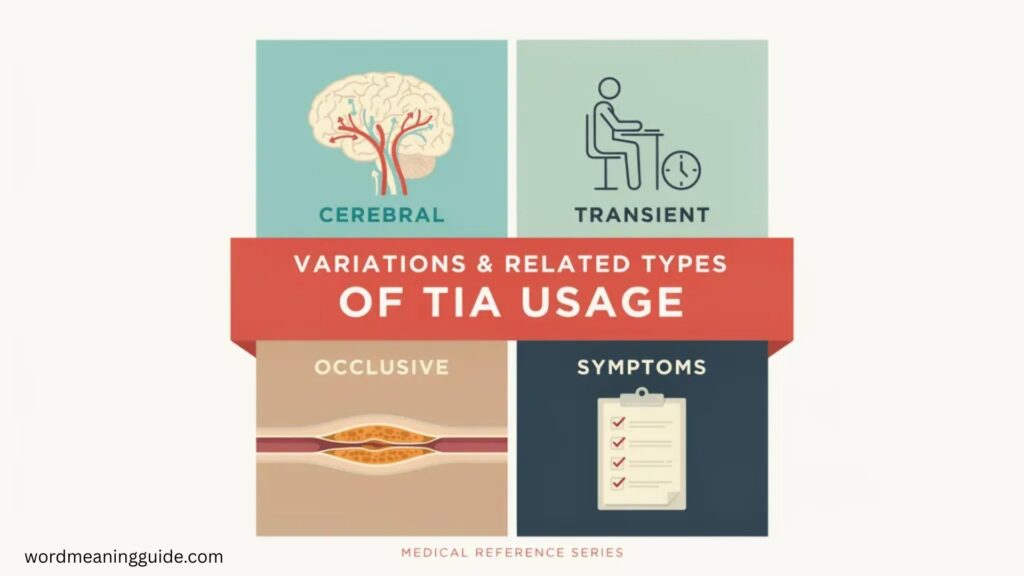
In medicine, TIA stands for Transient Ischemic Attack — commonly known as a “mini-stroke.” It’s a temporary disruption of blood flow to the brain that causes stroke-like symptoms lasting only minutes or hours. Medical professionals use TIA extensively in patient charts, research papers, and hospital discussions.
In aviation and aerospace, TIA is used as a shorthand in various technical documents, sometimes referring to “Technical Integration Agreement” or acting as airport and airspace codes depending on the context.
In physics and engineering, TIA stands for Transimpedance Amplifier — a circuit that converts current to voltage, widely used in fiber-optic communication systems, medical imaging equipment, and scientific instruments.
The key takeaway? Context is everything. When your friend texts “TIA for the help,” they mean thanks. When your doctor mentions TIA in a report, they’re discussing a neurological event. Always read the room — and the platform.
Real-Life Conversations Using TIA

One of the best ways to understand a term is to see it in action. Here are authentic-feeling examples across the platforms people use every day.
WhatsApp Example
Rania: Hey, can you pick up bread and eggs on your way home? Rania: TIA! 💛
Kamran: Sure, no problem!
Simple, warm, efficient. This is TIA at its most natural — a quick text between family or close friends where the expectation of help is already there.
Instagram DM Example
@sara.creates: Hey! I love your editing style. Could you share what preset you use for your reels? @sara.creates: TIA, you’re so talented 🙏✨
Here, TIA softens what could feel like a demanding request. Combined with a genuine compliment, it feels gracious rather than grabby.
TikTok Comment Example
@user89234: Does anyone know the song playing in this video? TIA!!
TIA in public comment sections is extremely common. The person is essentially casting a net and thanking whoever responds before they even know who that will be.
Work Chat Example
Bilal (Slack): Team, can someone review the draft proposal before 3 PM and drop any feedback in the shared doc? TIA
In a semi-formal workplace chat, TIA works well. It’s efficient without being robotic. However, notice it would feel less appropriate in an email to an external client or a senior executive.
Text Message Example
Zara: Can you cover for me at the meeting tomorrow? I have a doctor’s appointment. Zara: TIA, you’re a lifesaver 🙏
The emotional warmth here is real. Pairing TIA with something like “you’re a lifesaver” makes it feel less transactional and more personal.
Emotional & Psychological Meaning Behind TIA
Why People Use It
At its core, TIA is a form of what psychologists call “anticipatory gratitude.” Research in positive psychology, including studies cited in journals like Emotion, suggests that expressing gratitude — even preemptively — strengthens social bonds and increases the likelihood that the other person will follow through with the requested behavior.
In other words, TIA isn’t just polite. It’s strategically effective.
When someone says TIA, they’re subconsciously framing the interaction so that refusing to help feels like a social cost. Not in a manipulative way — but in the same way saying “you’re the best” before asking a favor does. Appreciation softens requests.
Social Psychology Behind It
Dr. Robert Cialdini, whose research on influence has shaped modern understanding of social dynamics, identified “reciprocity” as one of the most powerful drivers of human behavior. Expressing gratitude first — even before help is given — activates the reciprocity principle. The other person feels a subtle pull to justify the appreciation they’ve already received.
Discover More 80+ Other Ways to Say “Have a Good Day” (With Examples) In 2026
TIA, in this light, is a tiny but psychologically potent act.
Emotional Tone Matters
The emotional weight of TIA shifts dramatically based on what surrounds it.
- “TIA” alone feels neutral, sometimes even curt.
- “TIA! 😊” feels warm and friendly.
- “TIA, really appreciate it 🙏” feels sincere and grateful.
- “TIA — let me know ASAP” can feel demanding despite the gratitude.
The acronym itself is emotionally neutral. The emojis, punctuation, and words around it carry the feeling.
Usage of TIA in Different Contexts
Social Media Usage
On platforms like Twitter/X, Reddit, Facebook groups, and Instagram, TIA is used constantly in posts where someone is seeking help, recommendations, or information from a wide audience. Since the person doesn’t know who will respond, TIA serves as a blanket thank-you to whoever steps up.
Reddit, in particular, has normalized TIA to such a degree that it appears in thousands of posts daily. Subreddits ranging from cooking to tech support to relationship advice are filled with threads ending in “TIA.”
Friends & Relationships
Among close friends, TIA is casual and affectionate. It’s used the same way someone might say “you’re the best” or add a quick “thanks babe” to a request. The formality drops entirely, and TIA becomes just another piece of the everyday texting shorthand.
In romantic relationships, TIA is common in the context of small, practical favors — pick up dinner, remind me about the appointment, check on the delivery. It keeps communication breezy without losing warmth.
Work & Professional Settings
TIA in professional settings requires more careful calibration. In startup environments, creative agencies, and tech companies with casual cultures, TIA in Slack or Teams messages is completely normal. It fits the conversational tone of fast-moving teams.
However, in formal corporate environments, law firms, government institutions, or when communicating with clients you don’t know well, TIA can read as too informal or even flippant. In those settings, writing out “Thank you in advance for your time and assistance” carries more weight.
Best Professional Use
The safest professional use of TIA is in internal communications with colleagues you know well, in industries with casual communication norms, or in written requests where you’re already adopting a conversational tone. Pair it with a clear, specific ask and it lands well.
Casual vs Serious Tone
| Context | TIA Appropriate? |
| Text to a close friend | ✅ Absolutely |
| WhatsApp family group | ✅ Yes |
| Slack message to teammate | ✅ Usually fine |
| Email to your manager | ⚠️ Use with caution |
| Email to a client | ❌ Write it out fully |
| Medical or legal document | ❌ Never |
| Public social media post | ✅ Very common |
Common Misunderstandings About TIA
1. Thinking TIA Has Only One Meaning
As covered earlier, TIA means very different things in different fields. If you’re in a medical setting and someone mentions TIA, they’re almost certainly not thanking anyone in advance. Being aware of context-dependent meaning prevents confusion — and in medical situations, it prevents something far more serious.
2. Assuming It Always Sounds Polite
TIA can actually come across as presumptuous if used incorrectly. Saying “Fix this bug by Friday. TIA.” sounds like an order dressed in fake politeness. The request needs to actually be a request — respectful and open — for TIA to land with warmth rather than entitlement.
3. Using It in Very Formal Situations
Sending an email to a senior executive or a government official with TIA at the bottom immediately signals a certain informality that may not serve you well. When in doubt, write the full phrase. “Thank you in advance for your consideration” will always read better than “TIA” in formal correspondence.
4. Overusing It
When every single message ends in TIA, it loses its meaning. Like any expression of gratitude, repetition dilutes impact. Reserve it for actual requests where preemptive thanks genuinely adds something.
Comparison Table
| Acronym | Full Form | Tone | Best Used In |
| TIA | Thanks in Advance | Casual/Warm | Texts, social media, chats |
| TY | Thank You | Casual | Quick replies |
| TYVM | Thank You Very Much | Slightly formal | Friendly digital comm |
| THX | Thanks | Very casual | Informal texts |
| Cheers | Thank you (British) | Warm/casual | Spoken/written informal |
| TIA (Medical) | Transient Ischemic Attack | Clinical | Medical/healthcare |
| TIA (Tech) | Transimpedance Amplifier | Technical | Engineering/electronics |
Key Insight
TIA is uniquely positioned in that it expresses gratitude before an action, rather than in response to it. This makes it psychologically different from “TY” or “THX,” which are reactive. TIA is proactive gratitude — and that changes its social dynamics entirely.
Variations & Related Types of TIA Usage
People don’t always stick to the plain three-letter version. TIA comes in many flavors depending on tone, urgency, and relationship.
1. TIA
The standard. Neutral, clean, universally understood.
2. TIA!
The exclamation mark adds energy and enthusiasm. It sounds eager and friendly.
3. Big TIA
An intensified version, used when the request is significant or the person wants to emphasize genuine appreciation.
“Can you help me move this weekend? Big TIA 🙏”
4. TIA Everyone
Used in group chats or public posts where multiple people might respond.
“Does anyone have a template for a resignation letter? TIA everyone!”
5. TIA for the Help
A slightly more complete phrasing that sounds warmer and more personal than the bare acronym.
6. TIA Guys
Casual, friendly, often used in group chats. Has a conversational energy that works among friends or close colleagues.
7. Advanced Thanks
A rare but real alternative — used when someone wants to sound more formal than TIA but still proactive.
“Advanced thanks to anyone who can assist with this.”
8. Thanks Ahead of Time
The fully written version of TIA, used in professional emails where the acronym would be inappropriate.
9. Appreciate It in Advance
A softer, less direct version that sounds humble and genuinely appreciative.
10. Massive TIA
An amplified expression of gratitude, typically reserved for big requests or particularly kind acts.
“Massive TIA to whoever can cover my shift Saturday — I owe you one!”
How to Respond When Someone Uses TIA
When someone sends you TIA, they’re expressing confidence in you and asking for help. How you respond sets the tone of the interaction.
Casual Replies
- “Sure, no worries!”
- “On it! 😊”
- “No problem at all.”
- “Got you!”
- “Happy to help.”
Get More JSP Meaning in Text: What It Really Means in Chats, Social Media, and Real Life In 2026
Funny Replies
- “No need for advance thanks, I accept retroactive payment in coffee ☕”
- “TIA noted. I’ll send my invoice.”
- “Already on it before you even asked 😂”
Mature & Confident Replies
- “Of course — I’ll have it done by end of day.”
- “Absolutely. Let me look into it and get back to you.”
- “Consider it handled.”
Private or Respectful Replies
Sometimes the kindest response to a TIA is simply to deliver on the request without fanfare. Action, in many cases, speaks louder than any reply.
Regional & Cultural Usage of TIA
Western Culture
In the US, UK, Canada, and Australia, TIA is deeply embedded in digital communication. It’s used across age groups, though it’s more common among millennials and Gen Z. In British English, it sometimes appears alongside other casual thank-you expressions like “cheers” or “ta.”
Asian Culture
Across South Asia — including Pakistan, India, Bangladesh, and Sri Lanka — English-language digital communication has absorbed TIA enthusiastically. It appears frequently in WhatsApp family groups, educational forums, and professional chats. In Pakistan specifically, TIA often coexists with Urdu texting, with people switching fluidly between “shukriya” and “TIA” depending on the register of the conversation.
In East and Southeast Asia, where English-medium digital communication is widespread in professional circles, TIA is equally common — especially on platforms like LinkedIn, Slack, and international business emails.
Middle Eastern Culture
In the Gulf region, Egypt, and other parts of the Middle East where English is widely used in professional and social digital spaces, TIA has gained significant traction. It often appears in mixed Arabic-English communication, especially among younger, urban, and internationally educated users.
Global Internet Usage
Perhaps the most remarkable thing about TIA is how truly borderless it is. On Reddit, Discord, and gaming platforms, TIA appears in posts from users across dozens of countries. The internet has created a shared slang vocabulary that transcends geography, and TIA is firmly part of that global shorthand.
Explore More Other Ways to Say “I Will Let You Know”: The Ultimate Guide for Clear, Professional Communication
Differences from Similar Words
Understanding TIA becomes clearer when you compare it to expressions that seem similar but carry different weight.
TIA vs. Please: “Please” is a request modifier. TIA is a gratitude expression. They work well together but serve different functions.
TIA vs. Thank You: “Thank you” is reactive — said after something has been done. TIA is proactive — said before. This makes TIA bolder and more assumptive.
TIA vs. If You Could: “If you could help, that’d be great” leaves the outcome open. TIA presumes the help is coming. This is why TIA can feel presumptuous if the request isn’t framed carefully.
TIA vs. I Appreciate It: Similar in warmth, but “I appreciate it” doesn’t specify the advance nature of the thanks. It’s often used retrospectively or neutrally.
TIA vs. Cheers: “Cheers” is primarily British/Australian and is often used as a general goodbye or thanks in spoken language. TIA is text-specific and explicitly tied to making a request.
Relevance in Online Conversations & Dating Apps
TIA has a surprisingly active presence on dating apps and online relationship-seeking platforms. People use it in bio sections or opening messages in ways that reveal a lot about their personality.
Someone who writes “TIA to anyone who actually reads bios 😂” is signaling humor, self-awareness, and digital fluency. It’s a subtle but effective personality cue.
In conversation threads on apps like Bumble or Hinge, TIA pops up in requests — “Could you recommend a good place for a first date in this city? TIA!” — and functions as an icebreaker that’s both practical and charming.
Dating coaches and relationship writers note that how someone thanks you — even before you’ve done anything — reveals something about their character. Preemptive gratitude is associated with optimism, trust, and positive social expectations. In the early stages of dating, TIA can be an endearing signal.
Similar Terms & Alternatives
If TIA doesn’t feel right for a particular message, here are related terms that serve similar functions:
TYIA — Thank You in Advance. Slightly longer, slightly warmer than TIA. Less common but widely understood.
Thx in advance — A hybrid that writes “thanks” partially but abbreviates. Used when someone wants to be slightly less terse than TIA.
Much appreciated — A more formal alternative that doesn’t presume as much but still sounds warm.
I owe you one — Less formal, more personal. Implies reciprocity rather than just gratitude.
Thanks a mil — Casual and enthusiastic. Works among close friends.
Grateful in advance — Elevated, slightly literary. Unusual in texts but appears in thoughtful emails.
Thanks for your help — Simple and direct, works when you want to acknowledge the effort specifically.
Frequently Asked Questions
What does TIA mean in texting?
TIA in texting stands for “Thanks in Advance.” It’s used to express gratitude before someone has fulfilled a request. It’s one of the most commonly used informal acronyms in digital communication worldwide, appearing in text messages, social media comments, group chats, and work platforms.
Is it rude to use TIA?
TIA isn’t inherently rude, but it can come across as presumptuous if used incorrectly. The key is to frame your request respectfully before adding TIA. If the request itself is polite and the tone is warm, TIA adds a pleasant, appreciative touch. If the request sounds like a demand, TIA won’t soften it enough.
Can TIA be used in professional emails?
In casual professional environments — like startup Slack channels or creative team chats — TIA works well. In formal professional emails, especially to clients, executives, or external stakeholders, it’s better to write “Thank you in advance” in full. The written-out version reads as more considerate and polished in high-stakes contexts.
What is the difference between TIA and TYIA?
Both mean roughly the same thing. TIA stands for “Thanks in Advance” while TYIA stands for “Thank You in Advance.” TYIA is slightly more formal and feels a bit warmer because it includes the word “You,” making it more personal. TIA is more commonly used due to its brevity.
Does TIA have other meanings besides “Thanks in Advance”?
Yes. In medicine, TIA stands for Transient Ischemic Attack (a mini-stroke). In electronics and physics, TIA refers to a Transimpedance Amplifier. In aviation contexts, it may refer to technical agreements or be used as an airport code depending on the region. Context is everything when interpreting TIA.
Is TIA used globally or only in certain countries?
TIA is used globally. While it originated in English-language digital spaces, it has spread across international platforms including Reddit, Discord, LinkedIn, WhatsApp, and TikTok. Users from South Asia, the Middle East, East Asia, Europe, and the Americas all use TIA regularly in English-medium digital communication.
When did TIA become popular in texting?
TIA became popular in the early-to-mid 2000s as SMS texting and instant messaging platforms grew. The need to abbreviate drove the adoption of many acronyms during this era, and TIA — already a known phrase from formal writing — transitioned naturally into digital shorthand. Its popularity has only grown with the rise of social media and mobile-first communication.
How should I respond when someone says TIA to me?
The most natural responses are simple affirmations: “No problem,” “Sure thing,” “On it,” or “Happy to help.” If you want to add humor, you can play with the anticipatory nature of the thanks. If the request is complex or you need more information before committing, respond with a question or a clarification. The key is to acknowledge both the request and the gratitude.
Conclusion
Three letters. Infinite context.
TIA is one of those deceptively simple acronyms that tells a rich story about how humans communicate in the digital age. It compresses a complete social act — expressing gratitude, making a request, and signaling trust — into a tiny package that fits comfortably at the end of a text message.
Whether you’re using TIA in a WhatsApp family group, a Reddit thread, a Slack channel, or a TikTok comment, it carries the same essential meaning: I trust you, I appreciate you, and I’m grateful before you’ve even had the chance to help.
Understanding the nuances of TIA — when it’s warm, when it’s presumptuous, when it’s professional, and when it crosses into another meaning entirely — is part of being fluent in modern digital communication. And digital fluency, in a world where so much of our social and professional life happens on screens, matters more than ever.
The next time someone sends you TIA, you’ll know exactly what they mean. And the next time you reach the end of a request, you’ll know whether those three letters are just right — or whether the moment calls for something more.

Mr. Yaseen is a passionate content creator and language enthusiast dedicated to making words simple and meaningful for everyone. As the author behind WordMeaningGuide.com, he focuses on delivering clear, accurate, and easy-to-understand definitions that help readers improve their vocabulary and communication skills. With a keen eye for detail and a love for language, Mr. Yaseen ensures every piece of content is user-friendly, informative, and valuable for learners of all levels.