Whether you are sending a quick text to a friend or drafting a formal email to a client, the phrase “I will let you know” has become one of the most common commitments in modern communication. It is simple. It is reassuring. It buys time without sounding evasive.
But what happens when you say it too often? Or use it in the wrong tone for the wrong audience?
Imagine this: You are a project manager fielding questions from three different stakeholders in one afternoon. By the fifth time you type “I will let you know,” even you start to feel the weight of its vagueness. You have made a promise without a timeline, a plan, or a specific next step. Over time, that phrase can quietly erode trust — not because of bad intent, but because of repetition and ambiguity.
This guide gives you 70+ powerful alternatives to “I will let you know,” covering everything from casual conversation to high-stakes professional settings. You will learn when to use each one, what tone it conveys, and how to avoid the most common communication mistakes that professionals make every day.
What Does “I Will Let You Know” Mean?
At its core, “I will let you know” is a forward-looking commitment phrase. It signals that you do not have a complete answer right now, but you intend to share information once you do.
It is used to:
- Acknowledge a question without dismissing it
- Create a soft pause in communication
- Signal responsiveness and accountability
- Manage expectations in professional or personal exchanges
Linguistically, it belongs to a category of what communication scholars call phatic expressions — phrases that maintain social bonds rather than convey hard information. The phrase itself is grammatically complete, emotionally neutral, and universally understood.
However, its very convenience is also its weakness. When overused, it can sound noncommittal, vague, or even dismissive. That is exactly why having a rich vocabulary of alternatives transforms you from a passive communicator into an active, trusted one.
When Should You Use These Alternatives?
Not every situation calls for the same phrasing. Context matters enormously in communication, and choosing the right words can determine whether you come across as responsive, professional, warm, or reliable.
Use formal alternatives when:
- Communicating with senior leadership, clients, or partners
- Writing official emails or memos
- Responding to legal, financial, or compliance-related queries
Use casual alternatives when:
- Texting friends or family
- Chatting with a familiar colleague on Slack
- Responding in a relaxed, conversational setting
Use specific alternatives when:
- You have a clear timeline (“I’ll confirm by Thursday”)
- The topic is sensitive and requires precision
- You want to demonstrate accountability and follow-through
Research in workplace communication consistently shows that specific follow-up language increases perceived trustworthiness. A 2023 survey by Grammarly and The Harris Poll found that 72% of business leaders said clear, effective communication directly affected their trust in team members. Choosing the right phrase is not just about style — it is about credibility.
Is “I Will Let You Know” Polite or Professional?
The short answer: it can be both, or neither, depending on how and when you use it.
In most contexts, “I will let you know” is perfectly polite. It is not rude or dismissive by nature. It acknowledges the other person’s question and signals a future response. That qualifies as respectful communication.
However, professionalism is another matter. In high-stakes environments, vague commitments can undermine your authority. When a stakeholder asks, “Will the report be ready by Friday?” and you respond with “I’ll let you know,” you have answered without actually answering. The question was about timing; your response sidestepped it entirely.
The phrase becomes problematic when it is used as a deflection rather than a genuine commitment. Communication coaches often describe this as a “soft dodge” — technically polite, but strategically evasive.
The key is to pair any commitment phrase with a specific action, timeline, or next step. That small addition transforms vagueness into accountability.
Pros and Cons of Using “I Will Let You Know”
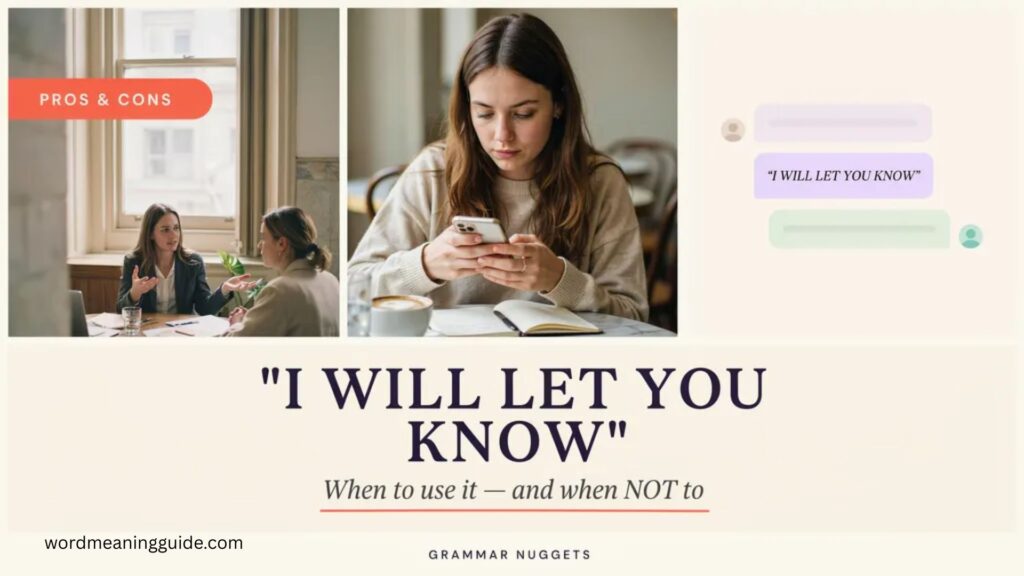
Pros
- Universally understood — works in virtually every English-speaking context
- Buys time gracefully — allows you to gather information before committing
- Emotionally neutral — unlikely to offend or confuse
- Flexible — usable in personal and professional settings alike
Cons
- Lacks specificity — gives no timeline, method, or detail
- Can feel dismissive — especially if said repeatedly without follow-through
- Reduces credibility — over-reliance makes you seem indecisive
- Missed opportunity — a more specific phrase builds stronger rapport and trust
Quick Alternatives List (For Busy Readers)
Here is a fast-reference list for those who need an alternative right now:
- I’ll get back to you.
- I’ll keep you posted.
- I’ll follow up with you.
- I’ll update you soon.
- I’ll reach out once I know more.
- I’ll confirm and get back to you.
- I’ll keep you informed.
- I’ll circle back with you.
- I’ll notify you.
- I’ll be in touch.
- I’ll provide an update when available.
- I’ll touch base with you soon.
- I’ll keep you in the loop.
- You’ll hear from me soon.
- I’ll fill you in later.
- I’ll ping you once I know.
- I’ll give you a heads-up.
- I’ll shoot you a message.
- I’ll holler when it’s sorted.
- I’ll let you know once decided.
26+ Core Alternatives Explained in Detail
1. “I’ll get back to you.”
Tone: Neutral, professional, widely accepted
This is the most common substitute for “I will let you know.” It carries a slightly stronger sense of commitment — implying that you will take action and return with an answer. It is appropriate in nearly every setting, from email to in-person conversation.
Example: “That’s a great question about the Q3 projections. I’ll get back to you by end of day.”
2. “I’ll keep you posted.”
Tone: Warm, informal-to-neutral
This phrase implies ongoing communication rather than a single update. It suggests that you will continue to share information as it develops — ideal for evolving situations or projects in progress.
Example: “The team is still reviewing the proposal. I’ll keep you posted as we finalize the details.”
3. “I’ll follow up with you.”
Tone: Professional, action-oriented
“Follow up” signals that there is a specific action you intend to take. It is particularly strong in business contexts because it implies responsibility and next steps.
Example: “I need to check with the legal team first. I’ll follow up with you once I have their input.”
4. “I’ll update you soon.”
Tone: Reassuring, slightly casual
This phrase is softer than “follow up” but carries a similar promise. “Soon” adds a vague temporal element — which can be either helpful or limiting depending on the context.
Example: “We’re working through the final edits. I’ll update you soon.”
5. “I’ll let you know once I have more details.”
Tone: Honest, transparent
This alternative is excellent because it explains why you cannot answer yet. It signals that more information is needed, which humanizes the delay and keeps the listener patient.
Example: “The vendor hasn’t confirmed pricing yet. I’ll let you know once I have more details.”
6. “I’ll confirm and get back to you.”
Tone: Formal, responsible
This phrase is especially useful when a definitive yes or no depends on verification. It signals diligence and a clear follow-through plan.
Example: “I need to verify the availability with the venue. I’ll confirm and get back to you.”
7. “I’ll keep you informed.”
Tone: Formal, authoritative
Slightly more formal than “keep you posted,” this phrase suits leadership communication. It implies a steady and deliberate flow of information.
Example: “As the audit progresses, I’ll keep you informed of any findings.”
8. “I’ll circle back with you.”
Tone: Corporate, slightly informal
Popular in business environments, “circle back” implies a return to the conversation after gathering more information. Some find it a bit jargon-heavy, so use it in contexts where that language feels natural.
Example: “Let me pull the data together. I’ll circle back with you after the team sync.”
9. “I’ll be in touch.”
Tone: Friendly, open-ended
This phrase is warm without being specific. It works well at the end of meetings or casual exchanges where an exact timeline is not necessary.
Example: “Thanks for reaching out. I’ll be in touch once I’ve had a chance to review your proposal.”
10. “I’ll notify you.”
Tone: Formal, one-directional
“Notify” implies a more official or transactional communication. Use it when delivering information that requires action or attention, such as policy updates or status changes.
Example: “Once the application has been reviewed, we’ll notify you of our decision.”
More Best Detailed Alternatives Explained
I’ll Update You Shortly
This phrase promises timeliness. “Shortly” suggests the wait will not be long, making it ideal when you genuinely expect to have news within a short period. It reduces anxiety and keeps the other party engaged.
I’ll Inform You
Slightly formal and direct. Works well in written communication where brevity is valued. Better suited to memos or transactional emails than warm personal exchanges.
I’ll Confirm Later
Acknowledges uncertainty without apology. Particularly useful after meetings where decisions are still pending sign-off.
I’ll Reach Out
Popular in professional American English, this phrase implies proactive contact. It positions you as the one who will initiate the next communication, which builds confidence.
I’ll Advise You
Carries a consultative or professional tone. Common in legal, financial, and medical settings where the communicator holds expert knowledge.
I’ll Respond Shortly
Signals that a formal reply is coming soon. Excellent for email correspondence or ticketing systems where “response” implies a documented answer.
I’ll Check and Reply
Combines two clear actions: investigation and follow-up. Transparent and reliable — the recipient knows exactly what will happen next.
I’ll Revert to You
Used heavily in South Asian professional English, particularly in India. Means “I will get back to you.” While some consider it non-standard, it is widely understood in those professional cultures.
I’ll Message You Later
Casual and direct. Best for texts, chat apps, or conversations with friends. Signals a relaxed, personal form of follow-up.
I’ll Confirm and Update
A doubled commitment — first confirming the facts, then sharing them. This phrase is strong for situations where accuracy is paramount before communication.
I’ll Inform You Once I Know
Adds a conditional element: you will share once knowledge is available. This manages expectations honestly.
I’ll Reach Out When I Have More Details
Especially transparent. Signals that the follow-up will be substantive and informative, not just a token check-in.
I’ll Touch Base With You Soon
Conversational and warm. Works in team environments. Slightly softer than “follow up,” but equally professional in low-stakes contexts.
I’ll Follow Up With Details
Emphasizes that the upcoming communication will be detailed, not vague. A great choice when the person needs comprehensive information.
I’ll Circle Back Shortly
Adds urgency to “circle back.” Best used when the delay is genuinely short and you want to reassure the recipient.
I’ll Notify You Once Confirmed
Strong in formal and process-driven contexts. The word “confirmed” adds a layer of verification that signals precision.
I’ll Make Sure You’re Updated
Proactive and customer-centric. Positions you as someone who is actively monitoring the situation on the recipient’s behalf.
I’ll Keep You in the Loop
Friendly and inclusive. Implies that the recipient is part of an ongoing process, not just waiting on the sidelines.
You’ll Hear From Me Soon
Slightly more personal and warm. Shifts the subject to “you,” centering the recipient’s experience.
I’ll Fill You In Later
Casual and conversational. Best for informal contexts where a full briefing will come after a meeting or event.
I’ll Ping You Once I Know
Tech-friendly and modern. Common in Slack, Teams, or digital-first workplaces.
I’ll Shoot You a Message
Very casual. Works in texts or chat. Not suitable for professional or formal emails.
I’ll Give You a Heads-Up
Signals advance notice rather than a comprehensive update. Useful when you want to warn someone before an official announcement.
I’ll Holler When It’s Sorted
Extremely casual and colloquial. Best for friends or team members in very relaxed environments. Avoid in professional or formal settings.
I’ll Let You Know Once Decided
Strong for group decisions or board-level discussions. Signals that a process is underway and communication follows resolution.
Mini Dialogue Examples
Workplace Email:
“Hi Sarah, thanks for your inquiry about the software rollout timeline. I’ll confirm with the IT team and follow up with you by Thursday afternoon.”
Text Message to a Friend:
“Not sure what time the party starts. I’ll ping you once I hear back from Jake!”
Customer Service Response:
“We’ve received your ticket and our team is reviewing the issue. You’ll hear from us within 24 hours.”
Manager to Team Member:
“Good question. I don’t have the budget numbers finalized yet, but I’ll keep you in the loop as soon as the CFO signs off.”
Doctor to Patient:
“We need to review your test results with the specialist. I’ll advise you once we have a complete picture.”
Mistakes to Avoid
1. Over-promising timelines you cannot keep Saying “I’ll get back to you in an hour” when you know it will take days destroys credibility faster than any vague phrase.
2. Using vague phrases as a deflection If someone asks a direct question and you consistently respond with “I’ll let you know” without ever following through, the phrase becomes a signal that you are avoiding the topic.
3. Using overly casual language in formal settings “I’ll holler when it’s sorted” to a senior executive will not land well. Match your register to your audience.
4. Forgetting to actually follow up The phrase is only as good as the action behind it. Always set a calendar reminder or task note to make sure you deliver on the promise.
5. Repeating the same phrase in one message Using “I’ll get back to you” three times in a single email signals disorganization. Vary your phrasing and provide context each time.
Cultural and Tone Tips
Communication norms vary significantly across cultures, industries, and relationships. Here is what to keep in mind:
American English: Prefers direct, action-oriented phrases like “I’ll follow up” or “I’ll get back to you.” Vagueness is often interpreted as avoidance.
British English: Slightly more formal phrasing is appreciated. “I shall revert with an update” or “I’ll be in touch shortly” fits well in corporate UK settings.
South Asian English: “I’ll revert” is widely used and professionally accepted. Do not correct it in those contexts.
High-context cultures (Japan, parts of East Asia): Indirect language is culturally preferred. Saying “I will need to consider this carefully” can carry the same weight as “I’ll let you know” without implying a specific promise.
Customer service settings: Specificity is king. “You will receive an email within 24 hours” outperforms “I’ll let you know” every single time in customer satisfaction surveys.
Comparison Table of the 10 Best Alternatives
| Phrase | Tone | Best Setting | Specificity Level |
| I’ll get back to you | Neutral | Universal | Low |
| I’ll follow up with you | Professional | Business/Email | Medium |
| I’ll keep you posted | Warm | Team/Projects | Medium |
| I’ll confirm and update you | Formal | Decisions/Approvals | High |
| I’ll notify you | Formal | Transactional | High |
| I’ll keep you in the loop | Friendly | Team/Casual | Low |
| You’ll hear from me soon | Personal | Clients/Relationships | Low |
| I’ll circle back shortly | Corporate | Meetings/Business | Medium |
| I’ll advise you | Expert | Legal/Medical/Finance | High |
| I’ll touch base with you | Conversational | Teams/Casual Meetings | Low |
Bonus Section: Short and Polite Alternatives
Sometimes brevity wins. Here are ultra-concise options when you need to keep it tight:
- “Noted — I’ll update you.”
- “Leave it with me.”
- “I’ll check and confirm.”
- “Watch this space.”
- “More to follow.”
- “Stand by for an update.”
- “I’ll be in contact shortly.”
- “Awaiting details — I’ll share once I have them.”
Frequently Asked Questions
What is the most professional alternative to “I will let you know”?
In formal business settings, “I’ll follow up with you” or “I’ll confirm and provide an update” are the strongest options. They signal clear action and a defined next step, which are both hallmarks of professional communication. Pairing them with a specific timeframe (“by end of week” or “within 24 hours”) elevates them even further.
Is it rude to say “I will let you know”?
No, it is not inherently rude. However, tone, context, and follow-through matter. If you say “I’ll let you know” and never follow up, it eventually signals disrespect for the other person’s time. The phrase itself is neutral — the behavior behind it determines whether it is perceived politely or dismissively.
What can I say instead of “I will let you know” in an email?
For email, consider: “I’ll follow up with you by [date],” “I’ll confirm once I have the details,” or “I’ll send you a comprehensive update shortly.” These options are specific, action-oriented, and appropriate for written professional communication.
How do you say “I will let you know” in a formal way?
Formal equivalents include: “I will advise you accordingly,” “I will notify you upon confirmation,” or “I will provide an update at the earliest opportunity.” These phrases work well in corporate, legal, or governmental communication.
How can I make my follow-up language more specific?
Add three things to any follow-up phrase: a timeline (“by Friday”), a method (“via email”), and a what (“with the final decision”). So instead of “I’ll let you know,” you might say: “I’ll email you the confirmed budget numbers by Friday afternoon.” Specificity transforms a vague promise into a trackable commitment.
What are some alternatives to “I will let you know” in customer service?
Customer service settings benefit from high-certainty language. Use: “You will receive a response within 24 hours,” “Our team will reach out to you by [date],” or “We’ll send you a confirmation email shortly.” These phrases reduce customer anxiety by providing concrete expectations.
Can I use “I’ll revert to you” in professional communication?
Yes, in many professional contexts — particularly in South Asian business culture — “I’ll revert to you” is completely standard and respected. In other regions, it may sound slightly unusual to native speakers of American or British English. Know your audience before using it.
Final Writing Tips
Before you close any conversation or email with a commitment phrase, ask yourself three questions:
- Have I given a timeline? If not, consider adding one.
- Have I explained what I’m checking or confirming? Transparency builds trust.
- Will I actually follow up? If the answer is no, be honest upfront rather than deferring indefinitely.
The most powerful communicators are not those who use the longest words or the most complex sentence structures. They are the ones who say what they mean, mean what they say, and follow through when they said they would.
Every one of the 70+ phrases in this guide is a tool. Used with intention and paired with action, any of them can transform your communication from something forgettable into something genuinely professional and trustworthy.
Conclusion
“I will let you know” is not a bad phrase. It is a starting point — a placeholder that has served us well in countless conversations. But language, like every other professional skill, grows more powerful with variety, precision, and context-awareness.
You now have more than 70 alternatives at your fingertips. Some are warm and casual. Some are formal and authoritative. Some are brief; others offer detail and transparency. The right choice depends on your audience, your setting, and what you are actually committing to.
The next time someone asks you a question you cannot fully answer yet, resist the reflex. Reach for a phrase that is specific, intentional, and appropriate to your context. Not only will you sound more professional — you will be more professional. And that small shift in language can make a larger difference than you might expect.
Because in the end, how you communicate is how you are remembered.

Mr. Yaseen is a passionate content creator and language enthusiast dedicated to making words simple and meaningful for everyone. As the author behind WordMeaningGuide.com, he focuses on delivering clear, accurate, and easy-to-understand definitions that help readers improve their vocabulary and communication skills. With a keen eye for detail and a love for language, Mr. Yaseen ensures every piece of content is user-friendly, informative, and valuable for learners of all levels.