
Three words. A small wave at the airport gate, a quick text before a friend boards a train, a comment under a vacation photo. “Safe travels” feels almost automatic, something we say without thinking twice. Yet behind this simple phrase sits a surprisingly rich layer of emotion, history, and social meaning.
Whether you’re texting a friend heading to the airport, replying to a coworker’s out-of-office note, or wondering how to respond when someone says it to you, this guide breaks down everything about “safe travels” — its real meaning, when to use it, how it’s understood across cultures, and more than two dozen fresh ways to say it.
Safe Travels – Quick Meaning
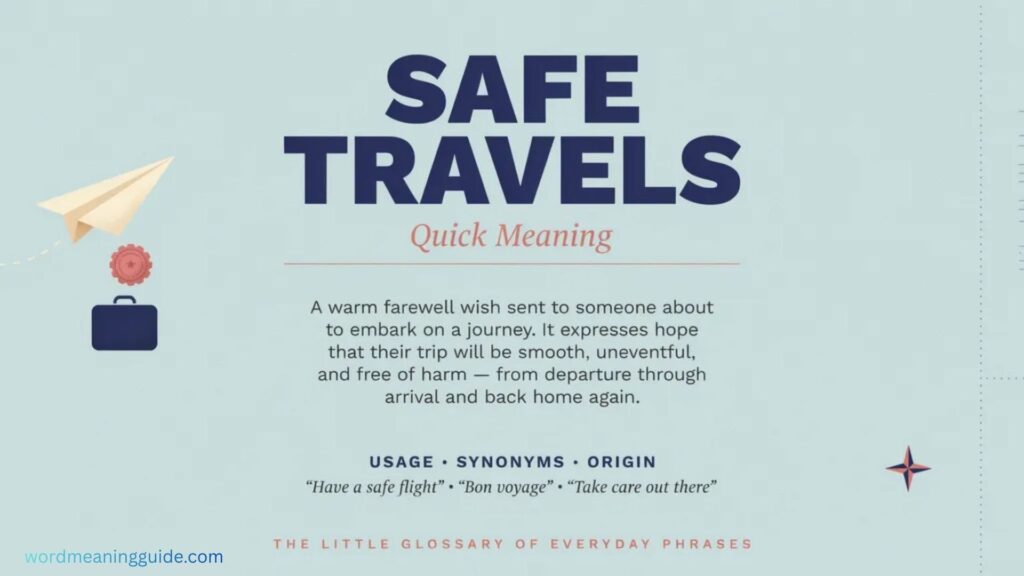
Simple breakdown
At its core, “safe travels” is a short, warm expression used to wish someone a secure and pleasant journey. It combines two ideas in one phrase: a hope for physical safety (no accidents, no danger) and a hope for a smooth, enjoyable experience along the way.
It’s not a question, it doesn’t require a detailed response, and it carries no formal rules. That’s exactly why it has become one of the most popular farewell phrases in modern communication — spoken, typed, or texted.
Quick examples
- “Heading to the airport now, see you in a week!” — “Safe travels! Text me when you land.”
- “Off on our road trip, wish us luck.” — “Safe travels, guys! Drive carefully.”
- A coworker’s email signature reads: “Out of office until Monday. Safe travels, everyone, for the long weekend.”
In each case, the phrase works as a small gesture of care, nothing more, nothing less — but that “nothing more” is actually doing quite a bit of emotional work.
Origin & Background
The phrase “safe travels” draws from a much older tradition of travel blessings. Long before smartphones and group chats, travel was genuinely dangerous. Roads were unpaved, sea voyages were unpredictable, and a journey of even a few days could involve real risk.
Across many languages, travel farewells reflect this history. The French “bon voyage” literally means “good journey.” Many Slavic and Latin-based languages have similar expressions wishing safety, smooth roads, or a guardian’s protection over the traveler. These phrases weren’t just polite — they were almost ritualistic, a way for communities to send loved ones off with a verbal shield against the unknown.
“Safe travels” in English became especially common in the 20th century as commercial air travel, road trips, and long-distance commuting became part of everyday life. As travel grew more accessible but still carried an element of unpredictability (delays, weather, traffic, mechanical issues), people needed a phrase that acknowledged this without sounding dramatic.
Today, in the digital era, “safe travels” has shifted again. It now appears constantly in text messages, social media captions, and comment sections — often detached from any sense of real danger, and instead used as a friendly, almost reflexive sign-off.
Real-Life Conversations
Seeing the phrase in actual conversation contexts makes its tone much clearer than any definition could.
1. WhatsApp Chat
Maya: Just boarded! Flight’s on time for once 🙏
Dev: Nice!! Safe travels, let me know when you land
Maya: Will do ❤️ see you soon
Here, “safe travels” slips in naturally between excitement and reassurance — it’s almost a placeholder for “I care about you and I’ll be thinking about you until I know you’re okay.”
2. Instagram DM
Priya: Heading out for my solo backpacking trip tomorrow!! Nervous but excited
Aisha: That’s amazing, you’re going to have the best time. Safe travels, and send pics!!
Notice how the phrase appears alongside encouragement and curiosity — it’s rarely standalone in casual digital conversations. It’s part of a small bundle of warmth.
Explore More TIA Meaning in Text: What It Really Means in Chats, Social Media, and Daily Conversations
3. Text Message
Mom: Did you pack your charger?
You: Yes mom, I have everything
Mom: Ok good. Safe travels sweetheart, call me when you land no matter how late it is
In family contexts, “safe travels” often carries more weight. It’s less casual and more protective — a parent’s way of saying “I worry about you, and I’ll feel better once I know you’re there.”
Emotional & Psychological Meaning
On the surface, “safe travels” looks like a throwaway phrase. But psychologically, it taps into something deeper: our innate discomfort with uncertainty, especially regarding people we care about.
When someone we love is “in transit,” they exist in a kind of limbo — not where they were, not yet where they’re going. This in-between state can trigger mild anxiety, even subconsciously. Saying “safe travels” is a small ritual that helps both the speaker and the traveler manage that uncertainty.
Psychologists who study communication often note that brief, repetitive social phrases — what linguists call “phatic expressions” — serve a bonding function rather than an informational one. “Safe travels” doesn’t tell the traveler anything they don’t already know (of course they hope their trip is safe). Instead, it signals: I see you. I care about what happens to you. You’re not leaving unnoticed.
This is why even a casual coworker saying “safe travels” before a business trip can feel surprisingly nice — it’s a small acknowledgment of your existence and your journey, even from someone who isn’t deeply invested in your life.
There’s also a subtle element of luck or superstition involved for many people. Even those who don’t consider themselves superstitious sometimes feel a small pull to say “safe travels” before someone leaves, almost as if not saying it might “jinx” the trip. This echoes the ancient travel-blessing traditions mentioned earlier — the instinct to verbally protect a traveler hasn’t disappeared, it’s just been compressed into three casual words.
Usage in Different Contexts
“Safe travels” is remarkably flexible, but its tone shifts depending on where and how it’s used.
1. Social Media
On platforms like Instagram, X (formerly Twitter), and Facebook, “safe travels” often appears in comment sections under travel photos, airport check-ins, or “see you later” posts. Here, it functions almost like a digital wave — quick, public, and slightly performative in a harmless way. It shows engagement without requiring a deep or personal response.
Hashtags like #SafeTravels are also commonly used by travel bloggers, airlines, and tourism boards, reinforcing the phrase as part of travel culture itself.
2. Friends & Relationships
Among friends, “safe travels” is often paired with affection or humor. It might be followed by “don’t do anything stupid,” “bring me back something,” or “miss you already.” In romantic relationships, it can carry a slightly more tender tone, especially before long-distance separations.
3. Work or Professional Settings
In professional contexts, “safe travels” is one of the few emotionally warm phrases that’s still considered completely appropriate. It’s commonly used:
- Before a colleague departs on a business trip
- In email sign-offs ahead of holidays involving travel
- During team meetings before someone heads to a conference
Unlike many casual expressions, “safe travels” doesn’t feel out of place in formal communication. It strikes a balance — friendly without being overly familiar, polite without being cold.
Discover More 45+ Fun Ways to Say Happy New Year That Go Beyond the Ordinary In 2026
4. Casual vs Serious Tone
The same three words can shift dramatically in tone based on context:
- Casual: “Safe travels! Don’t forget your passport this time 😂”
- Serious: “Safe travels. Please text me once you’ve landed, I’ll be worried until then.”
The phrase itself doesn’t change — but the surrounding words, punctuation, and relationship between speakers shape how it lands emotionally.
Common Misunderstandings
Despite how common the phrase is, several misconceptions persist.
1. Thinking It’s Only for Flights
Many people assume “safe travels” applies exclusively to air travel. In reality, it works for any form of transportation — road trips, train journeys, cruises, even a short drive in bad weather. The phrase is about the journey, not the vehicle.
2. Assuming It’s Formal Only
Some assume “safe travels” sounds stiff or overly polite, reserving it for emails and professional settings. But as shown earlier, it’s just as common (and natural) in casual texts between close friends.
3. Overusing It in Non-Travel Situations
Occasionally, people use “safe travels” jokingly for short commutes, like walking to the mailbox or driving five minutes to the grocery store. While this can be funny among friends who enjoy playful exaggeration, using it too often in genuinely non-travel contexts can dilute its meaning and come across as sarcastic when sincerity is intended.
4. Confusing It with “Good Luck”
“Safe travels” and “good luck” are not interchangeable. “Good luck” implies an uncertain outcome requiring success — like a job interview or exam. “Safe travels” simply wishes for safety and smoothness during a process whose outcome (arrival) is generally assumed. Using “good luck” before a routine flight can unintentionally suggest the trip is risky or doubtful, which may cause unnecessary worry.
Comparison Table
| Phrase | Best Used For | Tone | Formality Level |
| Safe travels | Any journey (flight, drive, train) | Warm, caring | Casual to professional |
| Have a safe flight | Air travel specifically | Considerate | Casual to professional |
| Drive safely | Road trips, short drives | Practical, protective | Casual |
| Bon voyage | Longer trips, vacations | Cheerful, slightly formal | Semi-formal |
| Good luck | Uncertain outcomes (not pure travel) | Encouraging | Casual |
| Enjoy your trip | Vacations, leisure travel | Upbeat, positive | Casual |
This table highlights why “safe travels” remains the most versatile choice — it works almost everywhere, for almost anyone, without needing to match a specific mode of transport or relationship type.
Variations / Types
Over time, “safe travels” has branched into several natural variations, each with a slightly different emphasis:
- Safe travels home – used specifically when someone is heading back rather than departing
- Safe travels and happy landings – a playful, aviation-flavored twist
- Safe travels, see you soon – combines the wish with anticipation of reunion
- Safe travels always – often used for frequent travelers or those with demanding travel schedules
These variations show how adaptable the core phrase really is — the structure stays familiar, but small additions personalize it for the specific relationship or situation.
How to Respond When Someone Says “Safe Travels”
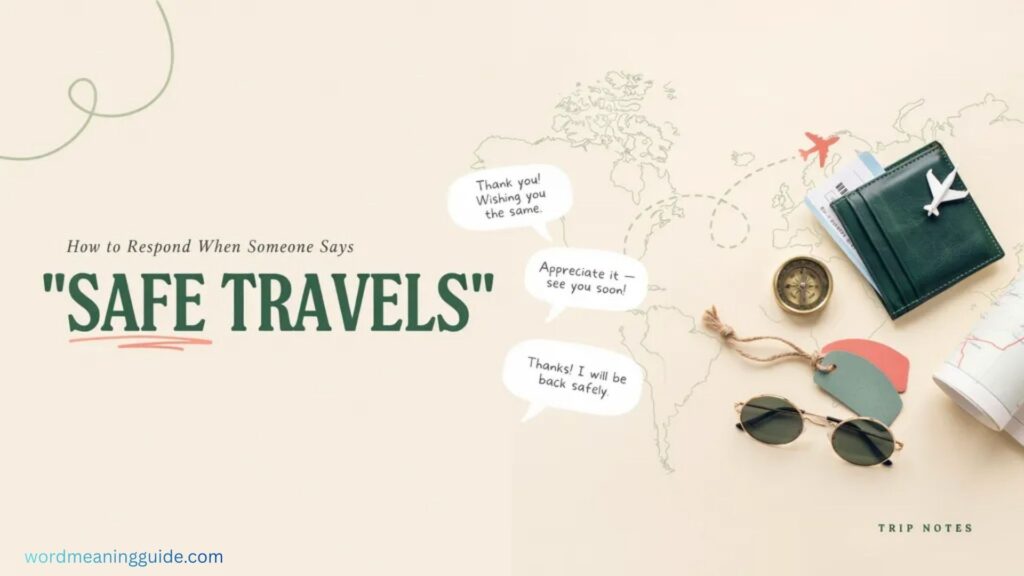
Many people pause for a second when they receive this phrase, unsure whether a response is even necessary. Here’s how to handle it depending on tone.
Casual Replies
- “Thanks! Will do 🙏”
- “Appreciate it! See you soon”
- “Thank you! I’ll try not to get lost lol”
Funny Replies
- “Will do my best not to miss the flight this time”
- “Safe travels to my luggage too, hopefully it makes it”
- “Thanks! Praying the WiFi works on this flight”
Mature / Confident Replies
- “Thank you, I appreciate that”
- “Thanks so much — I’ll check in once I land”
- “That means a lot, thank you”
Private / Respectful Replies
- “Thank you, that’s kind of you”
- “I appreciate you thinking of me”
- “Thanks — safe travels to you too, whenever you’re next on the road”
In most cases, a simple “thank you” is more than enough. The phrase doesn’t demand elaboration — its purpose is acknowledgment, and acknowledging the acknowledgment closes the loop nicely.
Regional & Cultural Usage
Western Culture
In the US, UK, Canada, and Australia, “safe travels” is extremely common and used across all relationship types — family, friends, coworkers, even acquaintances. It’s considered a safe, friendly default farewell whenever travel is involved.
Asian Culture
In many parts of Asia, travel farewells often carry additional layers — wishes for good health, smooth weather, or a return home safely to family. While English equivalents like “safe travels” are widely understood and used (especially among younger, multilingual populations), local languages often have their own deeply rooted travel blessings that emphasize family reunion and protection.
Middle Eastern Culture
In many Middle Eastern cultures, travel farewells are often paired with phrases invoking protection or blessings, reflecting strong traditions of hospitality and care for travelers. “Safe travels” fits comfortably alongside these expressions, especially in English-language or multilingual conversations.
Also Read This 36+ Other Ways to Say “Please Proceed” (With Examples) In 2026
Global Internet Usage
Online, “safe travels” has become something of a universal digital courtesy. Even in multilingual comment sections, English “safe travels” often appears alongside other languages’ equivalents, functioning as a kind of shared, instantly recognizable goodwill phrase — much like “congratulations” or “good morning.”
30 Other Ways to Say “Safe Travels” (With Examples)

What Does “Safe Travels” Mean?
As covered earlier, it’s a warm farewell expressing hope for a secure, smooth journey — applicable to any form of travel and any relationship type.
When to Use “Safe Travels”
Use it whenever someone you know is about to travel — departing for a trip, commuting long distance, heading home, or even just before a long drive. It works as a goodbye, a comment, a text, or part of an email sign-off.
Is It Professional/Polite to Say “Safe Travels”?
Yes. It’s one of the rare phrases that fits comfortably in both casual and professional settings without sounding awkward. Many companies even include it in automated email signatures or team announcements before holidays.
Synonyms For “Safe Travels”
1. Travel Safely
“Travel safely, and don’t forget to charge your phone before the flight.”
2. Have a Safe Trip
“Have a safe trip! Text us when you land.”
3. Enjoy a Safe Journey
“Enjoy a safe journey, and try to get some rest on the train.”
4. Wishing You a Smooth Journey
“Wishing you a smooth journey — hope there’s no traffic on the highway.”
5. Have a Pleasant Trip
“Have a pleasant trip, and say hi to your family for us.”
6. Journey Safely
“Journey safely, my friend, and call when you’re settled.”
7. Hope You Have a Safe Flight
“Hope you have a safe flight — those storm warnings looked scary.”
8. Have a Smooth Flight
“Have a smooth flight, and grab some sleep if you can.”
9. Drive Safely
“Drive safely, the roads might be icy tonight.”
10. Have a Safe Drive
“Have a safe drive, and text me when you’re halfway.”
11. Enjoy Your Trip
“Enjoy your trip — you’ve earned this break!”
12. Bon Voyage
“Bon voyage! Send photos from the coast.”
13. Have a Wonderful Trip
“Have a wonderful trip, you deserve this vacation.”
14. Travel with Care
“Travel with care, and keep your documents handy.”
15. Safe Journey to You
“Safe journey to you, and to everyone heading home for the holidays.”
16. Hope Everything Goes Smoothly
“Hope everything goes smoothly, from check-in to landing.”
17. Have a Comfortable Trip
“Have a comfortable trip — that’s a long flight ahead.”
18. Wishing You Safe Adventures
“Wishing you safe adventures on this backpacking journey.”
19. Take Care on Your Trip
“Take care on your trip, and don’t overpack again.”
20. Get There Safely
“Get there safely, and let us know when you arrive.”
21. Safe Trip Home
“Safe trip home, it was so good seeing you.”
22. Hope You Arrive Safely
“Hope you arrive safely despite the weather warnings.”
23. Travel Well
“Travel well, and rest up before the big meeting.”
24. Best Wishes for Your Journey
“Best wishes for your journey, wherever it takes you next.”
25. Have a Safe and Fun Trip
“Have a safe and fun trip — you deserve both!”
26. Smooth Travels Ahead
“Smooth travels ahead, hopefully no delays this time.”
27. May Your Journey Be Safe
“May your journey be safe, and may you find peace along the way.”
28. Safe and Happy Travels
“Safe and happy travels, see you when you’re back.”
29. Have a Relaxing Journey
“Have a relaxing journey — try to actually unplug this time.”
30. Wishing You Safe Roads Ahead
“Wishing you safe roads ahead on this long drive.”
Frequently Asked Questions
Is “Safe Travels” the Same as “Safe Trip”?
They’re very close in meaning, but “safe travels” tends to sound slightly more universal, while “safe trip” can feel a bit more specific to a single journey or destination. Both are equally acceptable in everyday conversation.
Can I Say “Safe Travels” to Someone I Don’t Know Well?
Yes. It’s neutral and friendly enough to use even with acquaintances, coworkers, or someone you’ve just met — without risking sounding overly familiar.
Is It Okay to Say “Safe Travels” After Someone Already Arrived?
It’s better suited for before or during a journey. Once someone has arrived safely, phrases like “glad you made it” or “welcome home” fit more naturally.
Does “Safe Travels” Apply to Local Trips Too?
While it’s most associated with longer journeys, it can absolutely apply to local trips — especially in bad weather or unfamiliar routes — though for very short distances, it’s sometimes used playfully rather than seriously.
What’s a Good Alternative If I’ve Already Said “Safe Travels” to Someone Recently?
Mixing it up with phrases like “travel well,” “smooth travels ahead,” or “have a safe drive” keeps your message feeling fresh and personal rather than repetitive.
Conclusion
“Safe travels” might be one of the smallest phrases in everyday language, but its impact is far from small. It carries centuries of tradition behind it, condensed into a quick goodbye that fits perfectly into a text message, an email sign-off, or a quiet moment at a departure gate.
What makes it special isn’t complexity — it’s consistency. Across cultures, relationships, and contexts, it reliably communicates one simple truth: someone is thinking of you, hoping you arrive safely, and looking forward to your return. And in a world that moves faster every year, that small reassurance still means something.
So the next time someone you care about is about to leave — whether for a long flight, a short drive, or a journey halfway across the world — those three words remain one of the warmest, simplest things you can say.

Mr. Yaseen is a passionate content creator and language enthusiast dedicated to making words simple and meaningful for everyone. As the author behind WordMeaningGuide.com, he focuses on delivering clear, accurate, and easy-to-understand definitions that help readers improve their vocabulary and communication skills. With a keen eye for detail and a love for language, Mr. Yaseen ensures every piece of content is user-friendly, informative, and valuable for learners of all levels.