Picture this: You’re in a high-stakes business meeting. Your colleague has just finished presenting the first phase of a project plan and looks at you expectantly, waiting for the signal to move forward. You say, flatly, “Please proceed.” The room stays quiet. It works — but does it land?
Language is more than information transfer. The words we choose shape the tone of every interaction, signal our level of formality, and even influence how motivated or respected the other person feels. A phrase as simple as “please proceed” can be the difference between an exchange that feels warm and collaborative and one that feels robotic and cold.
According to communication researchers, the average professional sends and receives well over 120 workplace messages per day. In that volume of language, the phrases we use to give permission, grant approval, or signal readiness carry enormous cumulative weight. They define us as communicators — and they define the culture of our teams.
This guide is your complete resource for finding the right words when you want to say “please proceed.” Whether you’re looking for something more formal, more casual, more empathetic, or more dynamic, you’ll find it here — along with examples, cultural tips, and a breakdown of when each alternative shines.
What Does “Please Proceed” Mean?
At its core, “please proceed” is a polite directive. It tells someone that they have permission, clearance, or encouragement to continue with whatever they were doing or were about to do. The phrase combines the politeness marker “please” with the action verb “proceed,” which carries a slightly formal, often bureaucratic tone.
You might encounter it in aviation (“You are cleared to proceed”), in legal depositions (“Please proceed with your testimony”), in project management meetings, or even in casual conversations where someone pauses mid-sentence and needs a cue to keep going.
The phrase is grammatically clean, unambiguous, and universally understood in English-speaking professional environments. But it isn’t always the most natural or contextually appropriate choice — which is exactly why having a toolkit of alternatives matters so much.
When to Use “Please Proceed”
“Please proceed” earns its place in specific contexts. It works particularly well in formal or semi-formal environments where clarity and brevity are valued. Some of the most common scenarios include:
Formal business or legal settings — When you’re chairing a meeting, leading a deposition, or managing a structured process, “please proceed” conveys authority without being abrupt.
Customer service interactions — When a customer or client is walking you through a problem and pauses, saying “please proceed” signals active listening and encourages them to continue.
Written communication — In emails or formal memos, “please proceed” is clear, concise, and leaves no room for ambiguity.
Process-driven environments — In manufacturing, aviation, medicine, or project management, where each step must be completed before the next begins, “please proceed” functions almost as a command checkpoint.
The phrase becomes less ideal in casual conversations, creative collaborations, or situations where you want to sound warm, encouraging, or peer-like rather than authoritative.
Is “Please Proceed” Polite or Professional?
The short answer: it’s both — but it leans professional over personal.
“Please proceed” has a formal register. The inclusion of “please” softens it from a command to a polite directive, but the verb “proceed” itself is not a word people use in everyday speech. It signals hierarchy, structure, and process. Most people don’t say “please proceed” to a friend; they save it for structured, often professional contexts.
In terms of politeness, it scores reasonably well. It avoids rudeness, acknowledges the other person’s pause, and keeps things moving. But it lacks warmth. It doesn’t convey enthusiasm, encouragement, or connection.
That’s why communication professionals often recommend matching your language to the relationship and context. In a tightly run board meeting, “please proceed” is exactly right. In a one-on-one coaching session, something like “go ahead, I’m listening” may feel far more human and supportive.
Pros and Cons of Using “Please Proceed”
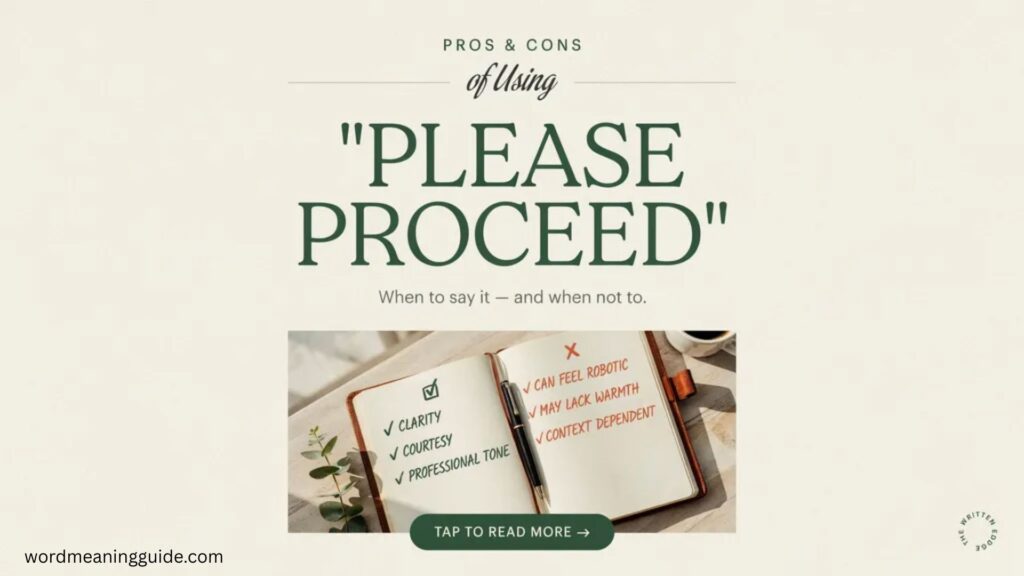
The Pros
Clarity: There is zero ambiguity in the phrase. The listener knows exactly what it means.
Formality: In professional or institutional settings, the formal register conveys seriousness and respect for process.
Conciseness: Two words do a lot of work. It doesn’t pad out communication unnecessarily.
Universality: In global English-speaking workplaces, virtually everyone understands this phrase regardless of regional dialect.
The Cons
Impersonal tone: It can feel cold or mechanical, particularly in contexts that call for human warmth.
Repetitiveness: Hearing the same phrase repeatedly in meetings or written exchanges can make communication feel robotic.
Formality mismatch: In casual or creative environments, it can feel oddly stiff, even a little off-putting.
Limited expressiveness: It gives the green light but nothing more. It doesn’t convey enthusiasm, empathy, or urgency.
Explore more Other Ways to Say “Best Wishes” 57+ Powerful Alternatives That Always Land Right In 2026
When Should You Use These Alternatives?
The goal of using alternative phrases isn’t to abandon “please proceed” entirely — it’s to expand your communication toolkit so you always have the right phrase for the right moment.
Use warmer alternatives like “go ahead” or “feel free to continue” when you’re in collaborative, team-based, or coaching environments. Opt for action-oriented phrases like “you’re cleared to proceed” or “you’re all set” in operational or technical settings. Choose encouraging phrases like “you may begin” or “proceed when ready” when the other person may feel nervous or uncertain. And in casual conversations, simple phrases like “keep going” or “carry on” do the job naturally and naturally.
The key is reading the room — or the inbox. Matching your phrase to the relationship, the context, and the emotional tone of the moment will always produce better outcomes than defaulting to a single formulaic option.
36+ Other Ways to Say “Please Proceed” (With Examples)
1. “You may continue.”
A formal yet slightly warmer alternative that grants permission without sounding overly mechanical.
Example: “Thank you for sharing the background context. You may continue with the proposal.”
Best for: Formal meetings, presentations, depositions.
2. “Go ahead.”
Perhaps the most natural, everyday alternative. It’s casual, direct, and instantly understood.
Example: “You were saying something about the timeline — go ahead.”
Best for: Casual conversations, quick check-ins, informal team interactions.
3. “Feel free to proceed.”
This phrase adds a sense of ease and openness. It implies that there’s no pressure or barrier in the way.
Example: “We’ve covered the prerequisites — feel free to proceed with the demo.”
Best for: Collaborative settings, customer service, onboarding conversations.
4. “Please go ahead.”
A gentle, approachable alternative that maintains the politeness of “please proceed” but sounds more conversational.
Example: “I see you have a question — please go ahead.”
Best for: Customer-facing roles, interviews, professional conversations.
5. “You’re good to continue.”
A reassuring phrase that signals not just permission but also confidence in the person.
Example: “Everything looks correct so far — you’re good to continue.”
Best for: Project check-ins, coaching, quality review processes.
6. “You may move forward.”
Carries the formal tone of “proceed” while using more accessible language.
Example: “The committee has reviewed your application. You may move forward to the next stage.”
Best for: Administrative processes, hiring pipelines, approval workflows.
7. “Please continue.”
A close cousin to “please proceed” — slightly warmer and more conversational while still polite.
Example: “That’s really helpful context — please continue.”
Best for: Meetings, presentations, conversations where someone has paused.
8. “You can proceed now.”
The addition of “now” gives this phrase a sense of immediacy and decisiveness.
Example: “The system has been updated. You can proceed now.”
Best for: Technical processes, IT support, step-by-step workflows.
9. “You’re cleared to proceed.”
Borrowed from aviation language, this phrase conveys authority and precision.
Example: “Security checks are complete — you’re cleared to proceed.”
Best for: Safety-critical environments, security protocols, formal approval processes.
10. “Please move ahead.”
A slightly more dynamic alternative that suggests forward momentum.
Example: “We’re all aligned on the objectives — please move ahead with phase two.”
Best for: Project management, strategic planning sessions.
11. “You may go on.”
Simple and slightly understated. It works well in conversational settings without sounding dismissive.
Also read this 167+Other Ways to Say “Thank You for Your Quick Response” In 2026
Example: “You were explaining the technical setup — you may go on.”
Best for: Interviews, presentations, coaching sessions.
12. “Go ahead and continue.”
Slightly redundant but very natural in spoken English. The doubling reinforces encouragement.
Example: “Don’t worry about the interruption — go ahead and continue where you left off.”
Best for: Casual professional conversations, mentorship settings.
13. “You’re welcome to proceed.”
A hospitable phrasing that makes the listener feel invited rather than simply permitted.
Example: “All materials are ready for your review. You’re welcome to proceed.”
Best for: Client-facing communication, onboarding, service environments.
14. “Please carry on.”
A classic British-English phrase with an air of calm authority and resilience.
Example: “There’s no need to pause on my account — please carry on.”
Best for: Formal British-style professional settings, leadership communication.
15. “You can move ahead now.”
Clear and action-oriented, with the reassuring word “now” signaling readiness.
Example: “The budget has been approved. You can move ahead now.”
Best for: Budget approvals, project launches, administrative decisions.
16. “Please take the next step.”
More specific than “proceed,” this phrase implies a structured process and active engagement.
Example: “You’ve completed the training module. Please take the next step and submit your assessment.”
Best for: E-learning, onboarding processes, structured workflows.
17. “You may begin.”
Clean, formal, and particularly suited to moments where something is about to start rather than resume.
Example: “All participants are ready. You may begin the presentation.”
Best for: Exams, presentations, formal openings.
18. “Please proceed accordingly.”
Adds nuance by implying that the listener should proceed in a specific, contextually appropriate manner.
Example: “The client has confirmed their preferences. Please proceed accordingly.”
Best for: Formal written communication, task delegation, client services.
19. “You can continue from here.”
A handoff phrase — it signals that you’re stepping back and trusting the other person to take it forward.
Example: “I’ve set up the framework. You can continue from here.”
Best for: Delegation, collaboration, mentorship, project handoffs.
20. “Please feel free to continue.”
Combines permission with comfort, making the listener feel relaxed about moving forward.
Example: “There are no more questions at this stage — please feel free to continue.”
Best for: Open-ended presentations, client interactions, team discussions.
21. “You’re all set to proceed.”
Upbeat and reassuring. Signals that everything is in order.
Example: “Your account has been verified — you’re all set to proceed with the purchase.”
Best for: E-commerce, customer service, tech onboarding.
Read More 55+ Creative Alternatives to Say Happy Birthday in English In 2026
22. “You may advance.”
More formal and directional, suggesting progression through stages or levels.
Example: “Your application has been reviewed. You may advance to the final interview.”
Best for: Hiring processes, structured programs, formal evaluations.
23. “Please continue forward.”
Adds a sense of direction and momentum. Slightly more emphatic than “please continue.”
Example: “We’re on track — please continue forward with the implementation.”
Best for: Project management, strategic discussions, leadership communication.
24. “You can take it from here.”
A trust-signaling phrase that empowers the listener.
Example: “I’ve briefed you on everything you need to know — you can take it from here.”
Best for: Leadership, delegation, team empowerment, mentorship.
25. “Proceed when ready.”
Puts the control firmly in the listener’s hands, which can feel respectful and empowering.
Example: “The materials are all available — proceed when ready.”
Best for: Self-paced processes, training, project kickoffs.
26. “Please move on to the next step.”
Highly specific and process-oriented. Works well when you want to ensure sequential progress.
Example: “The first module is complete — please move on to the next step.”
Best for: Training programs, SOPs, formal procedures.
More Quick Alternatives
Sometimes you need a phrase that’s short, punchy, and gets the job done without fanfare. Here’s a curated list of quick alternatives, each suited to slightly different tones and contexts.
Please continue — The closest plain-English cousin to “please proceed.” Natural in almost any professional context.
Carry on — Informal and warm. Particularly common in British English. Works well in both written and spoken communication.
Feel free to start — Welcoming and pressure-free. Great for beginners or nervous presenters.
You’re good to go — Casual and upbeat. Perfect for tech environments, creative teams, and startup cultures.
Please advance — Formal and precise. Useful in structured evaluation or approval processes.
Let’s continue — Collaborative and inclusive. Signals that you’re in this together.
Keep going — Encouraging and conversational. Ideal for coaching or feedback sessions.
Do proceed — Slightly archaic but carries gentle emphasis. More common in written formal communication.
Start whenever you’re ready — Respectful of the listener’s pace. Excellent for high-pressure situations where someone may feel anxious.
Proceed at your convenience — Highly deferential. Best for asynchronous communication or when the listener is a senior stakeholder.
Mini Dialogue Examples
Seeing alternatives in context helps bring them to life. Here are a few quick dialogues illustrating how different phrases work in real situations.
Dialogue 1 — Job Interview
Interviewer: “Could you tell me more about that project?” Candidate: “Of course — where would you like me to start?” Interviewer: “Please go ahead from the beginning.”
Dialogue 2 — Team Meeting
Team lead: “Thanks everyone for the updates. Sarah, you were about to share the Q3 numbers?” Sarah: “Yes, just pulling up the slide now.” Team lead: “Go ahead whenever you’re ready.”
Dialogue 3 — Customer Support Chat
Customer: “So I tried logging in but it keeps saying my password is wrong…” Support agent: “I understand, that sounds frustrating. Please continue — can you tell me what device you’re using?”
Dialogue 4 — Formal Approval Process
Manager (via email): “The compliance review is complete and all documents are in order. You may move forward with the contract signing.”
Dialogue 5 — Coaching Session
Coach: “You were talking about what happened in that meeting — it seemed important.” Coachee: “Yes, I just wasn’t sure if it was relevant.” Coach: “Keep going. Everything is relevant.”
Mistakes to Avoid
Choosing the right phrase is only half the battle. Here are the most common mistakes communicators make when giving the green light — and how to avoid them.
Using the same phrase repeatedly. Saying “please proceed” ten times in a single meeting makes you sound like a recording. Vary your language to keep the interaction feeling alive.
Mismatching register and context. Saying “carry on” in a formal legal proceeding may undermine your credibility. Conversely, “you are cleared to proceed” in a casual team check-in might get a laugh — but not the kind you want.
Adding unnecessary words. Phrases like “please feel free to go ahead and continue forward” are a jumble of good instincts that cancel each other out. Pick one strong phrase and commit to it.
Forgetting tone of voice or writing tone. “Go ahead” said warmly is encouraging; said flatly, it can sound dismissive. In writing, punctuation and sentence context carry that same load. “Go ahead.” (period) reads more curtly than “Go ahead!” or “Go ahead — I’m all ears.”
Using phrases that imply criticism. “You may proceed now” with heavy emphasis on “now” can imply that the person has been wasting time. Be mindful of how timing and emphasis land.
Cultural and Tone Tips
Language is deeply cultural, and the phrase you choose to replace “please proceed” should take into account the background and expectations of your audience.
In British English professional settings, phrases like “please carry on,” “do proceed,” and “you may continue” feel natural and appropriately formal. British workplace culture tends to favour understatement, so warmer or more effusive alternatives may feel excessive.
In American English, more energetic phrases are well-received. “You’re good to go,” “go ahead,” and “you’re all set” suit the generally direct, positive tone of American business culture.
In high-context cultures — such as many East Asian, Middle Eastern, or Latin American business environments — a single phrase rarely carries full meaning. Tone, non-verbal cues, and relationship context shape the message as much as the words themselves. In these settings, pair your phrase with a nod, a smile, or a warm follow-up to ensure the meaning lands as intended.
In written asynchronous communication — emails, project management tools, Slack messages — clarity is king. Phrases like “please proceed accordingly,” “you may move forward,” or “proceed at your convenience” work best here because they leave no room for misinterpretation.
Comparison Table of Best Alternatives
| Phrase | Formality Level | Best Context | Warmth |
| “Please proceed” | High | Formal/legal/institutional | Low |
| “Go ahead” | Low | Casual/team conversations | Medium |
| “You may continue” | High | Meetings/presentations | Medium |
| “Please carry on” | Medium-High | British formal settings | Medium |
| “You’re good to go” | Low | Tech/startup/casual | High |
| “Feel free to proceed” | Medium | Collaborative/service | High |
| “You’re cleared to proceed” | High | Safety/security/ops | Low |
| “Proceed when ready” | Medium | Self-paced/async | High |
| “You can take it from here” | Medium | Delegation/leadership | High |
| “Please proceed accordingly” | High | Written/formal emails | Low |
| “Let’s continue” | Low-Medium | Team collaboration | High |
| “You may begin” | High | Exams/formal openings | Low |
| “Start whenever you’re ready” | Low | Coaching/nervous contexts | Very High |
| “Please take the next step” | Medium | Structured workflows | Medium |
| “Do proceed” | High | Formal written comm. | Low |
Bonus Section: Polite Short Alternatives
When brevity is the priority — in chat messages, quick verbal cues, or time-sensitive situations — these short phrases get the point across with the minimum of words:
- “Go on.” — Encouraging and simple.
- “Continue.” — Authoritative but not rude when used in context.
- “Proceed.” — Formal one-word option.
- “Carry on.” — Classic and calm.
- “Begin.” — Use when something is starting fresh.
- “Ahead.” — Very minimal; suits operational settings.
- “Sure, go ahead.” — Adds warmth with “sure.”
- “Absolutely, please continue.” — Enthusiastic and warm.
- “You’re up.” — Casual, used when it’s someone’s turn.
- “Off you go.” — Playful; suits creative or informal environments.
Frequently Asked Questions
Is “please proceed” too formal for everyday use?
It can be, depending on your context and audience. In highly casual or conversational settings, “please proceed” may feel overly stiff. Alternatives like “go ahead,” “carry on,” or “feel free to continue” strike a more natural balance for everyday communication.
What is a professional synonym for “please proceed” in an email?
“Please proceed accordingly,” “you may move forward,” and “please continue” are all excellent choices for professional email contexts. They maintain a formal tone while being clear and direct.
How do I politely tell someone to continue talking?
Phrases like “please go ahead,” “feel free to continue,” “you may go on,” or even a simple nod-and-“go ahead” signal both permission and attentive listening. The key is pairing the phrase with body language or punctuation that communicates engagement.
What does “proceed accordingly” mean?
“Proceed accordingly” means to move forward in a manner that fits the situation, context, or previously discussed guidelines. It implies that the listener already knows what is expected and should act based on that understanding.
What are some encouraging alternatives to “please proceed”?
For encouragement-focused contexts, try “start whenever you’re ready,” “go ahead — I’m all ears,” “you can take it from here,” or “proceed at your convenience.” These phrases give permission while also expressing trust and support.
Can I use “carry on” in formal writing?
“Carry on” leans informal to semi-formal and is more common in British English than American English. In formal written communication such as legal documents or official correspondence, “please continue” or “please proceed” are safer choices.
What’s the difference between “proceed” and “continue”?
Both words mean to move forward, but “proceed” often implies starting or resuming a formal process, while “continue” simply means to keep going. “Proceed” is slightly more formal and is often used in institutional or procedural contexts. “Continue” feels more natural in conversation.
How do I tell someone to move to the next step politely?
“Please take the next step,” “please move on to the next step,” “you may advance,” and “you can continue from here” all work well. For added warmth, try “you’re all set — please move ahead whenever you’re ready.”
Conclusion:
Language is a living thing. The way we invite others to continue — the permission we give, the green light we extend — says as much about us as it does about the task at hand. A phrase as simple as “please proceed” can be delivered in dozens of ways, each carrying its own register, warmth, and meaning.
The best communicators aren’t those who know the most words. They’re those who know which word to use, in which moment, with which person. Whether you opt for the confident clarity of “you’re cleared to proceed,” the collaborative warmth of “let’s continue,” or the quiet trust of “you can take it from here,” you’re making a deliberate choice to shape the interaction for the better.
Keep this guide close. Build your phrase toolkit. And next time someone pauses mid-thought, mid-presentation, or mid-process and looks to you for a cue — give them the one that truly fits the moment.
Because sometimes, the difference between a good conversation and a great one is just the right three words.

Mr. Yaseen is a passionate content creator and language enthusiast dedicated to making words simple and meaningful for everyone. As the author behind WordMeaningGuide.com, he focuses on delivering clear, accurate, and easy-to-understand definitions that help readers improve their vocabulary and communication skills. With a keen eye for detail and a love for language, Mr. Yaseen ensures every piece of content is user-friendly, informative, and valuable for learners of all levels.