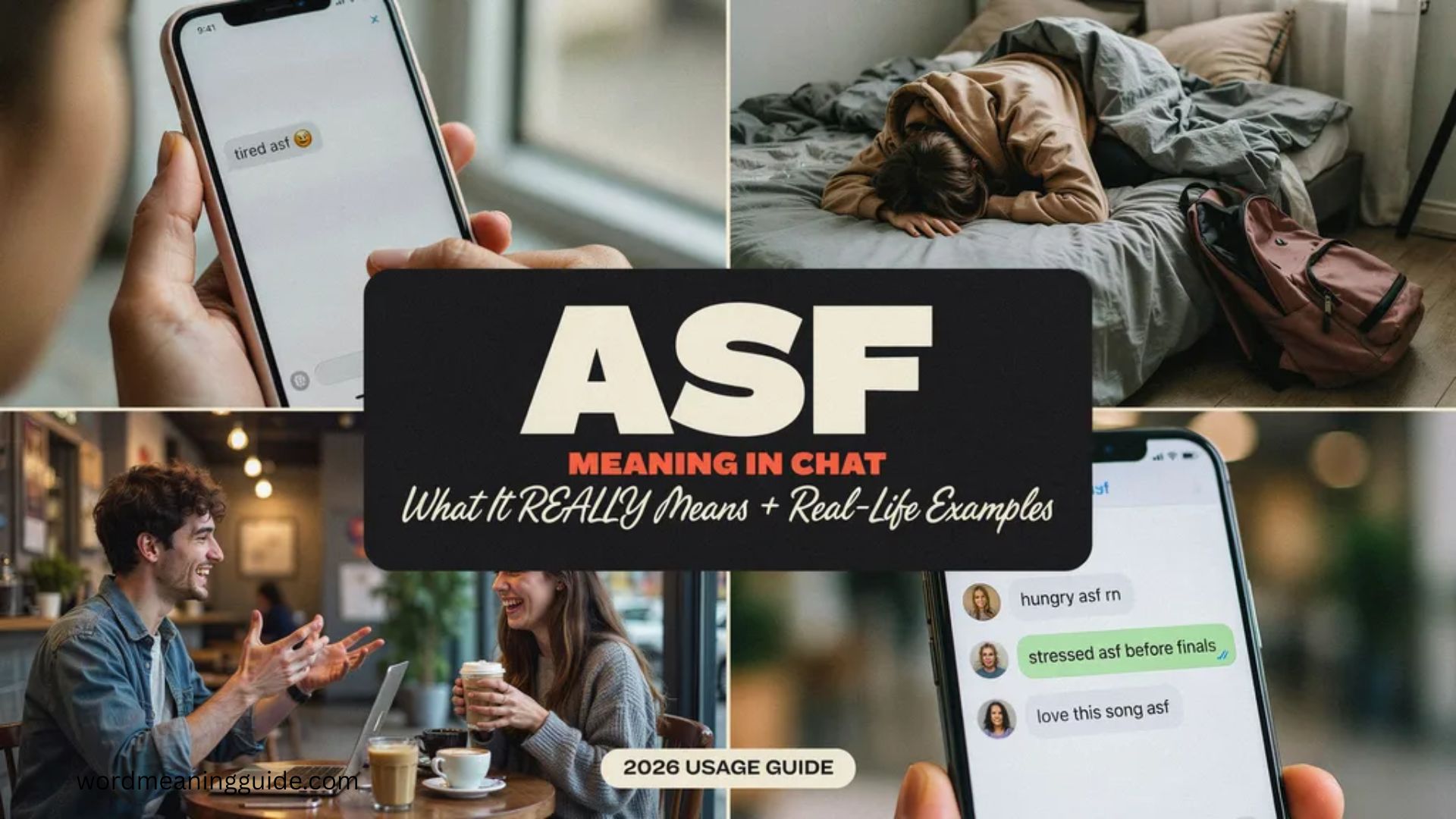
You’re scrolling through Instagram comments and someone writes, “This song is fire ASF.” Your friend texts you at midnight: “I’m tired ASF, can we reschedule?” A TikTok creator captions their video: “This recipe is easy ASF — try it tonight.”
And you pause. You know what it probably means. But do you really know what ASF means in chat, where it came from, when it’s appropriate, and when it could actually get you in trouble?
You’re not alone if you’ve been quietly piecing this together from context clues. Internet slang evolves so fast that even native English speakers sometimes feel left behind. According to a 2023 survey by YouGov, over 63% of adults over 35 admitted they regularly encounter digital slang they don’t fully understand — and ASF is near the top of that list.
This guide is your definitive, no-fluff resource on ASF. We’ll cover its meaning, emotional weight, real-life usage, hidden risks, regional differences, and even how to respond when someone uses it on you. Whether you’re a curious parent, a new social media user, or just someone who wants to use slang correctly — you’re in the right place.
ASF Meaning in Chat — Quick Answer
ASF stands for “As Fk.”**
It’s an intensifier — a word or phrase used to amplify the adjective that comes before it. In simple terms, ASF is the digital equivalent of saying “extremely,” “incredibly,” or “very, very much.”
Think of it this way: instead of saying “That was funny,” you say “That was funny ASF.” It punches the statement up. It makes it louder, more expressive, more you.
The “F” word at the end is implied and understood by virtually everyone in online spaces. This is what makes ASF both powerful and potentially problematic — it carries the weight of profanity without spelling it out in full.
Simple Explanation With Everyday Examples
Here are some clean, easy examples to illustrate how ASF works in natural conversation:
- “This pizza is good ASF.” → This pizza is extremely good.
- “I’m bored ASF right now.” → I’m incredibly bored.
- “She was rude ASF to me.” → She was extremely rude.
- “That movie was scary ASF.” → That movie was very, very scary.
- “He’s talented ASF.” → He’s incredibly talented.
The formula is straightforward: Adjective + ASF = Intensified Adjective. It’s clean, punchy, and gets the message across in seconds — which is exactly why it’s thrived in fast-paced digital communication.
Origin & Background: Where Did ASF Come From?
Language scholars and digital culture researchers trace ASF back to African American Vernacular English (AAVE), the same linguistic tradition that gave the internet phrases like “lowkey,” “on fleek,” “bussin,” and “no cap.” AAVE has been one of the most fertile sources of modern internet slang, shaping how millions of people communicate online.
The phrase “as f**k” itself predates the internet — it was widely used in spoken Black American slang throughout the 1990s and early 2000s. As social media platforms emerged, especially Twitter (now X), Tumblr, and later Instagram and TikTok, the phrase got abbreviated into the now-iconic “ASF.”
By the mid-2010s, ASF had fully crossed over into mainstream internet culture. It appeared in memes, comment sections, text messages, and eventually even song lyrics. Rappers and hip-hop artists played a massive role in popularizing both the full phrase and its abbreviated form, embedding it into the global vocabulary.
Today, ASF is used by people of all backgrounds and age groups — though it remains most common among Gen Z and younger Millennials (ages roughly 15 to 30). A 2024 study on digital communication trends noted that intensifier slang like ASF had increased in usage by over 180% across social media platforms between 2018 and 2023.
Real-Life Conversations (With Full Context)
Understanding slang in isolation is one thing. Seeing it in action is another. Here are authentic-style examples from different platforms.
WhatsApp Chat
Zara: Are you coming to the party tonight? Mia: Idk, I’m tired ASF. Might just stay in. Zara: Come on!! It’s gonna be fun ASF trust me Mia: Okay FINE. But I’m leaving early lol
In this exchange, both speakers use ASF to emphasize emotional states — exhaustion and anticipated fun. It flows naturally and carries no negative connotation.
Instagram DMs
@user1: bro your edit is clean ASF 😭🔥 @user2: LMAOOO thank you, I spent like 3 hours on it @user1: it shows fr, you’re talented ASF no cap
Here, ASF is used as genuine praise. Phrases like “talented ASF” and “clean ASF” are compliments, not insults. The tone is enthusiastic and affirming.
TikTok Comments
@commenter: this tutorial is helpful ASF!! finally someone explained it right @commenter2: easy ASF once you know the trick lol @creator: aww thank you guys!! means a lot ASF 💕
TikTok is perhaps the most natural habitat for ASF. It appears in both praise and casual reaction — even the creator uses it in a self-aware, playful way.
Text Messages
Jake: Dude I just failed my driving test again Leo: Noooo that’s unlucky ASF bro 😭 Jake: I know I’m embarrassed ASF Leo: Nah don’t be. Just practice more you’ll get it
Notice how ASF here carries empathy. “Unlucky ASF” isn’t mocking — it’s validating. This is a nuanced emotional use of the term that often gets overlooked.
Emotional & Psychological Meaning
ASF isn’t just a grammatical intensifier. It’s an emotional signal.
When someone says they’re “tired ASF,” they’re not just communicating a physical state — they’re telling you the intensity of that feeling. They want you to feel how tired they are. It’s a bid for connection, for understanding, for a response that matches their energy.
This is actually backed by communication psychology. Dr. Sherry Turkle, a leading researcher in digital communication at MIT, has noted that digital slang often compensates for the absence of tone, facial expressions, and body language in text-based conversations. Slang intensifiers like ASF help fill that emotional gap.
What It Reveals About Mindset
- High expressiveness: People who use ASF tend to communicate with intensity. They don’t do understatement.
- Comfort with informality: Using ASF signals that someone is relaxed, informal, and treating the conversation as a safe space.
- Cultural fluency: Using internet slang correctly — especially slang with AAVE roots — signals awareness of digital culture.
- Youth-oriented identity: It often signals alignment with younger generational communication norms, whether or not the speaker is actually young.
Hidden or Offensive Meanings of ASF
Here’s where things get a little more complicated.
While ASF is predominantly used as an intensifier, context matters enormously. Because the “F” word is embedded in the abbreviation, ASF technically counts as implied profanity — and that can create friction in several situations.
Additionally, ASF can occasionally be found in more explicit or aggressive slang contexts online. In certain communities, particularly in competitive gaming, aggressive comment sections, or heated arguments, ASF can appear in phrases that are outright hostile — “You’re annoying ASF” or “That’s dumb ASF” — where the intent shifts from neutral intensification to actual insult.
The word itself doesn’t change. The intent and the adjective it’s attached to determine whether it’s friendly banter or a verbal attack.
When ASF Can Be Problematic
ASF is not universally safe to use. Here are the main risk zones:
1. Around older adults who aren’t digitally fluent. Someone’s grandmother reading a family group chat that says “Thanksgiving was chaotic ASF this year” may be confused, offended, or both.
2. In professional or academic settings. More on this below — but briefly, using ASF in a work email or formal report can undermine your credibility instantly.
3. In cross-cultural communication. Not everyone globally understands what ASF means, and the implied profanity can be misread or mistranslated.
4. When paired with negative adjectives directed at a person. Calling someone “stupid ASF” or “ugly ASF” is genuinely offensive, regardless of any slang defense.
Safe vs Risky Usage
| Situation | Safety Level | Notes |
| Texting close friends | ✅ Very Safe | Natural, expected, no issues |
| Instagram / TikTok comments | ✅ Safe | Standard usage, widely understood |
| WhatsApp with family (mixed ages) | ⚠️ Use Caution | Older relatives may be confused |
| Work Slack (casual team) | ⚠️ Use Caution | Depends on company culture |
| Professional email | ❌ Avoid | Unprofessional, risks credibility |
| Academic writing | ❌ Never | Completely inappropriate |
| Directed as insult at someone | ❌ Avoid | Can constitute harassment |
Usage in Different Contexts
1. Social Media
This is ASF’s home turf. On platforms like TikTok, Instagram, Twitter/X, and Snapchat, ASF appears constantly and without friction. It’s embedded in the visual-verbal shorthand of modern content culture. Creators use it in captions, comments, and bios.
“New video is up — editing was hard ASF but worth it 💪”
2. Friends & Relationships
Between close friends, romantic partners, or tight-knit social groups, ASF functions like a warmth signal. It’s informal, expressive, and intimate in a low-key way. Saying “I missed you ASF” carries more emotional punch than simply “I missed you.”
3. Work or Professional Settings
This is where ASF becomes a liability. Most workplaces — even casual ones — operate with a layer of professional decorum that ASF violates. Even in start-up culture where Slack DMs are casual, ASF can read as immature to senior colleagues or external stakeholders.
4. Casual vs Serious Tone
ASF is almost always a casual-register word. It softens serious statements and amplifies light ones. It signals I’m not being formal right now — which is exactly right for casual chats, but wrong for serious, sensitive, or formal conversations.
ASF in Professional Communication
Why ASF Is Risky at Work
Workplaces are built on perception. Using slang that contains implied profanity — even abbreviated — can make you seem unprofessional, immature, or careless about how your words land. This is especially true in client-facing communication, performance reviews, or any written documentation.
Imagine a professional email that reads: “The project was challenging ASF but the team delivered.” Even if your manager is 28 and texts ASF to their friends, receiving it in a work context creates cognitive dissonance. It signals a failure to read the room.
Better Alternatives in Professional Settings
| Instead of… | Try… |
| “Tired ASF” | “Completely exhausted” |
| “Difficult ASF” | “Extremely challenging” |
| “Happy ASF about this” | “Genuinely thrilled” |
| “Clean ASF design” | “Incredibly polished design” |
Strong vocabulary is actually more impressive than slang in professional contexts — and it demonstrates range.
Why ASF Is Popular in Dating Chats
Romance and digital flirtation have their own dialect, and ASF has carved out a meaningful space in it. Dating apps like Tinder, Bumble, and Hinge are conversational platforms where personality comes through fast or not at all. ASF helps people project energy, humor, and relatability quickly.
“Your taste in music is good ASF” is more charming than “I like your music taste.” The slang adds personality. It signals cultural awareness. It communicates that you’re cool, relaxed, and fun to talk to.
A 2022 OkCupid data report found that people who used expressive, informal language in early conversations had higher response rates than those who used overly formal tones. Slang signals approachability.
Tips for Using ASF in Dating Chats
- Use it when complimenting something specific: “Your bio is funny ASF.”
- Don’t overuse it — once or twice per conversation feels natural, more than that feels try-hard.
- Mirror the other person’s energy. If they’re using slang freely, you can too. If they’re more formal, hold back.
- Never use it in a way that could sound like an insult, even playfully.
Common Misunderstandings About ASF
1. Thinking It’s Always Offensive
It’s not. ASF is profanity-adjacent, not profanity itself. The full phrase is implied, not written. Most people — especially younger users — don’t read it as offensive in casual contexts at all.
2. Misreading Tone
“That’s weird ASF” can be said with affection or with contempt depending on the relationship and context. Don’t assume hostility unless other signals support it.
3. Using It Everywhere
Some people overuse ASF in a way that dilutes its impact. When everything is “good ASF,” the intensification loses power. Use it where it actually adds emphasis.
4. Assuming Older Audiences Understand It
Even digitally active people over 45 often don’t recognize ASF immediately. Don’t assume comprehension based on age or tech-savviness alone.
Comparison Table: ASF vs Similar Slang
| Slang | Full Meaning | Tone | Appropriate For |
| ASF | As F**k | Casual, expressive | Texts, social media |
| AF | As F**k | Same as ASF | Same as ASF |
| TBH | To Be Honest | Reflective, sincere | Most informal settings |
| NGL | Not Gonna Lie | Candid, casual | Texts, comments |
| FR | For Real | Agreement, emphasis | Very casual |
| LOWKEY | Secretly/Somewhat | Understated | Most informal settings |
| DEADASS | Seriously/Truly | Intense, assertive | Casual, mostly urban slang |
Key Insight
ASF and AF are functionally identical — “ASF” and “AF” both mean “as f**k.” Some users prefer ASF because it sounds more phonetically complete when read aloud. Others use AF out of habit or preference. Neither is more correct than the other.
Variations and Related Forms
Language never stays still. ASF has spawned and coexists with several variations:
- AF — The original abbreviation; interchangeable with ASF
- As hell — A tamer, non-profane alternative: “tired as hell”
- As anything — Very informal British variant
- ASF fr fr — “As f**k, for real for real” — double intensification for extreme emphasis
- Lowkey ASF — A contradiction that’s become a phrase: “secretly extremely,” meaning more than I’m willing to fully admit
- Highkey ASF — The opposite: openly and extremely
These variations show how living slang evolves. Users mix, layer, and remix these terms to create more nuanced expression.
How to Respond When Someone Uses ASF
Sometimes you receive a message with ASF and you’re not sure how to reply in kind. Here’s a quick guide.
Casual Replies
- “Fr fr, same energy 😭”
- “Bro I felt that lol”
- “That’s so valid tbh”
Funny Replies
- “ASF?? You good?? 💀”
- “Okay dramatic but fair”
- “Same honestly I’m barely surviving”
Mature / Confident Replies
- “Yeah, it really was — no exaggeration.”
- “I hear you. That sounds like a lot.”
- “Honestly same, it’s been a week.”
Private or Respectful Replies (When the Slang Feels Off)
If someone uses ASF in a way that feels too casual for your relationship or comfort level, you can simply respond at your own register without matching their slang. You don’t have to mirror their language. Healthy communication means expressing yourself, not performing.
Regional & Cultural Usage
ASF didn’t spread equally around the world. Its reception and usage vary significantly by region and culture.
Western Culture (US, UK, Canada, Australia)
ASF is widely understood and used, particularly among anyone under 35 with regular social media exposure. In the US especially, it’s essentially mainstream slang at this point. The UK has embraced it through TikTok culture, though British slang variants sometimes compete with it.
Asian Culture (East & Southeast Asia)
In countries like the Philippines, Indonesia, and Malaysia — where English social media use is very high among young people — ASF appears frequently. It’s been adopted naturally into local digital communication styles, often mixed with native language phrases. In Japan and South Korea, it appears mostly among users who heavily consume English-language content.
Middle Eastern Culture
In countries like Saudi Arabia, UAE, Egypt, and Lebanon, ASF has gained traction among younger, English-fluent social media users. However, given cultural sensitivities around profanity — even implied — ASF is used more cautiously here. Many users are aware of the F-word embedded in the abbreviation and reserve ASF for close friendships only.
Global Internet Usage
Broadly speaking, ASF follows the spread of TikTok and Instagram. Wherever these platforms dominate youth culture, ASF tends to follow. It’s a genuinely global slang term now — though cultural comfort with implied profanity shapes how freely it’s used in each region.
Frequently Asked Questions
What does ASF mean in a text message?
ASF in a text message means “As F**k” — it’s an intensifier used to amplify the strength of whatever adjective precedes it. If someone texts you “I’m happy ASF,” they mean they’re extremely happy.
Is ASF the same as AF?
Yes, ASF and AF are functionally identical slang terms. Both stand for “As F**k.” Some people prefer ASF because it reads more completely; others use AF out of habit. Either is correct in casual conversation.
Is it okay to use ASF at work?
Generally, no. ASF is informal and contains implied profanity. Even in casual workplaces, using ASF in written communication — especially emails, reports, or client messages — can come across as unprofessional. Save it for personal conversations.
Where did ASF come from?
ASF evolved from AAVE (African American Vernacular English) and became widely adopted through hip-hop culture, social media platforms, and the general growth of internet slang throughout the 2010s.
Can ASF be offensive?
It depends on context. ASF itself is not inherently offensive, but because it contains implied profanity and can be paired with negative adjectives directed at a person, it can become offensive in the wrong context. The adjective and intent matter as much as the slang itself.
What’s a polite alternative to ASF?
If you need to express extreme intensity without implied profanity, try: “extremely,” “incredibly,” “genuinely,” “deeply,” “beyond words,” or “as anything.” These carry similar meaning without the language risk.
Do people over 40 understand ASF?
Some do, especially those who are active on social media or have younger family members. But many don’t immediately recognize it. If you’re communicating with older adults, it’s safer to use standard language rather than slang like ASF.
Is ASF used globally?
Yes, but with varying frequency. It’s most common in North America and among English-speaking youth globally. It appears across social media worldwide, particularly wherever TikTok and Instagram culture thrives.
Conclusion:
ASF tells you something is a lot. It tells you the speaker wants you to feel the intensity of their experience. It’s an act of expressiveness, of connection, of wanting your words to land with the full weight of what you feel.
That said, like all powerful tools, it requires context, judgment, and awareness. Using ASF in the right place — a casual text, a fun comment section, a flirty DM — adds color and personality. Using it in the wrong place — a job application, a formal email, a message to someone unfamiliar with modern slang — can create real misunderstanding.
The most fluent communicators aren’t those who use the most slang or the least. They’re the ones who know when to use which — who can slide between registers with ease and connect with whoever they’re talking to, wherever they are.
Now you know ASF inside and out. Use it well.

Mr. Yaseen is a passionate content creator and language enthusiast dedicated to making words simple and meaningful for everyone. As the author behind WordMeaningGuide.com, he focuses on delivering clear, accurate, and easy-to-understand definitions that help readers improve their vocabulary and communication skills. With a keen eye for detail and a love for language, Mr. Yaseen ensures every piece of content is user-friendly, informative, and valuable for learners of all levels.