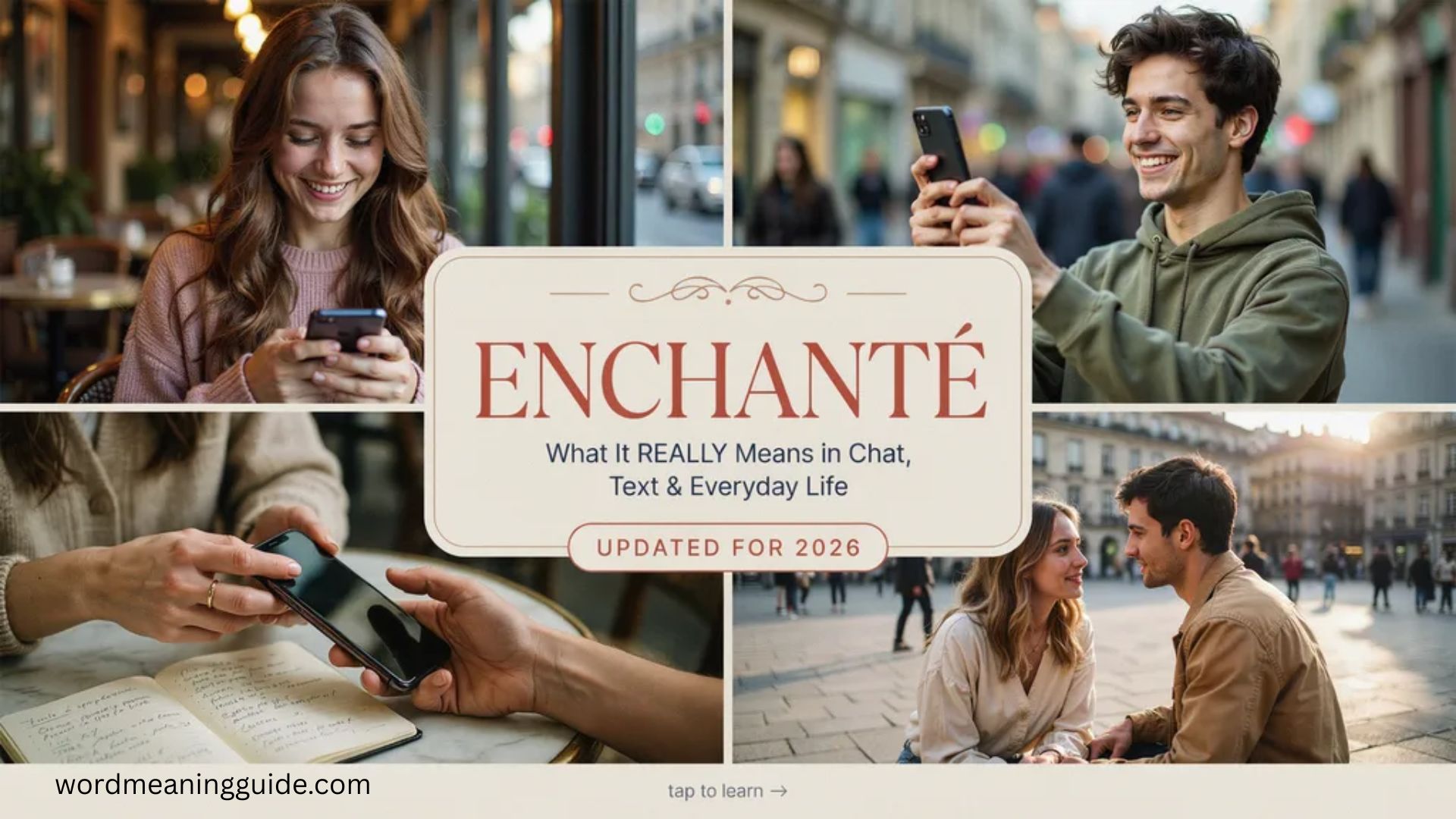
Picture this: You’re scrolling through a text thread or a social media DM when someone replies with “Enchanté!” and you pause, unsure whether they’re being sophisticated, flirtatious, or just plain showing off. You’re not alone. Thousands of people search for the meaning of this elegant little word every single month — because it carries so much more than its dictionary definition suggests.
Whether you’ve seen it in a period drama, heard it in a French café, or spotted it in a chat message from a friend who just got back from Paris, “Enchanté” has a magnetic quality that makes you want to understand it more deeply. It whispers of old-world charm while slipping effortlessly into modern digital conversations.
This guide covers everything — from the basic definition of Enchanté and its roots in the French language to how it’s used in casual texts, formal greetings, pop culture, and social media in 2025. By the time you finish reading, you’ll not only know exactly what Enchanté means, but you’ll also know when and how to use it confidently and correctly. Let’s dive in.
What Does “Enchanté” Mean in Chat or Text?
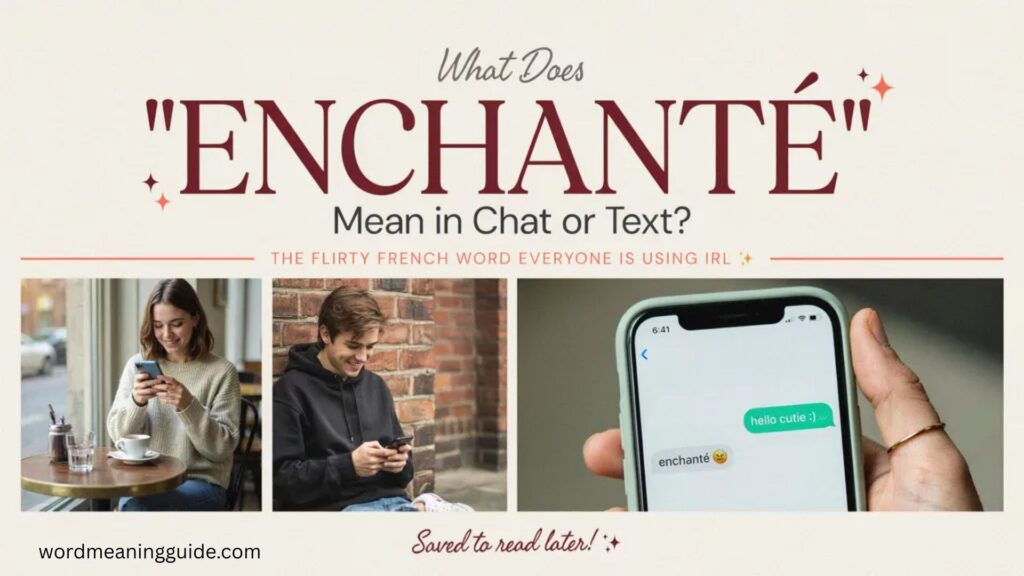
In the world of modern messaging and social media, “Enchanté” carries a layered meaning that blends classical French etiquette with contemporary digital expression.
At its most basic level, when someone types “Enchanté” in a chat or text, they are saying “Enchanted to meet you” or simply “Pleased to meet you.” It functions as a charming, slightly formal — but also playful — way to introduce oneself or to acknowledge a new connection.
However, in online spaces, the word has evolved. People increasingly use “Enchanté” as a stylish, tongue-in-cheek greeting that signals cultural awareness, a love of languages, or even a bit of theatrical flair. Think of it as the digital equivalent of kissing someone’s hand rather than shaking it.
It’s also frequently used ironically. Someone might type “Enchanté, I’m sure” to sarcastically greet an introduction they find unimpressive — playing on the word’s connotation of being truly delighted. Context, as always, is everything.
In short, in chat and text, “Enchanté” can mean:
- A sincere, warm introduction (“Pleased to meet you”)
- A stylish, culturally aware greeting
- A playful or ironic acknowledgment
- A flirtatious opener in romantic contexts
Understanding which meaning is intended requires reading the tone of the conversation around it — and this guide will help you do exactly that.
How People Use “Enchanté” in Real Conversations
The usage of Enchanté in real conversations — both in-person and digital — is far more nuanced than simply saying “nice to meet you.” People deploy this word with purpose, personality, and occasionally a dash of humor.
In romantic or flirtatious contexts, “Enchanté” is one of the smoothest openers in the book. When a person says or writes “Enchanté” while meeting someone they find attractive, it signals not just politeness but genuine delight. There’s a reason romance novels and films set in Paris feature the word so prominently — it carries a warmth and sincerity that plain English equivalents like “nice to meet you” simply don’t replicate.
In professional or networking settings, using “Enchanté” can signal sophistication and cultural literacy. At a business event, especially one with an international crowd, dropping a well-timed “Enchanté” can make an introduction feel memorable rather than forgettable.
In casual friendship groups, the word often gets used humorously. Friends might greet a mutual connection with an exaggerated “Enchanté!” as a running joke, leaning into the theatrical nature of the word to lighten the mood and get a laugh.
In digital communities — Discord servers, Twitter/X threads, group chats — “Enchanté” sometimes replaces “hey” or “nice to meet you all” as a witty, personality-driven greeting. It’s the kind of introduction that makes people smile and immediately signals that you’re someone worth talking to.
Explore More 35+ Other Ways to Say “Please Be Advised” (Formal, Informal & Professional Alternatives 2026 updated)
Language experts note that borrowing single expressive words from French is a well-established tradition in English communication. The word “Enchanté” sits comfortably in this tradition, functioning as what linguists sometimes call a “prestige borrowing” — a word adopted from another language precisely because it carries a sense of elegance or cultural cachet that the native language struggles to replicate in a single term.
Real-Life Examples of “Enchanté” in Text Messages
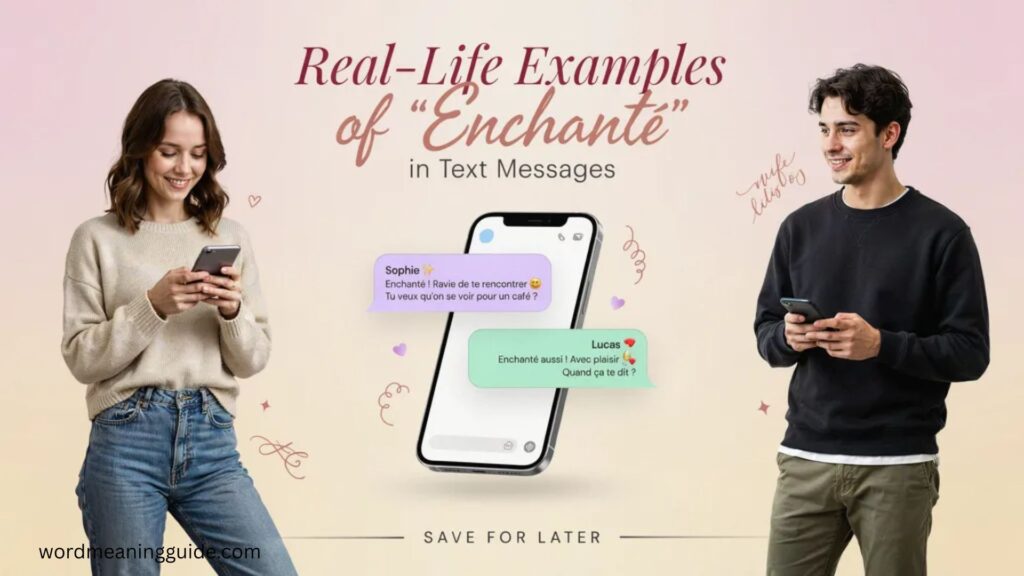
Seeing a word used in real examples is often the fastest path to understanding it. Here are several authentic-feeling scenarios in which “Enchanté” appears naturally in modern text communication:
Example 1 — A new introduction:
Friend A: “Hey, I want you to meet my colleague Layla. She’s brilliant.” Layla: “Enchanté! I’ve heard so much about you.”
Here, Layla uses the word as a warm, slightly elevated version of “pleased to meet you.” It immediately establishes her as someone with personality and culture.
Example 2 — A flirtatious exchange:
Message: “So you’re the one who’s been stealing everyone’s attention at these meetings.” Reply: “Guilty. Enchanté, by the way — I realize we’ve never been formally introduced.”
The word here carries both politeness and a flirtatious undertone. It turns a simple introduction into something memorable.
Example 3 — Ironic or humorous usage:
Group chat: “Everyone, this is Dave. He once microwaved fish in the office.” Dave: “Enchanté, obviously.”
The ironic use here is clear — Dave is self-deprecatingly aware that his introduction isn’t exactly glamorous, so he leans into the fanciness of “Enchanté” for comic effect.
Example 4 — Online community introduction:
Discord server post: “New member just joined! Say hi to @MarcellaB!” MarcellaB: “Enchanté, everyone! Happy to be here.”
In this digital context, the word functions as a charming alternative to the standard “hi everyone!” and helps Marcella immediately stand out as someone with a distinctive voice.
Example 5 — Texting a new contact:
First text: “Hey! Got your number from Alex. I’m Jordan.” Reply: “Enchanté, Jordan. Alex speaks very highly of you.”
This usage is polished and warm, transforming what could be an awkward first text into something graceful.
Common Mistakes and Misunderstandings
Despite its elegance, “Enchanté” is frequently misused, misunderstood, and mispronounced. Knowing the pitfalls helps you use it confidently.
Mistake 1: Using it as a general expression of happiness Some people mistakenly use “Enchanté” to mean “I’m enchanted by this idea” or “this is enchanting,” treating it as a generic adjective. In reality, Enchanté as a greeting is specifically tied to meeting someone — it’s not interchangeable with “I’m delighted” in all contexts.
Mistake 2: Using only the masculine form with everyone In formal French, “Enchanté” is the masculine form. Women speaking French would traditionally say “Enchantée” (with an extra ‘e,’ though the pronunciation is identical). In English text conversations, this distinction is often dropped entirely — and that’s perfectly fine. But if you’re using it in a French-language context or with someone who speaks French fluently, being aware of the gendered form shows you’ve done your homework.
Mistake 3: Overusing it “Enchanté” works precisely because it’s distinctive. Using it in every single introduction quickly strips it of its charm. Like a great perfume, a little goes a long way.
Mistake 4: Using it sarcastically without context Ironic use can be hilarious — but only when the context makes the irony clear. Sending a standalone “Enchanté” in a text to someone you’ve known for years who suddenly needs something from you could easily be misread as either sweet or passive-aggressive. If you’re going for humor, add a winking emoji or a follow-up line to land the joke.
Mistake 5: Assuming it’s pretentious Some people hesitate to use “Enchanté” because they fear it will come across as showy or pretentious. In reality, most people receive it as charming and warm — especially in a world where so much digital communication has been flattened into “lol” and “np.” A well-placed “Enchanté” tends to be received as refreshing rather than pompous.
Discover More Other Ways to Say Emotional Intelligence: Formal, Informal & Professional Alternatives In 2026
Related Slangs and Abbreviations
If you enjoy the warmth and personality of “Enchanté,” you’ll likely appreciate these related expressions and linguistic cousins:
Ravi(e) de vous rencontrer — The fuller French phrase meaning “delighted to meet you.” Enchanté is the shorthand version of this sentiment.
Bonjour — The classic French hello, often paired with Enchanté in introductions.
Enchanted — The direct English equivalent. Less common as a standalone greeting in English, but you’ll occasionally see it in literary or theatrical contexts.
Charmed — A close English analogue. “Charmed, I’m sure” was a fashionable greeting in mid-20th century English speech and remains charmingly retro today.
Pleased to meet you — The standard English equivalent, but considerably less elegant.
It’s a pleasure — Another formal English alternative, often used in professional settings.
Ravished — Occasionally misused as a synonym (it actually means overwhelmed, typically in a more intense sense). Avoid this substitution.
Delighted — A warm, formal English synonym for the feeling behind Enchanté.
C’est un plaisir — French for “It’s a pleasure,” a related phrase for expressing delight at an introduction or interaction.
In modern internet culture, you might also see “Enchanté” abbreviated or creatively adapted in memes and social posts, though it hasn’t been reduced to a simple acronym the way many English phrases have. Its elegance seems to protect it from that particular fate.
Basic Definition of Enchanté
Let’s strip it down to the essentials. “Enchanté” is a French adjective and exclamation derived from the verb enchanter, meaning to enchant, to delight, or to charm.
When used as a greeting — which is its most common usage in both French and English contexts — “Enchanté” translates directly to “Enchanted” or, more naturally in English, “Pleased to meet you” or “Delighted to make your acquaintance.”
It’s worth noting that the word carries a sense of genuine pleasure — even wonder. To say you are “enchanté” upon meeting someone isn’t just polite; it suggests that the meeting itself has cast a small spell on you. That’s what makes it so much more evocative than a simple “nice to meet you.”
The feminine form, “Enchantée,” is spelled with a double ‘e’ at the end. In spoken French and in most English-language contexts, the two forms sound identical and are used interchangeably.
Enchanté Meaning in French Language
In the French language, “Enchanté” occupies a specific and beloved place in the vocabulary of social interaction. It’s one of the first phrases French children learn as part of polite meeting etiquette, and it’s also one of the phrases most commonly taught in French-language classes worldwide.
Grammatically, Enchanté functions as a past participle of enchanter used in an adjectival sense — essentially short for “Je suis enchanté(e) de faire votre connaissance,” meaning “I am enchanted to make your acquaintance.” Over time, the full phrase was condensed into the elegant single-word greeting it is today.
French culture places enormous value on the art of meeting and greeting. First impressions, proper forms of address, and the choreography of introductions are all taken seriously in French social life. “Enchanté” is a small but significant part of this dance — a word that signals not just politeness but genuine pleasure at connection.
It’s also worth noting that French makes a distinction between formal and informal registers. In formal settings, “Enchanté” is perfectly appropriate. In casual French, you might hear “Ravi de te voir” (glad to see you) or simply “Salut” (hi). “Enchanté” straddles this line gracefully — formal enough to be respectful, warm enough to feel personal.
Enchanté Meaning in Greetings
As a greeting, “Enchanté” performs a very specific social function: it signals that the speaker is not merely acknowledging a new person’s existence, but actively expressing pleasure at their presence.
This is notably different from neutral greetings like “Hello” or “How do you do?” — which are social formalities without embedded emotional warmth. “Enchanté” says, in effect, “Meeting you is a good thing. I am glad this moment is happening.”
In French-speaking regions — France, Belgium, Switzerland, Canada’s Quebec, much of West and Central Africa — “Enchanté” is standard meeting etiquette. It’s typically accompanied by a handshake (in France), a cheek kiss or bisou (in more casual French social contexts), or simply a warm smile.
In English-speaking contexts, using “Enchanté” as a greeting instantly signals linguistic awareness and a certain cosmopolitan sensibility. It’s the kind of greeting that makes people lean in rather than step back.
For those learning French or studying international communication, the greeting function of “Enchanté” is essential vocabulary. It’s one of those phrases that pays dividends far beyond its small size.
Read More Other Ways to Say “I Will Keep You Updated”: Formal, Informal & Professional Alternatives In 2026
Enchanté Meaning in Daily Life
In everyday life — both for French speakers and for English speakers who borrow the word — “Enchanté” pops up in a surprising range of situations.
You’ll hear it at dinner parties when a host introduces two guests who haven’t yet met. You’ll find it in email sign-offs among people who want their correspondence to feel warm and distinguished. You’ll see it in social media bios, Instagram captions, and even as the name of restaurants, perfumes, and boutique hotels — precisely because its meaning (“enchanted,” “delighted”) lends an air of magic to whatever it names.
In daily French life, the word is used so naturally that native speakers barely notice it. It’s as automatic as “nice to meet you” in English — a linguistic handshake. But for non-native speakers or those who encounter it in English contexts, it retains a shimmer of elegance that everyday phrases lack.
A French language instructor once observed that “Enchanté” might be the single most effective word to drop in an introduction if you want to leave a lasting impression — because it implies that the meeting itself has value, not just the information exchanged.
Common Misunderstandings About Enchanté
Beyond the individual mistakes covered earlier, there are some broader misunderstandings about “Enchanté” that are worth addressing directly.
Misunderstanding 1: It’s only for formal occasions Not true. While “Enchanté” does carry a formal elegance, it’s used comfortably in casual contexts too — particularly in France and in international social circles. The key is tone: a warm, genuine delivery makes it feel natural rather than stiff.
Misunderstanding 2: It’s outdated Some people associate “Enchanté” with old black-and-white films or Victorian drawing rooms. In reality, it’s alive and well in contemporary French speech and increasingly popular in English digital communication, where it’s being rediscovered by a generation that values expressive, personality-driven language over bland filler phrases.
Misunderstanding 3: You need to speak French to use it Absolutely not. Just as English speakers use “Bon appétit,” “Merci,” and “Faux pas” without speaking French fluently, “Enchanté” is perfectly available to non-French speakers. As long as you understand its meaning and use it appropriately, it’s yours to use.
Misunderstanding 4: It’s always gender-specific In written English text, “Enchanté” is commonly used by speakers of all genders without modification. The gendered distinction matters primarily in formal written French, not in casual English communication.
Enchanté in Formal Settings
In formal settings — whether a business conference, an official reception, a black-tie event, or a professional email introduction — “Enchanté” carries a polished authority that few alternatives can match.
Imagine meeting a new client at a corporate event. Rather than the standard “Pleased to meet you,” a composed “Enchanté” communicates that you’re at ease in sophisticated environments, attentive to cultural nuance, and capable of making people feel special. It’s a small linguistic investment with a significant social return.
In diplomatic and international business contexts, where French is still widely used as a language of diplomacy, “Enchanté” is entirely expected and warmly received. Many senior professionals in international organizations, the arts, academia, and luxury industries use the word naturally and frequently as part of their professional vocabulary.
For those writing formal correspondence — a cover letter, a networking email, an introduction to a distinguished contact — ending a self-introduction paragraph with a line like “I am truly enchanté to have made this connection” adds a touch of memorable warmth without veering into unprofessionalism.
Enchanté in Casual Contexts
The casual life of “Enchanté” is just as rich as its formal one — perhaps richer, because casual usage allows for creativity, humor, and play.
Among close friends, “Enchanté” often functions as an inside joke or affectionate exaggeration. When one friend introduces another to someone new, a theatrical “Enchanté!” delivered with wide eyes and a hand gesture can get a laugh and ease the tension of a new social situation.
In casual texting, it often shows up as a kind of verbal flourish — a way of saying “hey, I have personality” without writing a paragraph about yourself. In an era when many text conversations feel flat and abbreviated, “Enchanté” is a small act of linguistic rebellion: proof that you can be warm, witty, and a little bit fancy even in a DM.
Gen Z and millennial users in particular have embraced the word in its ironic and playful forms, often pairing it with deliberately mundane information for comic effect:
“Enchanté. I eat cereal for dinner and have been rewatching the same show for six months.”
This kind of self-deprecating, Enchanté-fronted introduction has become a recognizable meme format — proof that the word is not just surviving but actively evolving in modern digital culture.
Enchanté Meaning in Modern Usage
In 2025, “Enchanté” occupies an interesting position in the linguistic landscape. It sits at the crossroads of sincere sophistication and self-aware irony — a word that can mean exactly what it says, or mean the precise opposite depending on delivery.
Social media has given the word new life in several directions. Travel content creators use it to caption posts from Paris or Provence. Lifestyle and luxury brands invoke it to signal elegance in their marketing language. Language learning accounts cite it as one of the most charming French words for English speakers to adopt.
Meanwhile, the word has grown beyond its strictly French-origin meaning to function as a general expression of being genuinely delighted — by a meal, a sunset, a piece of music, an unexpected kindness. “This view has me absolutely enchanté,” someone might post under a photograph, using the word adjectivally rather than as a greeting.
This expansion of meaning is a sign of a living, breathing word — one that’s being actively adopted and adapted rather than simply preserved in amber. Language scholars would recognize this as a healthy process of semantic widening: a word’s meaning broadening as it enters new cultural contexts.
How to Pronounce Enchanté
Pronunciation is where many non-French speakers stumble, and getting it right will serve you well in any context where you use the word out loud.
“Enchanté” is pronounced approximately as: ahn-shahn-TAY
Breaking it down:
- The first syllable “En” is pronounced like the French nasal vowel “ahn” — think of the sound in the French word “an.” The ‘n’ is not fully pronounced; instead, it nasalizes the vowel before it.
- The second syllable “chan” is pronounced “shahn” — with a soft ‘sh’ sound at the start and another nasal vowel.
- The final syllable “té” is pronounced “TAY” — clean, clear, and with a slight emphasis.
The stress in French generally falls on the final syllable, so the emphasis lands on that final “TAY.”
A common mistake is pronouncing it like the English word “enchanted” — “en-CHAN-ted.” This loses the French nasal vowels and the final accent, resulting in something that sounds more like a translation than the original.
If you want to practice, try listening to native French speakers say the word and repeating it slowly. Even an approximate French pronunciation will be warmly received; the effort itself communicates respect for the language.
Also read This FNF Meaning: What It Really Means in Chat, Texts, and Social Media (Updated for 2026)
Enchanté in French Culture
To understand “Enchanté” fully, it helps to understand something about French cultural values — particularly around social interaction, politeness, and the art of meeting people.
French culture is famously formal in the context of first meetings. The French take introductions seriously: a proper handshake, eye contact, and the right words matter deeply. Rushing past pleasantries or being overly casual with strangers is considered poor form in many French social contexts.
“Enchanté” fits perfectly into this cultural framework because it’s a word that takes the moment of meeting seriously. It says: “This introduction is not just a formality. I am genuinely pleased to be standing here with you.”
French film, literature, and theatre are saturated with the word — from classic 19th-century novels to contemporary romantic comedies. It appears in the works of Molière, Balzac, and countless modern French screenwriters. Each time, it carries that same elegant weight: an expression of genuine pleasure wrapped in beautiful sound.
French culture has also exported the word globally through its soft power: fashion, food, cinema, and the aspirational lifestyle that the world associates with France. “Enchanté” has traveled alongside Coco Chanel, the Eiffel Tower, and croissants as part of the cultural vocabulary of elegance.
Benefits of Using Enchanté
Why should you consider adding “Enchanté” to your vocabulary — whether in French or in English? The benefits are more tangible than you might expect.
It makes you memorable. In a world of interchangeable introductions, a well-placed “Enchanté” immediately distinguishes you. People remember the person who made them feel genuinely welcomed rather than merely acknowledged.
It signals cultural literacy. Using words from other languages thoughtfully communicates that you are curious, well-traveled, and open to the world. This matters in professional contexts, social circles, and first impressions of all kinds.
It carries warmth. The meaning of “Enchanté” — genuine pleasure at meeting someone — is intrinsically kind. Using it regularly encourages you to approach introductions with real openness rather than performative politeness.
It invites reciprocity. When you greet someone with warmth and elegance, they tend to respond in kind. “Enchanté” can literally change the tone of a conversation from its very first moment.
It bridges language barriers. In international or multicultural settings, recognizable French words often serve as small bridges between people from different linguistic backgrounds. “Enchanté” is known and appreciated well beyond the borders of French-speaking countries.
It adds texture to digital communication. In the flatlands of emoji and abbreviations, “Enchanté” is a small act of linguistic richness. It reminds both you and the reader that language is capable of beauty.
How to Use Enchanté Correctly in Sentences
Using “Enchanté” correctly is straightforward once you understand its core meaning and register. Here are the key principles and practical sentence examples:
As a standalone greeting upon meeting someone: “Enchanté!” (paired with a handshake or a nod)
As part of a fuller introduction: “Enchanté, I’m Camille — I’ve heard so much about you.”
In a formal written introduction: “I am enchanté to have the opportunity to collaborate with someone of your expertise.”
After being introduced to someone online: “Enchanté! Your work on this project is exactly what our team has been looking for.”
In a playful or ironic casual context: “Enchanté, I’m the one who always finishes the office coffee and never restocks it.”
In a response to an introduction: “The pleasure is mine — truly enchanté.”
Key rules to remember:
- Use it at the moment of meeting, not as a general expression of happiness.
- In English contexts, the masculine form “Enchanté” is universally acceptable regardless of gender.
- Match your tone: sincere in formal settings, playful only when the context makes humor clear.
- Don’t follow it immediately with something deeply casual — let it breathe for a moment.
Enchanté Meaning in Social Etiquette
From the perspective of social etiquette, “Enchanté” is a masterclass in how a single word can carry tremendous relational weight.
Good social etiquette is fundamentally about making other people feel seen, valued, and comfortable. A greeting like “Enchanté” does all three simultaneously. It sees the person (you are directing warmth specifically at them), values them (you are expressing genuine pleasure at the encounter), and puts them at ease (the warmth of the word disarms social anxiety).
Etiquette experts — particularly those who work in international or luxury contexts — often recommend learning a handful of greeting phrases from other languages precisely because of the relational impact they have. “Enchanté” consistently ranks among the most effective of these borrowed phrases.
In the hierarchy of introductory greetings, “Enchanté” sits comfortably at the top: more expressive than “hello,” more personal than “how do you do,” more memorable than “nice to meet you,” and more genuinely warm than any number of alternatives.
It also reflects well on the person who uses it. Social intelligence includes the ability to adapt your communication to the register and warmth level that serves the moment — and “Enchanté” is one of those rare words that almost always serves the moment beautifully.
Frequently Asked Questions
What is the literal meaning of Enchanté?
The literal meaning of Enchanté is “enchanted” — as in, under a charm or spell. When used as a greeting, it functions as a shorthand for “I am enchanted (delighted) to meet you.” It comes from the French verb enchanter, meaning to enchant, delight, or bewitch.
Is Enchanté masculine or feminine?
In French grammar, “Enchanté” is the masculine form. The feminine form is “Enchantée” (with a double ‘e’ at the end), though the two are pronounced identically. In English-language usage, both forms are commonly written as “Enchanté” regardless of the speaker’s gender.
Can English speakers use Enchanté?
Absolutely. “Enchanté” is widely understood and warmly received by English speakers, particularly in international, cultural, or cosmopolitan contexts. Like “bon appétit” and “faux pas,” it has been partially absorbed into global English usage and carries no expectation of full French fluency.
How do you respond to someone who says Enchanté?
Common responses include “The pleasure is mine,” “Enchanté(e)!” in return, “Likewise,” “So glad to meet you too,” or simply a warm smile and reciprocal greeting. In French-speaking contexts, responding with “Enchanté(e) de vous rencontrer aussi” (enchanted to meet you too) is entirely appropriate.
When should you NOT use Enchanté?
Avoid using “Enchanté” in contexts where it would feel forced or incongruous — for example, in a very informal, slang-heavy conversation where it would land as jarring rather than charming. Also avoid using it repeatedly with the same person; it’s a greeting for first meetings, not a repeated expression.
Is Enchanté used in modern French?
Yes, absolutely. “Enchanté” remains a standard and widely used greeting in contemporary French — in France, Belgium, Switzerland, Quebec, and across many French-speaking regions of Africa. It has not become archaic or old-fashioned; it remains a natural part of French social interaction.
What is the difference between Enchanté and Bonjour?
“Bonjour” is a general greeting meaning “good day” or “hello” — it can be used in any situation, at any time, with anyone. “Enchanté” is specifically a greeting used upon meeting someone for the first time, expressing pleasure at that meeting. You would typically say “Bonjour” before or after “Enchanté” when being introduced to someone.
Does Enchanté have romantic connotations?
It can, depending on context and delivery. Because “enchanté” literally refers to being under a charm or spell, it carries an inherent sense of being captivated — which lends itself to romantic undertones when used in appropriate contexts. In everyday social use, however, it functions as simple polite warmth without necessarily implying romantic interest.
Conclusion
“Enchanté” is a small word that carries enormous weight. From its roots in the French language to its modern life in text messages, social media, and international social encounters, it has proven itself to be one of the most enduring and beloved greetings in the human vocabulary.
What makes it special isn’t complexity or rarity — it’s sincerity. To say “Enchanté” is to say, however briefly, that this moment of meeting matters. That you are not just going through the motions of an introduction but are genuinely, honestly pleased to be here, in this moment, with this person.
In a world that increasingly communicates through abbreviations, reactions, and shorthand, “Enchanté” is a quiet act of elegance. It’s a reminder that language, at its best, does more than transmit information — it creates connection.
Whether you use it sincerely at a formal event, playfully in a group chat, or self-deprecatingly to introduce yourself as someone who microwaves fish, “Enchanté” invites people in. And in the end, isn’t that what the very best words always do?
Enchanté to have you as a reader. Truly.

Mr. Yaseen is a passionate content creator and language enthusiast dedicated to making words simple and meaningful for everyone. As the author behind WordMeaningGuide.com, he focuses on delivering clear, accurate, and easy-to-understand definitions that help readers improve their vocabulary and communication skills. With a keen eye for detail and a love for language, Mr. Yaseen ensures every piece of content is user-friendly, informative, and valuable for learners of all levels.