Imagine you are at a coffee shop, and the barista leans over the counter and asks, “What kind of milk do you want?” Simple. Clean. Perfect.
Now imagine a language teacher standing in front of a classroom, asking students, “What kinds of animals live in the rainforest?” Suddenly, a whole world of possibilities opens up.
Two phrases. One tiny letter. A world of difference in meaning.
The distinction between “what kind” and “what kinds” is one of those small grammatical choices that carries enormous weight in English communication. Whether you are a native speaker trying to polish your writing, a student building academic fluency, or a professional crafting precise business communication, mastering this difference — and knowing the many alternatives available — can transform how you express yourself.
According to linguistics research, noun-number agreement errors are among the most commonly flagged grammar mistakes in both spoken and written English. The singular-plural relationship between “kind” and “kinds” trips up even advanced English speakers, often because context and collective nouns blur the lines.
This guide is your complete resource. You will discover what makes “what kind” and “what kinds” different, explore over 27 alternative phrases for every situation, and walk away with practical tools to ask better, clearer, more confident questions — in academic writing, business meetings, everyday conversations, and beyond.
Understanding the Basics: Singular vs. Plural
Before diving into alternatives and nuances, it helps to build a solid foundation. The entire “what kind vs what kinds” discussion rests on one of English grammar’s most fundamental concepts: the singular-plural distinction.
In English, nouns change form to reflect quantity. “One dog” becomes “three dogs.” “A type” becomes “several types.” The same logic applies to “kind” and “kinds.”
The word “kind” in these phrases is not just a descriptor. It is the head noun of the question. It is doing the grammatical heavy lifting. When you ask about one category or classification, “kind” stays singular. When you are exploring multiple categories, it becomes “kinds.”
Simple in theory. Nuanced in practice.
“What Kind of”: The Singular Inquiry
The phrase “what kind of” is a singular interrogative expression. It asks about one specific type, category, or classification. It narrows the field of answers down to one defining characteristic.
Think of it as pointing a spotlight at a single category. You are not asking for a list. You are asking for the type.
Examples in action:
- “What kind of person would do something like that?”
- “What kind of music did they play at the event?”
- “What kind of job are you looking for?”
Notice that in each of these, the speaker expects — or at least implies — one category as an answer. The question is focused, specific, and pointed.
This makes “what kind of” ideal for:
- Gathering a specific descriptor or classification
- Narrowing down options in a conversation
- Making a precise inquiry in professional or academic contexts
“What Kinds of”: The Plural Exploration
Flip the lens, and “what kinds of” opens the conversation up. This phrase invites multiple answers, acknowledges complexity, and signals to the listener that a range of responses is expected and welcome.
Examples in action:
- “What kinds of books do you enjoy reading?”
- “What kinds of plants grow best in this climate?”
- “What kinds of challenges did the team face?”
In each case, the question is exploratory. The asker is not looking for one answer — they are looking for a landscape of answers. Multiple types, multiple categories, multiple possibilities.
This makes “what kinds of” ideal for:
- Research, surveys, and interviews
- Educational settings where diverse thinking is encouraged
- Brainstorming sessions and open-ended discussions
- Any context where a range of examples is useful
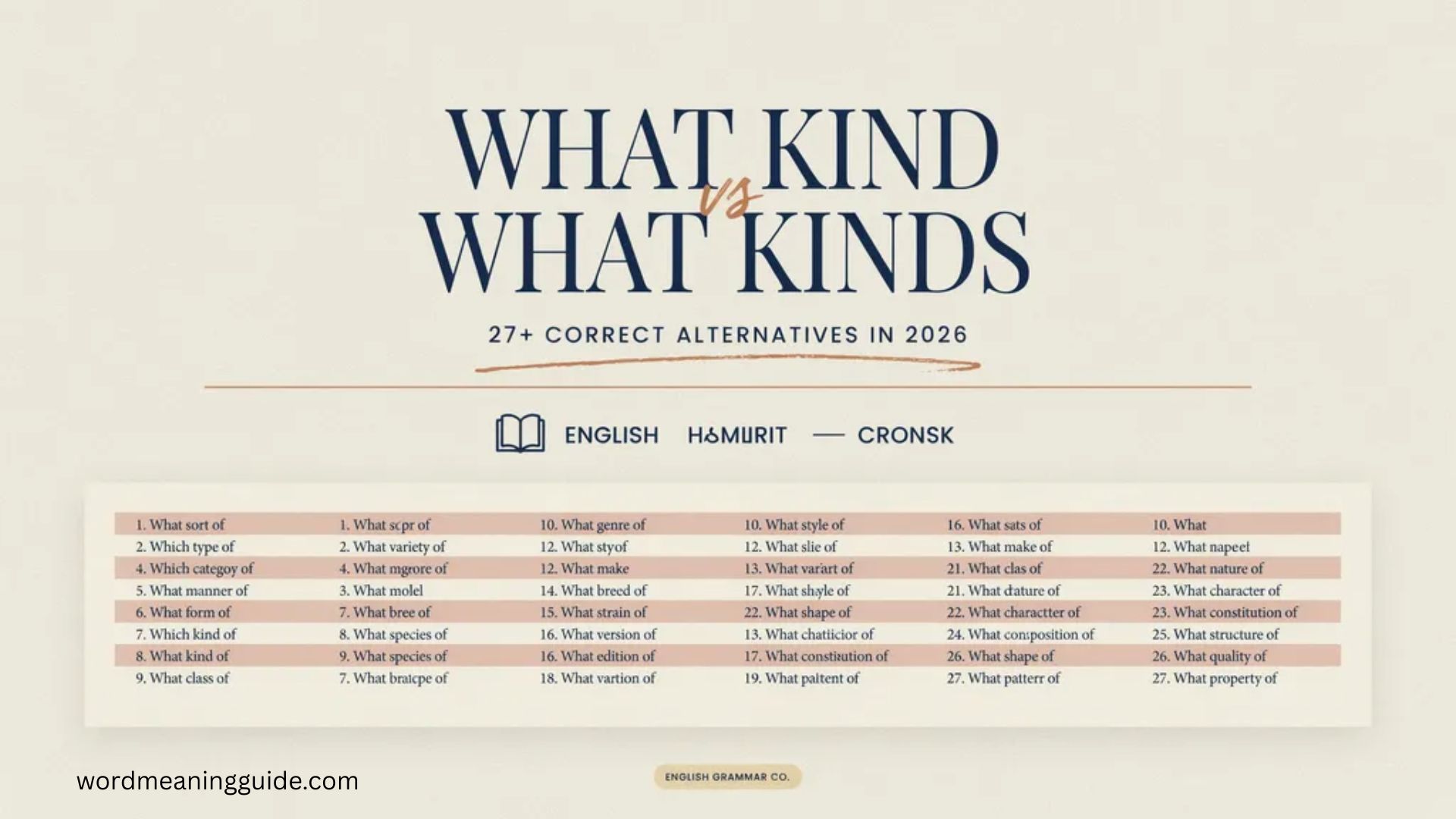
27+ Correct Alternatives to “What Kind / What Kinds”
Now for the heart of this guide. English is a language of extraordinary richness, and “what kind of” is just one way to ask about categories, types, and classifications. Here are over 27 powerful alternatives — each with its own flavor, formality level, and best use case.
1. “What Type of”
Perhaps the closest synonym to “what kind of,” this phrase works in virtually any context where you would use the original. It carries a slightly more formal or technical tone.
“What type of contract are we signing?”
2. “What Types of”
The plural form, perfect when you are exploring a range of possibilities.
“What types of certifications do employers look for?”
3. “Which Kind of”
Using “which” instead of “what” adds an element of selection from a known set. You are implying that the options are already defined, and you are asking the person to choose from them.
“Which kind of insurance policy fits your needs best?”
4. “Which Kinds of”
The plural form of the above, used when multiple selections from a defined set are possible.
“Which kinds of treatments has the doctor recommended?”
5. “What Sort of”
This alternative carries a distinctly British flavour and is widely used in informal and semi-formal contexts. It is warm, conversational, and approachable.
“What sort of arrangement did you have in mind?”
6. “What Sorts of”
The plural expansion of “what sort of,” useful for broad, open-ended inquiries.
“What sorts of activities do children enjoy at this age?”
7. “What Category of”
More formal and often used in academic or bureaucratic contexts. It positions the answer within a classification system.
“What category of spending does this expense fall under?”
8. “What Categories of”
Plural form — excellent for research or organizational contexts.
“What categories of data does the survey collect?”
9. “What Form of”
This phrase highlights the shape, manifestation, or expression of something. It works well when talking about abstract or process-based concepts.
“What form of payment do you accept?”
10. “What Forms of”
The plural version invites discussion of multiple expressions or manifestations.
“What forms of communication are most effective in remote work?”
11. “What Version of”
Ideal when talking about iterations, updates, or variations of something with multiple renditions.
“What version of the software are you running?”
12. “What Versions of”
Used when multiple versions or iterations are part of the conversation.
“What versions of this document exist in the archive?”
13. “What Style of”
Best suited for creative, aesthetic, or preference-based conversations.
“What style of architecture do you prefer for your home?”
14. “What Styles of”
Opens the question to a range of aesthetic or methodological preferences.
“What styles of writing are most appropriate for this publication?”
15. “What Variety of”
This phrase adds a sense of uniqueness or distinction. It implies that the subject exists in multiple distinct forms.
“What variety of apple grows best in cold climates?”
16. “What Varieties of”
The plural exploration of types within a broader category.
“What varieties of tea does the shop carry?”
17. “What Model of”
Particularly useful in technology, engineering, or commercial contexts where specific models or versions exist.
“What model of laptop did the company provide?”
18. “What Models of”
For contexts involving multiple products, frameworks, or structures.
“What models of leadership does this organization promote?”
19. “What Nature of”
A more literary and formal phrase, often used to inquire about the character or essence of something.
“What nature of objection does the committee have?”
20. “What Kind Exactly”
Adding “exactly” creates precision. It signals to the listener that a vague answer will not suffice — you need specifics.
“What kind exactly are we talking about here?”
21. “What Specific Kind of”
Similar to the above, this phrase front-loads the demand for specificity. It is direct and clear.
“What specific kind of support do you need from the team?”
22. “What Exactly Do You Mean by”
This is less of a categorization question and more of a clarification request. It works in dialogue when someone has used a vague term.
“What exactly do you mean by ‘flexible hours’?”
23. “Which Type Would You Say”
A softer, more conversational way to ask someone to classify something, especially when you want them to reflect and self-identify.
“Which type would you say your management style is?”
24. “What Group Does It Belong to”
This phrase positions the subject within a taxonomy or classification system. It is common in scientific, academic, and organizational contexts.
“What group does this species belong to?”
25. “How Would You Describe the Kind of”
A reflective, open-ended question that invites the respondent to use their own language to classify something.
“How would you describe the kind of culture this company has?”
26. “What Classification Does It Fall Under”
Formal and precise — ideal for legal, scientific, governmental, or academic writing.
“What classification does this compound fall under?”
27. “What Exactly Are You Looking For”
A practical, user-focused question that reframes the inquiry from classification to need. Widely used in customer service, counseling, and consultative selling.
“What exactly are you looking for in a mentor?”
Bonus Section: Polite and Professional Variations
Beyond the 27 alternatives above, English offers a rich toolkit of polite, professional ways to ask about types and categories. These are especially useful in business communication, interviews, and formal writing:
- “Could you clarify what kind of…” — Politely asks for clarification without sounding demanding.
- “I was wondering what type of…” — Softens the directness of the question, suitable for emails and formal conversations.
- “Would you be able to specify what kind of…” — Highly formal, used in professional correspondence.
- “May I ask what sort of…” — Extremely polite, ideal for customer-facing communication.
- “Do you have a preference for what kind of…” — Empowers the respondent, often used in service industries.
As communication expert Deborah Tannen has noted, the way we frame questions reveals as much about our intent as our words do. A politely framed type-inquiry builds rapport, while a blunt or mismatched one can feel confrontational.
When Should You Use These Alternatives?
Knowing the alternatives is half the battle. Knowing when to deploy them is the other half.
Use these alternatives freely when:
- The context demands variety to avoid repetitive language
- You want to match the register of the conversation (formal vs. informal)
- The original phrase feels awkward in the sentence structure
- You are writing for SEO and need natural keyword variations
- You want to signal precision, openness, or a specific social dynamic
Avoid using these alternatives when:
- The specific phrase “what kind of” is part of a fixed expression or idiom
- The audience expects standardized language (e.g., legal contracts, regulatory filings)
- Overusing synonyms creates confusion rather than clarity
- The context is so casual that any formal alternative would feel stilted
Contextual Usage: When to Use What Kind of vs What Kinds of
Specific Inquiries
“What kind of” shines in specific inquiries where a single classification is expected. In customer service: “What kind of issue are you experiencing?” In a job interview: “What kind of work environment do you thrive in?”
These single-answer questions streamline communication and help move conversations forward efficiently.
Broad Explorations
“What kinds of” thrives in exploratory dialogue. In education: “What kinds of sources should students consult for their research?” In product development: “What kinds of features are users requesting?”
These questions invite diversity of thought and signal that the asker is open to complexity.
Common Mistakes and How to Avoid Them
Mismatching Singular and Plural
The most frequent error is using “what kind of” when “what kinds of” is clearly more appropriate, or vice versa. A sentence like “What kind of movies do you like?” is not technically wrong — English allows singular “kind” to act as a general classifier — but “What kinds of movies do you like?” is often more natural when you genuinely want a diverse answer.
Confusion with Collective Nouns
Collective nouns create real confusion here. Consider: “What kind of team is this?” vs. “What kinds of team exist in this league?” The first asks about character; the second asks about categorization. Getting this wrong can muddy the meaning of a sentence.
Overlooking Context
A grammar rule without context is just a formula. The real skill lies in reading the situation. In casual conversation, strict singular-plural agreement matters less. In academic writing or formal business communication, it matters enormously.
Practical Examples in Various Contexts
In Educational Settings
Teachers regularly use both forms. A teacher building a taxonomy lesson might ask: “What kinds of mammals live in the arctic?” — inviting students to brainstorm a list. In contrast, an essay prompt might read: “What kind of leader was Winston Churchill?” — pointing students toward a single character analysis.
In Professional Environments
A project manager might ask a client: “What kind of outcome are you expecting from this sprint?” This singular question focuses the conversation. Later, in a retrospective, they might ask: “What kinds of challenges did the team encounter?” — opening the floor to multiple issues.
In Everyday Conversations
At a bookstore: “What kind of story are you in the mood for?” vs. “What kinds of books have you enjoyed lately?” The first narrows; the second explores.
Advanced Uses and Exceptions
Uncountable Nouns
With uncountable nouns, “what kind of” is almost always the correct choice, since uncountable nouns resist pluralization. “What kind of advice did you receive?” is correct; “What kinds of advice” sounds odd to many ears, though it is not universally condemned in academic grammar literature.
Collective Nouns Revisited
Collective nouns like “furniture,” “information,” and “equipment” behave like uncountable nouns in this context. “What kind of furniture suits this space?” is correct. “What kinds of furniture” is possible but rare in everyday speech.
Abstract Concepts
When dealing with abstract ideas — love, justice, creativity — the singular “what kind of” tends to dominate. “What kind of justice does this system provide?” is more natural than the plural form.
Contextual Nuances
Sometimes, the choice between singular and plural signals the speaker’s assumptions. Asking “What kind of car do you drive?” assumes the person owns one car. Asking “What kinds of cars have you driven?” signals openness to a range of experiences. This subtle signaling matters in qualitative research, interviews, and surveys.
Cultural and Regional Variations
English is not monolithic. American English, British English, Australian English, and Indian English all handle “kind” and “kinds” with slight differences in frequency and preference.
British English tends to favor “what sort of” as an equivalent. Australian English is similarly flexible. In American English, “what type of” is often preferred in professional contexts, while “what kind of” dominates casual speech.
Cross-cultural communication researchers note that these small variations can affect comprehension in international settings. When writing for a global audience, opting for clear, unambiguous alternatives like “what type of” or “which category of” can reduce potential confusion.
Why “What Kind of” Confuses Many English Learners
English learners from Romance language backgrounds often struggle here because in languages like Spanish or French, the equivalent of “kind” does not shift based on number in the same structural way. The phrase structure itself changes, making direct translation unreliable.
Additionally, many learners overgeneralize the rule: if you want multiple answers, always use “kinds.” In reality, “What kind of movies do you like?” is perfectly acceptable even when multiple answers are expected, because “kind” here acts as a general, uncountable concept.
This inconsistency — the fact that both forms can sometimes be used interchangeably — is precisely what makes the rule tricky to teach and learn.
How “What Kinds of” Changes the Meaning of a Question
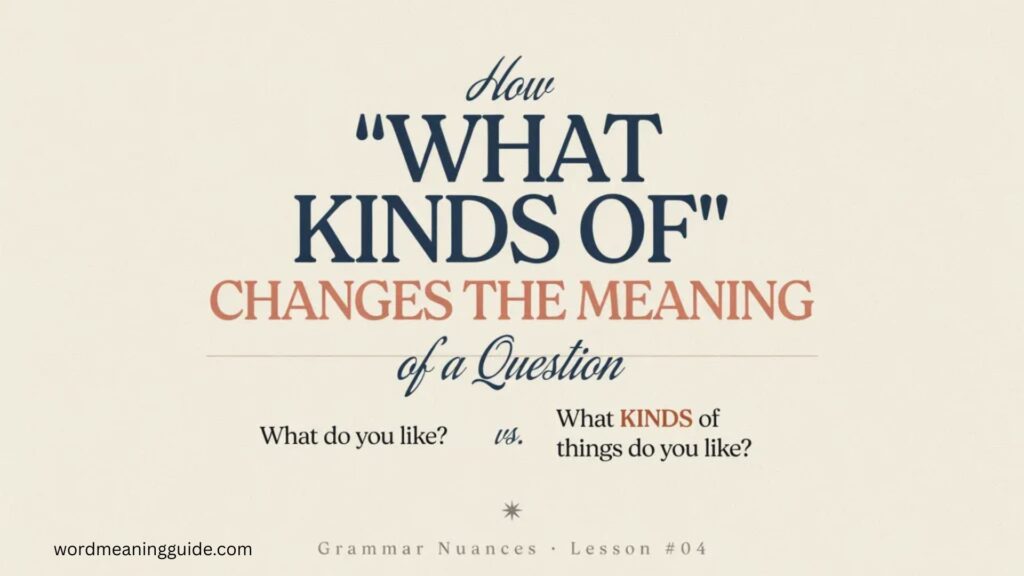
Adding that plural “s” does more than satisfy grammatical rules. It actively changes the implied relationship between questioner and respondent.
“What kind of person are you?” — suggests one answer, one identity.
“What kinds of people work here?” — suggests diversity, multiplicity, range.
In interview research, question wording significantly influences response depth. Participants given plural-framed questions tend to provide longer, richer answers because the question structure signals that breadth is welcome.
The Role of Singular and Plural Nouns in English Questions
English question formation is deeply tied to noun number. Interrogative pronouns (“what,” “which”) combine with nouns to signal the scope of an expected answer. When “kind” is singular, it narrows. When “kinds” is plural, it widens.
This is why grammar instruction on this topic is so valuable — not because breaking the rule produces incomprehensible sentences, but because following it produces more precise, more effective communication.
Using “Kind” and “Kinds” in Daily Conversations
Most native speakers navigate this instinctively, guided by what “sounds right.” But for learners and writers who want conscious control over their language, a simple rule helps:
If your question has one expected answer → “what kind of” If your question invites many answers → “what kinds of”
This is not a rigid rule. It is a practical compass.
In daily conversation, do not overthink it. Focus on the meaning you want to convey, choose the form that matches, and let natural usage guide you over time.
Formal vs Informal Use
Formality shifts which alternatives feel natural:
Formal alternatives: “What classification does it fall under,” “What category of,” “What type of,” “What form of”
Informal alternatives: “What sort of,” “What kind exactly,” “What exactly are you looking for”
Neutral alternatives: “What variety of,” “Which kind of,” “What style of”
Matching formality to context is a mark of communicative competence — and it makes every question land better.
How This Grammar Rule Helps in Academic and Professional Life
In academic writing, precision matters. A research question framed as “What kinds of barriers do first-generation students face?” signals methodological awareness — the researcher expects a taxonomy of barriers, not a single cause. This framing directly influences how data is collected and analyzed.
In business communication, the distinction helps in surveys, needs assessments, and stakeholder interviews. A well-framed question yields more actionable data. A poorly framed one yields noise.
As writing scholar Joseph Williams argued in his influential work on style, clarity in questions is as important as clarity in answers. The question shapes the thinking that follows.
Learning “Kind vs Kinds” as a Step Toward Fluency
Fluency is not just vocabulary breadth. It is grammatical confidence — the ability to make intentional choices about singular and plural, formal and informal, specific and general.
Mastering the “kind vs kinds” distinction, along with its 27+ alternatives, is one of those small but significant steps toward truly fluent, professional English. It signals awareness. It signals precision. It signals that you understand not just the words, but the ideas those words carry.
Practical Applications in Writing and Speaking
Academic Writing
In academic papers, research questions often hinge on this distinction. Use “what kinds of” when your study involves categorization, taxonomy, or multiple-factor analysis. Use “what kind of” when investigating a specific, unified characteristic.
Business Communication
In emails, proposals, and reports, choosing the right phrase demonstrates attention to detail. “What type of support does the client require?” sounds more professional than a vague, mismatched construction.
Journalistic Writing
Journalists use interrogative phrases constantly. A well-placed “What sorts of challenges are emerging in this space?” signals depth and invites a richer source quote than a narrow, closed question.
Frequently Asked Questions
Q1: Is it ever correct to use “what kind of” when expecting multiple answers?
Yes, absolutely. While “what kinds of” more explicitly signals multiple answers, “what kind of” is frequently used colloquially even when the speaker expects several responses. “What kind of movies do you like?” is natural and correct even if the answer is “action, comedy, and drama.”
Q2: What is the difference between “what kind” and “which kind”?
“What kind” is open-ended and does not presuppose a defined set of options. “Which kind” implies that the options are known or limited. “What kind of person would do this?” vs. “Which kind of insurance did you choose?”
Q3: Can “what sort of” and “what kind of” be used interchangeably?
In most informal and semi-formal contexts, yes. “What sort of” has a slightly British ring to it and can sound more conversational, while “what kind of” is more neutral. In formal writing, “what type of” is often preferred over both.
Q4: How do I know when to use “what form of” vs “what kind of”?
Use “what form of” when you are asking about the manifestation, expression, or medium of something — especially abstract or process-based concepts. “What form of resistance did the movement use?” Use “what kind of” for general categorization.
Q5: Are there contexts where all these alternatives become inappropriate?
Yes. In highly standardized language — legal documents, technical specifications, regulatory filings — the precise phrasing may be mandated. In such contexts, substituting synonyms for the required phrase could introduce ambiguity or legal risk.
Q6: Why do some grammar guides say “what kind of” takes a singular noun after it?
Traditional grammar rules hold that after “what kind of,” the following noun should be singular: “what kind of book” not “what kind of books.” However, modern usage has drifted toward flexibility, and “what kind of books” is now widely accepted. Strict formal writing still tends to prefer the singular.
Q7: Does “what nature of” sound outdated in modern English?
Somewhat, yes. “What nature of” is formal and a little literary. It works well in academic or legal writing but can sound stilted in everyday speech. For most modern communication, “what kind of” or “what type of” is more natural.
Q8: How do these phrases translate in cross-cultural communication?
When communicating across cultures, simpler, more direct phrases like “what type of” tend to translate and comprehend most easily. Idiom-heavy phrases like “what sort of” may confuse non-native speakers who learned American English.
Final Writing Tips
Mastering “what kind vs what kinds” — and the full ecosystem of alternatives around it — does not happen overnight. But the journey is worth every step.
Here are final practical tips to carry forward:
Read widely. Notice how skilled writers and speakers use these phrases. Academic journals, quality journalism, and well-crafted business writing are all excellent models.
Practice out loud. Grammar becomes intuitive when you hear it. Practice asking questions using different alternatives until they feel natural.
Write with intention. Before choosing a phrase, ask yourself: am I looking for one answer or many? Is this formal or informal? What exactly do I want to know?
Embrace the richness. English gives you over 27 ways to ask about types and categories. Use that richness. Vary your language. Match your phrasing to your context. And never stop exploring.
Conclusion:
A single letter — the “s” that turns “kind” into “kinds” — is a tiny thing. But in language, tiny things carry enormous meaning.
The difference between “what kind of” and “what kinds of” is not just grammatical. It is conceptual. It signals how you think about the world — whether you see it in single categories or in rich, overlapping pluralities.
And the 27+ alternatives in this guide? They are not just synonyms. They are tools. Each one carries its own tone, its own formality level, its own implied relationship between the question and the answer.
Whether you are asking “What type of leader do you want to be?” or “What kinds of experiences have shaped you?” — the right phrasing makes your question more precise, your communication more powerful, and your thinking clearer.
That is the true gift of mastering this small but mighty corner of English grammar. Use it well.

Mr. Yaseen is a passionate content creator and language enthusiast dedicated to making words simple and meaningful for everyone. As the author behind WordMeaningGuide.com, he focuses on delivering clear, accurate, and easy-to-understand definitions that help readers improve their vocabulary and communication skills. With a keen eye for detail and a love for language, Mr. Yaseen ensures every piece of content is user-friendly, informative, and valuable for learners of all levels.