You open your phone and see a message from a friend: “I fw your energy so much.” You check your inbox and spot an email thread that starts with “FW: Meeting Notes from Thursday.” You scroll through TikTok comments and someone writes, “Not me fwing this at 2am.”
Same two letters. Completely different meanings.
If you have ever stared at those two letters and felt a flicker of confusion, you are not alone. In a world where digital language evolves faster than any dictionary can keep up, FW has quietly become one of the most context-dependent abbreviations in modern communication. It slides smoothly from email inboxes to Instagram DMs, from professional Slack threads to Gen Z TikTok comment sections — and it means something different in almost every space it enters.
According to a 2024 report by Statista, over 5 billion people worldwide use messaging apps daily. With that kind of volume, shorthand like FW has become the linguistic glue holding fast-paced digital conversations together. Understanding what FW means is no longer just useful — it is practically essential for navigating life online in 2026.
This guide breaks it all down. You will learn every meaning of FW, how real people use it in real conversations, why context is everything, and how to respond when someone drops it in your chat. Let us get into it.
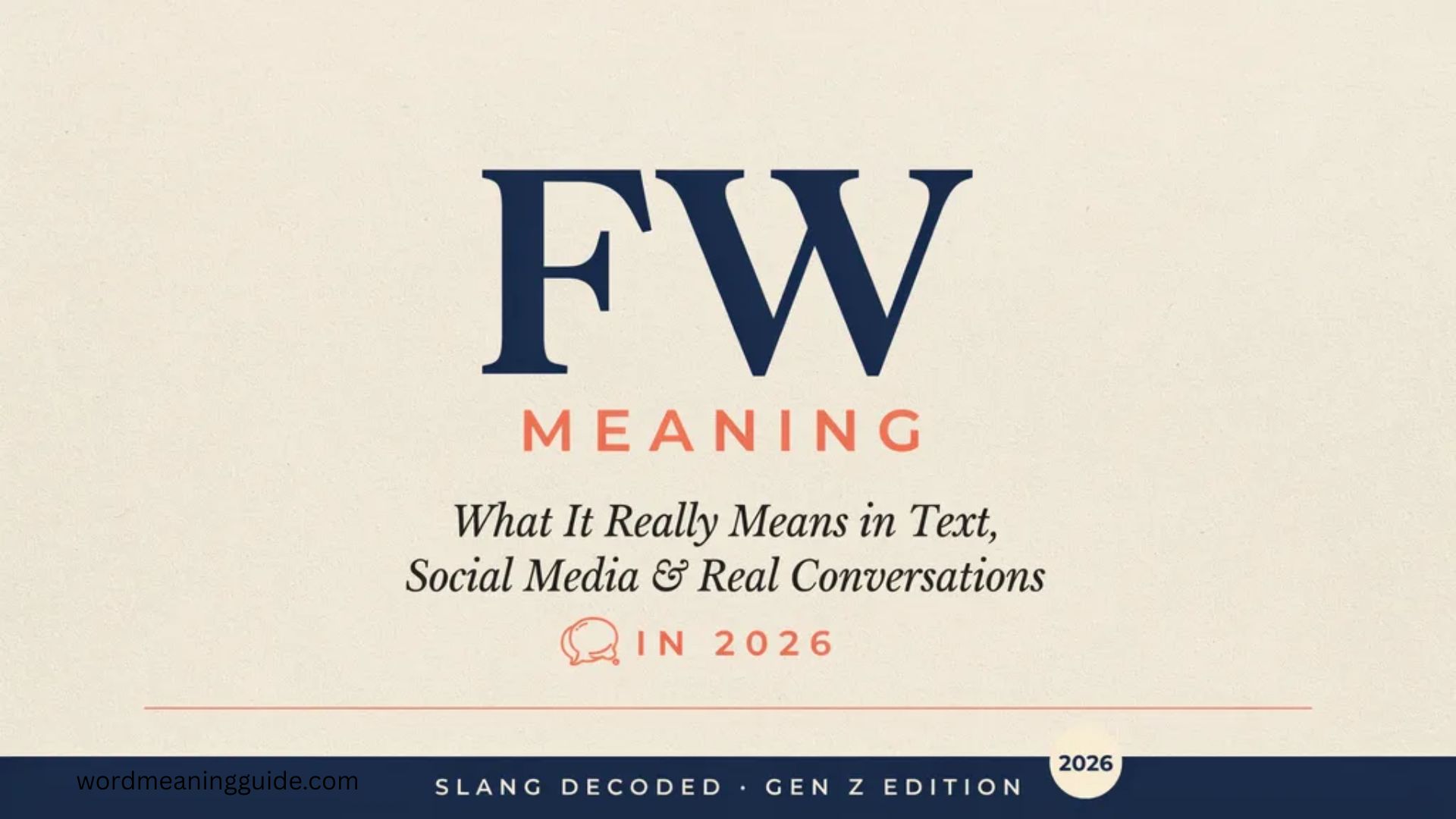
FW Meaning – Quick Definition
Before diving into the nuance, here is the short version you came for.
FW most commonly stands for one of two things:
- Forward — as in forwarding an email, message, or piece of content to someone else
- F*ck With — as in liking, supporting, enjoying, or being interested in something or someone
Both meanings are widely used, but they live in very different worlds. The “Forward” meaning lives mostly in professional and semi-professional communication — emails, work chats, and information-sharing contexts. The “F*ck With” meaning lives in casual, social, and youth-driven spaces like Instagram, TikTok, Snapchat, and everyday text conversations.
The meaning changes depending entirely on where you see it, who says it, and what surrounds it.
Simple Definitions
To keep things crystal clear before we get into examples:
FW = Forward means to pass along a message, file, link, or piece of information from one person (or group) to another. The sender is essentially acting as a relay.
FW = F*ck With means to support, like, be interested in, or vibe with something or someone. It can also mean to mess with or bother someone in certain contexts, though that usage is less common.
Both are abbreviations born from practicality. One saves time in professional environments. The other carries an entire emotional register in three characters.
Example Uses
Here is a quick preview of how FW shows up in the wild:
- “FW: Budget Report Q3” — an email subject line meaning the message was forwarded
- “I really fw that new album” — meaning the speaker genuinely likes or is into the album
- “Can you fw me that file?” — asking someone to forward a document
- “Don’t fw with me today” — meaning do not bother or mess with me
- “She fw me heavy lately” — meaning she is really into or supportive of the speaker
Origin & Background
Language evolves out of need. Both meanings of FW arose because people needed faster, shorter ways to say something they were saying all the time.
1. FW as “Forward”
The “Forward” meaning predates smartphones entirely. It was born in the early days of email culture — think early 2000s corporate inboxes and AOL chains. When email clients introduced the “forward” button, the subject line automatically generated a prefix: FW: or Fwd:. This became so normalized that people began typing it themselves in casual messages.
By the time instant messaging platforms took hold, FW as “forward” was already embedded in digital communication habits. It simply migrated from email to SMS, then to WhatsApp, then to Slack and beyond.
2. FW as “F*ck With”
The slang meaning has a different lineage altogether. “F*ck with” as a phrase — meaning to like, support, or engage with something — has roots in African American Vernacular English (AAVE) and hip-hop culture going back decades. Artists, communities, and subcultures were using full phrases like “I f*ck with that” and “we don’t f*ck with them” long before the internet turned it into an acronym.
As Black culture’s influence on internet slang grew — particularly through platforms like Twitter, Vine, and later TikTok — the phrase got abbreviated to FW. It spread widely through memes, comment sections, and casual conversations, eventually becoming part of mainstream digital vocabulary.
Language researchers at institutions like Oxford Internet Institute have noted that AAVE-derived slang consistently drives internet language trends, with abbreviations like FW being prime examples of how linguistic communities shape the broader cultural vocabulary online.
Real-Life Conversations (How People Actually Use FW)
Theory is one thing. Real usage is another. Here is what FW actually looks like in the wild.
WhatsApp Chat
Malik: bro did you hear that new track? Jordan: yeah bro I fw it hard, been on repeat Malik: same, fw me the link when you get a chance
Notice how both meanings appear in the same conversation. “I fw it hard” means Jordan is really into the track. “fw me the link” means forward it to him.
Instagram DM
User 1: ok this fit is insane User 2: lmaooo ty I fw your style too honestly User 1: we should collab User 2: yes!! fw this to everyone we know
Here FW is used first as appreciation (I support/like your style) and then as “spread this/forward this.”
Email at Work
Subject: FW: Revised Project Timeline From: Sarah J. “Hey team — forwarding this from the client. Please review before Friday’s meeting.”
In professional settings, FW is clean and functional. It signals that this message originated elsewhere and is being passed along. No slang, no ambiguity.
TikTok Comment
Video about a new cafe opening Comment: “ok I fw this place fr fr 😭❤️”
Here “fw” means the commenter genuinely likes or supports the cafe. There is no forwarding happening — it is pure enthusiasm expressed in shorthand.
Emotional & Psychological Meaning
Language is never just about information. It is about connection, identity, and belonging.
When someone says “I fw you,” they are doing something meaningful. They are expressing alignment — I see you, I support you, I am in your corner. It is compact but it carries weight. In relationships and friendships, using “fw” can signal warmth, loyalty, and shared values without the vulnerability of saying something longer or more exposed.
On the flip side, “I don’t fw that” or “I don’t fw them anymore” communicates distance, disapproval, or a broken trust. It is the emotional equivalent of a quiet wall going up.
Psychologists who study digital communication note that abbreviated emotional language like this performs a social function: it allows people to express genuine sentiment with just enough ambiguity to feel safe. It is emotional expression with a protective layer of casualness.
Practical Meaning of FW
Beyond the emotional dimension, FW has enormous practical utility.
In professional life, FW saves time. A two-letter prefix communicates that you are not the original author, that there is a chain of communication behind this message, and that the recipient should know this content came from elsewhere. It sets expectations instantly.
In personal life, “can you fw me that?” is simply the fastest way to say “can you share that with me?” It removes friction from information exchange.
In social media culture, “I fw this” or “I fw you” compresses a feeling into three characters — making it ideal for fast-moving comment sections, quick DMs, and the general rapid-fire rhythm of online communication.
Usage in Different Contexts
Social Media
On platforms like Instagram, TikTok, Twitter/X, and Snapchat, FW almost exclusively means “F*ck With” in its positive sense. You will see it in comments, captions, stories, and DMs. It is used to express approval, interest, connection, and support.
“I fw this artist so much, their energy is different.” “Not gonna lie, I fw the new direction they’re taking.”
Friends & Relationships
Among close friends, FW is warm and casual. Telling someone “I fw you heavy” is like saying I genuinely like and support you as a person. It is a low-pressure, high-meaning compliment that fits naturally in text conversations.
In romantic contexts, it can signal interest or attraction, though the meaning depends heavily on tone and relationship history.
Work or Professional Settings
In professional environments, FW almost always means “Forward.” You will see it in email subject lines, Slack messages, and project management tools. Using the slang version of FW in a work email would be considered highly inappropriate and confusing to most colleagues.
The exception: younger, more informal workplaces where team culture is casual might see FW used loosely — but even then, context and audience matter enormously.
Casual vs Serious Tone
The casual tone dominates when FW = F*ck With. It is breezy, quick, and conversational. Even when expressing genuine admiration, the format keeps things light.
The “Forward” usage can carry a serious tone depending on context. An FW: email about a legal matter, a complaint, or an urgent work issue carries professional weight — despite the tiny prefix.
Common Misunderstandings
1. Assuming It Always Means “Forward”
Older generations who grew up with email culture sometimes read every instance of FW as a forwarding action. Imagine receiving a text from a friend that says “I fw your new haircut” and interpreting it as a request to forward something. The confusion is real and sometimes awkward.
2. Thinking It’s Always Aggressive
Because the full phrase “f*ck with” can mean to mess with or antagonize someone, some people assume FW carries aggression. In most modern usage, especially among younger speakers, the meaning is positive or neutral. Context is everything.
3. Using It in Formal Emails
Using “fw” to mean “I support this idea” in a formal email or business proposal would likely confuse or alarm most professional recipients. Keep the slang version out of formal written communication entirely.
4. Misreading Tone
Because FW is so brief, tone can be hard to read. “I don’t fw that” could mean mild disinterest or serious disapproval. Without emojis, context, or knowing the person, the intensity is hard to gauge.
5. Confusing FW With Reply
In email chains, people sometimes confuse FW (Forward) with RE (Reply). Forwarding sends the message to a new recipient. Replying responds to the existing sender. They are not interchangeable, though the confusion is surprisingly common.
Comparison Table
| Context | FW Meaning | Example | Tone |
| Email Subject Line | Forward | FW: Team Update | Professional |
| Text Message | Forward or F*ck With | “fw me that” / “I fw it” | Casual |
| Instagram Comment | F*ck With (positive) | “I fw this look” | Informal |
| TikTok | F*ck With (positive) | “fw this creator fr” | Very Casual |
| Either meaning | Depends on context | Casual | |
| Work Slack | Forward | FW: Client Response | Semi-Professional |
| Snap/DMs | F*ck With | “I fw you sm” | Casual/Personal |
| Negative Use | F*ck With (negative) | “don’t fw with me” | Assertive |
Variations / Types of FW (10 Common Forms)
FW does not exist in isolation. Here are ten common variations and how they function:
1. “I fw this” — I like/support this (most common positive form)
2. “I fw you” — I like you as a person, I support you
3. “I fw with that” — Extended version, same positive meaning
4. “I don’t fw that” — I dislike or disapprove of that
5. “FW heavy” — Intensified version; I really strongly support this
6. “Don’t fw with me” — Do not bother or mess with me (assertive/protective)
7. “FW: [subject]” — Email/message forwarding prefix
8. “Can you fw that to me?” — Please forward that file or message to me
9. “She fw him” — She is interested in him romantically
10. “We fw different things” — We have different tastes/values (neutral distance)
How to Respond When Someone Uses FW
Knowing how to reply to FW is just as important as knowing what it means.
Casual Replies
If someone says “I fw your vibe,” you can respond with:
- “Appreciate that, I fw you too”
- “That means a lot honestly”
- “Same energy fr”
Funny Replies
If the moment calls for humor:
- “My vibe has been waiting for this validation”
- “Finally someone gets it”
- “I fw the fact that you fw me”
Mature / Confident Replies
When the message is sincere and you want to match that energy:
- “I respect that, genuinely”
- “You know that’s mutual”
- “Good to know, I got you”
Private / Respectful Replies
When someone uses FW to share something personal or forward something important:
- “Thanks for sending this my way”
- “I’ll take a look and get back to you”
- “Noted, will handle it”
Regional & Cultural Usage
Western Culture
In the United States, the United Kingdom, Canada, and Australia, both meanings of FW are well established. The slang version is most common among younger demographics — particularly those under 35 — while the “forward” meaning spans all ages and professions. American pop culture and social media have been the primary engines driving the slang version globally.
Asian Culture
In countries like South Korea, Japan, and India, English-language internet slang including FW has gained traction among younger, digitally active populations. Korean and Japanese Gen Z users frequently adopt English slang through platforms like Twitter/X, TikTok, and YouTube. In India, where English is widely spoken and internet usage is among the highest globally, FW circulates freely in urban youth communication.
Middle Eastern Culture
In Gulf countries and across the MENA region, FW as “Forward” is standard in professional and digital communication, given how embedded email culture is in business settings. The slang meaning has gained some foothold among younger Arabic-speaking users who consume English-language content online, particularly through music and entertainment.
Global Internet Usage
The internet is fundamentally flattening language. According to research from We Are Social, over 60% of the global population is online, and English remains the dominant language of social media platforms. This means FW — in both its meanings — is crossing borders, languages, and cultures at unprecedented speed. You are just as likely to see “I fw this” in a Lagos comment section as you are in Los Angeles.
Why Understanding FW Meaning in Text Matters Today
Language shapes how we connect. Misreading FW might seem like a small thing — but small miscommunications accumulate. They create awkwardness, misunderstandings, and in professional contexts, real problems.
Understanding FW meaning in text matters in 2026 because:
Communication is faster than ever. With attention spans shortened and messages coming in rapid succession, abbreviations carry more weight per character than ever before. Misreading one could derail an entire conversation.
Generational divides are real. A 55-year-old manager and a 22-year-old employee may both type FW and mean something completely different. Bridging that gap requires awareness.
Professional and personal lines blur. Remote work, casual business culture, and hybrid communication styles mean the formal/informal divide is thinner than it has ever been. Knowing when FW is professional and when it is slang protects your credibility in both worlds.
Digital literacy is a life skill. In an era where so much of life — work, relationships, community — happens online, fluency in digital language is not a bonus skill. It is foundational.
How FW Is Used in Daily Life
1. Forwarding Important Work Emails
Sarah, a project manager at a marketing firm, starts most of her mornings scanning her inbox. When a client sends over revised briefs, she forwards them to her team with a quick note: “FW: Updated Brief — please review.” The FW prefix immediately tells the team this message originated outside the organization. No explanation needed.
2. Sharing News or Information
Marcus sees a job posting that would be perfect for his friend Yvonne. He screenshots it and sends it over on WhatsApp: “Yo fw this to your email, it’s right up your alley.” Here FW does double duty — asking her to forward it and flagging that it is relevant.
3. Passing Along Funny Content
A group chat lights up. Someone drops a meme and follows it with: “fw this to everyone who needs to see it.” The content is so good it needs a wider audience. FW becomes a distribution instruction.
4. Sharing Opportunities
A music producer posts on Instagram about a new collaboration she is open to. In the comments: “I fw your production style, slide in the DMs.” This is not about forwarding anything — it is an expression of genuine artistic alignment and an invitation.
5. Spreading Awareness
An activist shares a thread about a community issue and writes in the caption: “If you fw this cause, please share and tag people who care.” Here FW acts as a values alignment check — are you in? Do you support this? Then amplify it.
Frequently Asked Questions
What does FW mean in a text message?
In a text message, FW typically means either “Forward” — as in please send this to someone or indicating a message was passed along — or “F*ck With” in slang, meaning to like, support, or be interested in something or someone. The meaning depends entirely on context and tone.
What does FW mean on TikTok?
On TikTok, FW almost always means “F*ck With” in the positive sense. When someone writes “I fw this” in a comment, they are expressing genuine appreciation, interest, or support for the content or creator. It is one of the most common expressions of approval in TikTok comment culture.
What does “I fw you” mean?
“I fw you” means “I f*ck with you” — which translates to “I genuinely like you,” “I support you,” or “I am aligned with who you are.” It is typically a warm, affirming expression used between friends, romantic interests, or people with shared values. Context and relationship determine the exact emotional weight.
Is FW rude or offensive?
FW itself is not inherently rude. When it means “Forward,” it is completely neutral and professional. When it means “F*ck With,” it contains an implicit profanity in the full form, which makes it inappropriate for formal settings. In casual conversation among friends or online communities, it is generally not considered offensive. “Don’t fw with me” has a sharper, more assertive edge — but is still contextual.
What is the difference between FW and Fwd in email?
Both FW and Fwd are used as prefixes in forwarded emails and mean the same thing. Different email clients generate different prefixes — Microsoft Outlook often uses FW: while Apple Mail and Gmail tend to use Fwd:. There is no meaningful difference in meaning; both signal that the original message is being passed along to a new recipient.
Can FW be used in professional communication?
FW as “Forward” is completely standard in professional communication and has been since the early days of email. FW as slang (“F*ck With”) should never be used in formal professional settings — it would be inappropriate and confusing to most workplace recipients. In very casual startup or creative cultures, some slang creeps into communication, but even then, caution is advised.
What does “I don’t fw that” mean?
“I don’t fw that” means “I don’t f*ck with that” — expressing disinterest, dislike, or disapproval. It can refer to a person, place, idea, piece of content, or anything else. The tone is typically firm but not aggressive. It is essentially a compact way of saying “that’s not for me” or “I want nothing to do with that.”
When did FW become popular slang?
The slang usage of FW evolved from the AAVE phrase “f*ck with” which has been in use in urban communities and hip-hop culture for decades. Its abbreviation and widespread adoption online accelerated in the 2010s with the rise of Black Twitter, Vine, and eventually TikTok. By 2020 it was firmly embedded in mainstream internet vocabulary, particularly among younger users.
Conclusion:
If there is one lesson to take from all of this, it is that language is never just about words — it is about the space those words live in.
FW is a perfect case study in how digital communication has evolved. It is a tiny abbreviation carrying significant weight, shape-shifting between a formal email prefix and a heartfelt expression of connection depending on nothing more than context. The same two letters can mark a professional handoff or declare genuine admiration for a person, a piece of art, or an idea.
In 2026, fluency in digital language is not just a nice-to-have. It is a practical, social, and professional necessity. Whether you are navigating a work inbox, sliding into DMs, or trying to understand what your younger sibling means in a voice note, knowing what FW means — and which FW is being deployed in the moment — puts you ahead of the curve.
The next time you see FW pop up on your screen, you will not need to pause. You will read the room, understand the context, and respond with confidence.
And that, in its own way, is what it means to truly fw the language of the internet.

Mr. Yaseen is a passionate content creator and language enthusiast dedicated to making words simple and meaningful for everyone. As the author behind WordMeaningGuide.com, he focuses on delivering clear, accurate, and easy-to-understand definitions that help readers improve their vocabulary and communication skills. With a keen eye for detail and a love for language, Mr. Yaseen ensures every piece of content is user-friendly, informative, and valuable for learners of all levels.