Every conversation — professional or personal — carries a moment of parting. And in that moment, we reach for words that bridge the gap between goodbye and the next hello. “Looking forward to seeing you” is one of the most commonly used phrases in the English language, showing up in emails, text messages, meeting invites, and casual conversations alike. But when you say the same thing every single time, it stops meaning anything at all.
Language is a living, breathing tool. The words you choose reveal your personality, your emotional intelligence, and the depth of your relationships. Whether you’re wrapping up a business email, saying farewell to a dear friend, or closing out a formal meeting, the right phrase can leave a lasting impression — the kind that makes the other person genuinely look forward to your next encounter.
This guide goes beyond the ordinary. You’ll find over 55 thoughtful, creative, and contextually appropriate alternatives to “looking forward to seeing you,” along with expert insight on when and how to use each one. By the time you finish reading, you’ll never be at a loss for words again.
What Does “Looking Forward to Seeing You” Mean?
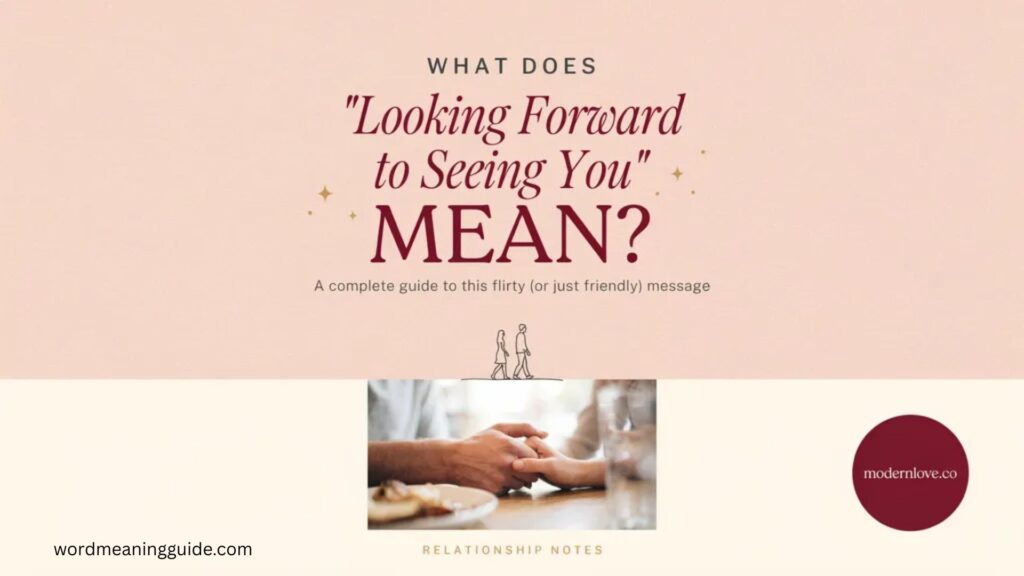
At its core, “looking forward to seeing you” is an expression of anticipation and positive expectation. It signals that the person you’re addressing holds value in your world — that their presence is something you genuinely await with eagerness rather than dread.
The phrase blends emotion with courtesy. It’s part social ritual, part authentic expression. Psycholinguist Dr. Deborah Tannen, who has written extensively on conversational patterns, notes that closing phrases in communication serve as “rapport-building devices” — they don’t just end a conversation, they set the emotional tone for the next one.
Think about it: when someone tells you “I can’t wait to see you,” how does that make you feel? Valued. Anticipated. Warm. That’s exactly the effect a well-chosen closing phrase can have. The challenge is making sure the sentiment stays genuine and doesn’t become robotic through overuse.
Is It Polite or Professional?
The short answer is: it depends on how it’s used.
“Looking forward to seeing you” walks a comfortable line between professional and personal. In a corporate email, it comes across as warm yet respectful. In a casual message to a friend, it can feel slightly formal. In a love note, it might seem underwhelming.
The phrase is broadly considered polite and appropriate in most professional contexts. According to communication researchers, closing pleasantries in business emails significantly impact how the sender is perceived — respondents in one study rated emails with warm closings as more competent and more likable than those with abrupt endings.
However, “polite” and “powerful” are not the same thing. Relying on the same phrase repeatedly can make you seem formulaic. A thoughtfully chosen alternative shows intentionality — and that’s always a mark of a skilled communicator.
When Should You Use These Alternatives?
Context is everything. Before choosing a phrase, ask yourself three questions:
Who are you addressing? A colleague, a client, a friend, a romantic partner, or a professional mentor all call for different registers of warmth and formality.
What’s the medium? An email to a hiring manager differs dramatically from a text to your college roommate. The medium shapes the message.
What’s the relationship stage? Meeting someone for the first time versus reconnecting with an old friend calls for very different energy. New relationships often benefit from enthusiasm tempered with professionalism. Long-established ones can handle more casual, heartfelt expressions.
With those filters in mind, let’s explore the full landscape of alternatives — from the professional to the playful, the brief to the beautifully expressive.
Other Ways to Say “Looking Forward to Seeing You”
1. “I look forward to meeting you.”
This is perhaps the cleanest, most universally accepted professional alternative. The shift from “seeing” to “meeting” adds a touch of formality without sacrificing warmth. Use it in first-contact business emails, pre-interview correspondences, or when you’re about to meet someone for the very first time.
The subtle distinction matters: “seeing” implies familiarity; “meeting” implies a formal introduction. When precision counts, this phrase delivers.
2. “I’m excited to see you.”
Where the original phrase is measured, this one is enthusiastic. “Excited” injects genuine energy into the farewell. It works beautifully with friends, mentors, and colleagues you’ve built rapport with. In a professional setting, use it sparingly — reserve it for relationships where that level of enthusiasm is appropriate and reciprocated.
3. “I look forward to our meeting.”
A subtle but meaningful variation — by referencing “our meeting” as a shared event rather than simply “seeing you,” this phrase emphasizes the professional nature of the upcoming interaction. It’s ideal for formal business correspondence, especially when confirming a scheduled appointment or call.
4. “I can’t wait to see you.”
Arguably the most emotionally charged option on this list. “I can’t wait” communicates barely contained excitement — that the upcoming encounter is genuinely something you’re counting down to. This is perfect for personal relationships: close friends returning from a trip, family members you haven’t seen in months, or a romantic partner after time apart.
In a professional setting, exercise caution. It can work with well-established colleagues but may feel overly informal in client communication.
5. “I’m looking forward to our time together.”
This phrase elevates the sentiment by emphasizing shared experience rather than simply the act of seeing someone. “Our time together” implies intentionality — that you’re looking forward not just to the person, but to what you’ll create, discuss, or experience in each other’s company.
It’s especially powerful in mentorship, coaching, and close professional relationships.
6. “I look forward to seeing you soon.”
The addition of “soon” does something deceptively simple: it creates urgency and specificity without naming an exact date. It’s forward-leaning and implies the reunion is near, which amplifies the sense of anticipation. Use this when you have a meeting or visit on the horizon but want to keep the tone breezy.
7. “I’m eager to see you.”
“Eager” is a word that carries intellectual and professional weight. Unlike “excited,” which reads as emotional, “eager” suggests readiness and active anticipation — more suited to professional contexts. An eager professional is prepared; an excited one might seem impulsive.
8. “I look forward to connecting with you.”
In a world dominated by networking culture, this phrase has become a staple of professional communication — particularly on platforms like LinkedIn or in introductory emails. “Connecting” implies an exchange of value, a meeting of minds. It’s modern, purposeful, and project-facing.
9. “I’m happy we’ll be meeting.”
There’s something quietly sincere about this phrasing. Rather than projecting anticipation into the future, it grounds the feeling in the present moment: right now, knowing that a meeting is coming, there is happiness. It’s understated, genuine, and works especially well in written communication where warmth can sometimes get lost.
10. “I look forward to seeing you in person.”
As remote work and virtual meetings have become more common, this phrase has gained particular resonance. It signals that a face-to-face encounter holds special significance — more than another video call or voice message. Use it when transitioning from a digital relationship to a physical one, or after a long period of virtual-only contact.
11. “I’m glad we’ll see each other soon.”
This is a softer, more relaxed version of the standard phrase. “Glad” is a warm but not overwhelming emotion — it doesn’t perform enthusiasm, it simply expresses it. This phrasing works especially well in semi-formal contexts: colleagues you know well, professional mentors, or family friends.
12. “I look forward to catching up with you.”
“Catching up” implies a shared history — a bond that predates the next meeting. It’s inherently personal and warm, suggesting that there’s a backlog of experiences, stories, and updates waiting to be shared. Use this with people you haven’t seen in a while but feel genuinely close to.
13. “I’m pleased to be meeting you.”
Formal, gracious, and polished — this phrase carries the weight of a slightly older, more distinguished style of communication. It signals genuine courtesy and sets a respectful tone. It’s excellent for first meetings with senior professionals, executives, or esteemed contacts.
14. “I’m looking forward to seeing everyone.”
When you’re addressing a group — a team, a gathering, a class, a community — this collective phrasing is both inclusive and warm. It acknowledges that the group’s collective presence, not just individual members, is something to look forward to. Ideal for event announcements, group emails, and team communications.
15. “I look forward to our discussion.”
Purposeful and specific, this phrase centers the anticipation on what will happen at the meeting: the exchange of ideas. It’s professional, intellectually focused, and especially appropriate for academic settings, strategy meetings, or any interaction where substantive dialogue is the main event.
16. “I’m delighted to see you.”
“Delighted” is a beautiful word — refined, warm, and expressive without being excessive. It’s been a hallmark of gracious communication for generations and retains a classic elegance. It works in both professional and personal contexts, though it leans slightly formal. In an age of casual communication, using “delighted” can actually stand out in the most memorable way.
17. “I look forward to welcoming you.”
This phrase is particularly suited to hosts — whether you’re welcoming a guest to your office, your home, or an event you’re organizing. It carries an implicit promise of warmth and preparation. The speaker isn’t just meeting someone; they’re creating an environment of welcome.
18. “I’m anticipating our meeting.”
“Anticipating” adds a layer of thoughtful preparation to the sentiment. It suggests that the speaker has been thinking ahead, preparing, making mental space for what is to come. In professional correspondence, it signals seriousness and engagement.
19. “I look forward to seeing you again.”
The word “again” transforms this phrase entirely. It acknowledges shared history, a relationship already in motion. It’s warm, familiar, and appropriate for any context where there’s a prior connection — business partners, old classmates, returning clients, or family.
20. “I’m eager for our meeting.”
Energized and professional, this phrase combines intellectual readiness with genuine excitement. It works well in pre-meeting emails, proposal follow-ups, or any context where demonstrating engagement and preparation is important.
21. “I’m happy to be seeing you.”
Casual, unpretentious, and warm — this phrase feels like a verbal smile. It’s not trying too hard; it simply states a happy fact. Use it in personal messages, casual workplace settings, or anywhere the relationship has a friendly, relaxed quality.
22. “I look forward to meeting in person.”
The emphasis on “in person” makes this phrase particularly resonant in our increasingly digital world. It acknowledges the unique value of physical presence — the handshake, the shared space, the body language that no screen can replicate. It’s professional and modern, carrying a faint note of anticipation that’s hard to manufacture artificially.
23. “I’m excited about our meeting.”
By directing excitement toward “our meeting” as a shared event, this phrase becomes both personal and professional. It’s slightly more formal than “I’m excited to see you” because the focus is on the meeting itself — its content, its purpose — rather than just the person.
24. “I look forward to our upcoming meeting.”
Adding “upcoming” creates a sense of nearness and specificity. It’s organized, professional, and slightly more formal. Ideal for corporate communication, client emails, or any context where professionalism is paramount.
25. “I’m pleased to see you again.”
A gracious, refined expression suited to formal contexts — especially valuable when reconnecting with someone after time apart in a professional setting. It communicates satisfaction and warmth without crossing into informality.
26. “I look forward to spending time together.”
Perhaps the most human phrase on this list. “Spending time together” centers the relationship itself, not the meeting, not the agenda, not the task. It says: your company is valuable. This time we’ll share matters. Use it in personal relationships or in professional settings where the relationship itself is the point.
Expressive Greetings and Meeting Phrases
Beyond farewells, sometimes you want to express joy at the moment someone arrives. Here are expressive alternatives that work beautifully as warm welcomes and in-person greetings:
Glad to See You
Simple, sincere, and impossible to misread. “Glad to see you” is a small sentence with a big heart. It doesn’t overthink; it simply states a truth. Perfect in casual settings, family gatherings, and friendly workplace environments.
It’s Great to See You
This is the conversational workhorse of warm greetings — friendly, genuine, and versatile enough to work in almost any setting. It’s easy to say, easy to receive, and never sounds hollow when said with a smile.
So Nice to See You
The word “so” does powerful emotional work here — it intensifies the sentiment without making it dramatic. “So nice to see you” is warm, gracious, and perfectly calibrated for both professional and personal encounters.
Thrilled to See You
“Thrilled” is an underused gem. It implies delight layered with surprise — as if the person’s presence is even better than you expected. Use it when someone you care about shows up unexpectedly, or to add genuine spark to a planned reunion.
Wonderful to See You
Elegant and genuinely warm, “wonderful” elevates the greeting without making it feel performative. It’s a word that carries real weight — and when used sincerely, it lands beautifully.
Happy You’re Here
Brief, direct, and deeply human. “Happy you’re here” shifts the focus from the act of seeing to the reality of presence — the person is here, in this space, in this moment, and that matters. It’s especially powerful in personal relationships.
Good to See You
The reliable, friendly standard. “Good to see you” never fails because it never overpromises. It’s honest and warm in equal measure — a conversational handshake.
Lovely to See You
British in flavor but universally charming, “lovely to see you” has a gentle, unhurried quality. It suits anyone who values grace in communication and works wonderfully in both personal and professional settings.
It’s a Pleasure to See You
Formal, gracious, and timeless. This phrase belongs at networking events, formal meetings, and any occasion where first impressions or professional respect are at stake.
Overjoyed to See You
Reserved for truly special reunions — the returning soldier, the long-lost friend, the family member who has been far away for far too long. “Overjoyed” doesn’t just describe happiness; it describes a happiness that overflows.
Nice Seeing You
The casual, comfortable bookend to a pleasant interaction. “Nice seeing you” works as a parting phrase after an enjoyable encounter and carries a relaxed, genuine warmth.
Happy to Have You Here
When you’re the host — of a meeting, an event, a dinner — this phrase signals that the person’s presence genuinely contributes to the occasion. It’s welcoming, gracious, and slightly more formal than “happy you’re here.”
What a Pleasure to See You
An exclamatory version of “it’s a pleasure” — this phrase conveys that the pleasure is real and perhaps unexpected in its intensity. It’s enthusiastic yet refined, and works wonderfully as a warm opening in formal or semi-formal reunions.
I’ve Been Looking Forward to Seeing You
By using the past continuous tense, this phrase communicates that the anticipation has been ongoing — not just a polite gesture at the moment of meeting, but a genuine feeling that has been building. It’s personal, authentic, and memorable.
So Glad You’re Here
Warm and informal, this phrase works beautifully in personal settings and casual professional ones. The emphasis on “you’re here” echoes the theme of presence and belonging.
Always Great to See You
The word “always” transforms this into a statement of consistent affection — that every encounter with this person is a good one. It implies a valued, ongoing relationship and is perfect for close colleagues, long-time friends, or cherished family members.
I’m Happy You Made It
This phrase acknowledges effort. “You made it” implies that showing up wasn’t easy — there may have been distance, scheduling challenges, or competing commitments. By noting that they “made it,” you honor the effort behind their presence.
It Brightens My Day to See You
Beautiful, specific, and genuinely moving. This phrase doesn’t just say you’re happy — it says the person’s presence has a measurable positive effect on your world. Use this with close friends, beloved colleagues, or anyone whose presence genuinely lifts your spirits.
Great Having You Here
Warm and slightly informal, “great having you here” works well in hosted settings — welcoming a colleague to your workspace, a friend to your home, or a guest to your event.
It Means a Lot to See You
Vulnerable and sincere, this phrase communicates genuine emotional significance. It’s especially powerful when reuniting after a difficult period — illness, conflict, distance, or loss. It says: your presence is not taken for granted.
I’m Grateful to See You
Gratitude elevates any expression of warmth. To be grateful for someone’s presence is to acknowledge that it isn’t owed — it’s given, freely, and it matters. This phrase is quietly powerful in deeply personal relationships.
You’re a Sight for Sore Eyes
An old idiom that hasn’t lost its charm. “A sight for sore eyes” is vivid and affectionate — it communicates that seeing this person is a relief, a balm, a joy. Best used in casual, close personal relationships where such expressiveness is natural.
It’s Fantastic to See You
Enthusiastic and modern, “fantastic” brings fresh energy to a familiar sentiment. It works well with friends, upbeat colleagues, and anyone with whom you share a lively, energetic relationship.
I’m Delighted You Came
This phrase works especially well when someone has made an effort to be present — attending an event, traveling to meet you, or showing up despite a busy schedule. “Delighted you came” acknowledges both the joy of their presence and the effort it required.
Warm Welcome to You
Formal, inclusive, and gracious — this is the language of hosts, speakers, and community builders. It works beautifully at the opening of events, meetings, or any gathering where someone is being received into a space.
I Can’t Tell You How Happy I Am to See You
A deeply personal phrase that carries the weight of genuine emotion. By saying “I can’t tell you,” you’re paradoxically communicating that the feeling exceeds what language can easily contain. Reserve this for truly meaningful reunions.
Bonus Section: Short Polite Variations
Sometimes brevity is the soul of warmth. Here are quick, polished alternatives for when you want to express the sentiment in just a few words:
- “See you soon.” — Simple, warm, forward-looking.
- “Until next time.” — Elegant and slightly nostalgic; works well in formal contexts.
- “Can’t wait!” — Casual and energetic; best for personal messages.
- “Counting the days.” — Playful and affectionate.
- “Looking forward to it.” — Professional and versatile.
- “See you there.” — Casual, situational, and confident.
- “Till we meet again.” — Old-fashioned charm, unexpectedly touching in modern use.
Frequently Asked Questions
Is “looking forward to seeing you” appropriate for professional emails?
Yes, absolutely. “Looking forward to seeing you” is widely accepted as a professional and polite closing phrase. However, if you’re writing to a highly formal contact — a senior executive, a client in a formal industry, or a government official — you might prefer something like “I look forward to our meeting” or “I’m pleased to be meeting with you,” which carry a slightly more formal register.
What is the most formal alternative to “looking forward to seeing you”?
The most formal alternatives include “I look forward to our meeting,” “I’m pleased to be meeting you,” and “I anticipate our upcoming discussion.” These options are well-suited to high-stakes business correspondence, legal communication, and formal invitations.
Can I use these phrases in text messages or casual conversations?
Absolutely. Many of the expressions in this guide — such as “can’t wait to see you,” “so glad you’re here,” and “I’m excited to see you” — are perfectly suited to informal, conversational use. The key is matching the phrase to the context, the relationship, and the emotional register of the exchange.
How do I avoid sounding repetitive in professional emails?
Rotate your closing phrases based on the context and the relationship. Keep a mental (or literal) list of a few favorites and alternate between them. When you vary your language thoughtfully, it signals that your words are intentional rather than automatic — which actually enhances your professional credibility.
What phrase should I use when meeting someone for the first time?
“I look forward to meeting you” or “I’m pleased to be meeting you” are ideal for first-time encounters. They’re warm without being presumptuous and maintain an appropriate level of formality while still communicating genuine anticipation.
Are there cultural differences in how these phrases are used?
Yes, significantly. In British English, phrases like “lovely to see you” and “it’s a pleasure to see you” carry more everyday currency than they might in American English, where they can sound slightly formal. In some East Asian business cultures, understated expressions of anticipation are preferred over highly enthusiastic ones. When communicating internationally, err on the side of warmth paired with restraint.
What’s the difference between “looking forward to seeing you” and “looking forward to meeting you”?
The distinction is subtle but meaningful. “Meeting” implies a first or formal encounter, while “seeing” suggests familiarity or an ongoing relationship. Use “meeting” when it’s a new acquaintance or a formal professional setting; use “seeing” when you already know the person.
Final Writing Tips
The words you use to close a conversation are more powerful than most people realize. Research consistently shows that the final moments of an interaction — what psychologists call the “end effect” — disproportionately influence how the entire exchange is remembered.
Here are a few principles to guide your choices:
Match the energy of the relationship. If you’re playful and warm with someone, choose a phrase that reflects that. If the relationship is more formal, honor that with measured, respectful language.
Be specific where you can. “I look forward to our discussion about the project” is more memorable than “looking forward to seeing you.” Specificity signals attention and care.
Say it like you mean it. Any phrase, no matter how beautifully constructed, falls flat if it’s delivered mechanically. Genuine warmth can’t be faked with vocabulary alone — but the right vocabulary can amplify genuine warmth beautifully.
Don’t over-engineer it. The goal is connection, not performance. Sometimes the simplest phrase — “glad you’re here,” “can’t wait,” “see you soon” — lands with the most power precisely because it doesn’t try too hard.
Language at its best is an act of generosity. When you tell someone you’re looking forward to seeing them — in whatever form that takes — you’re offering them something real: the knowledge that their presence matters, that their company is anticipated, and that the world is a little better because they’re in it.
Choose your words with that spirit in mind, and you’ll never sound formulaic again.
Conclusion
Words may seem small, but the way you express excitement about meeting someone can leave a lasting impression. Choosing different ways to say “looking forward to seeing you” helps your conversations feel more thoughtful, personal, and emotionally real.
Whether you want to sound professional, friendly, romantic, or casual, the right phrase can strengthen your connection with others. Sometimes, a simple change in wording is all it takes to make someone smile before you even meet them.

Mr. Yaseen is a passionate content creator and language enthusiast dedicated to making words simple and meaningful for everyone. As the author behind WordMeaningGuide.com, he focuses on delivering clear, accurate, and easy-to-understand definitions that help readers improve their vocabulary and communication skills. With a keen eye for detail and a love for language, Mr. Yaseen ensures every piece of content is user-friendly, informative, and valuable for learners of all levels.