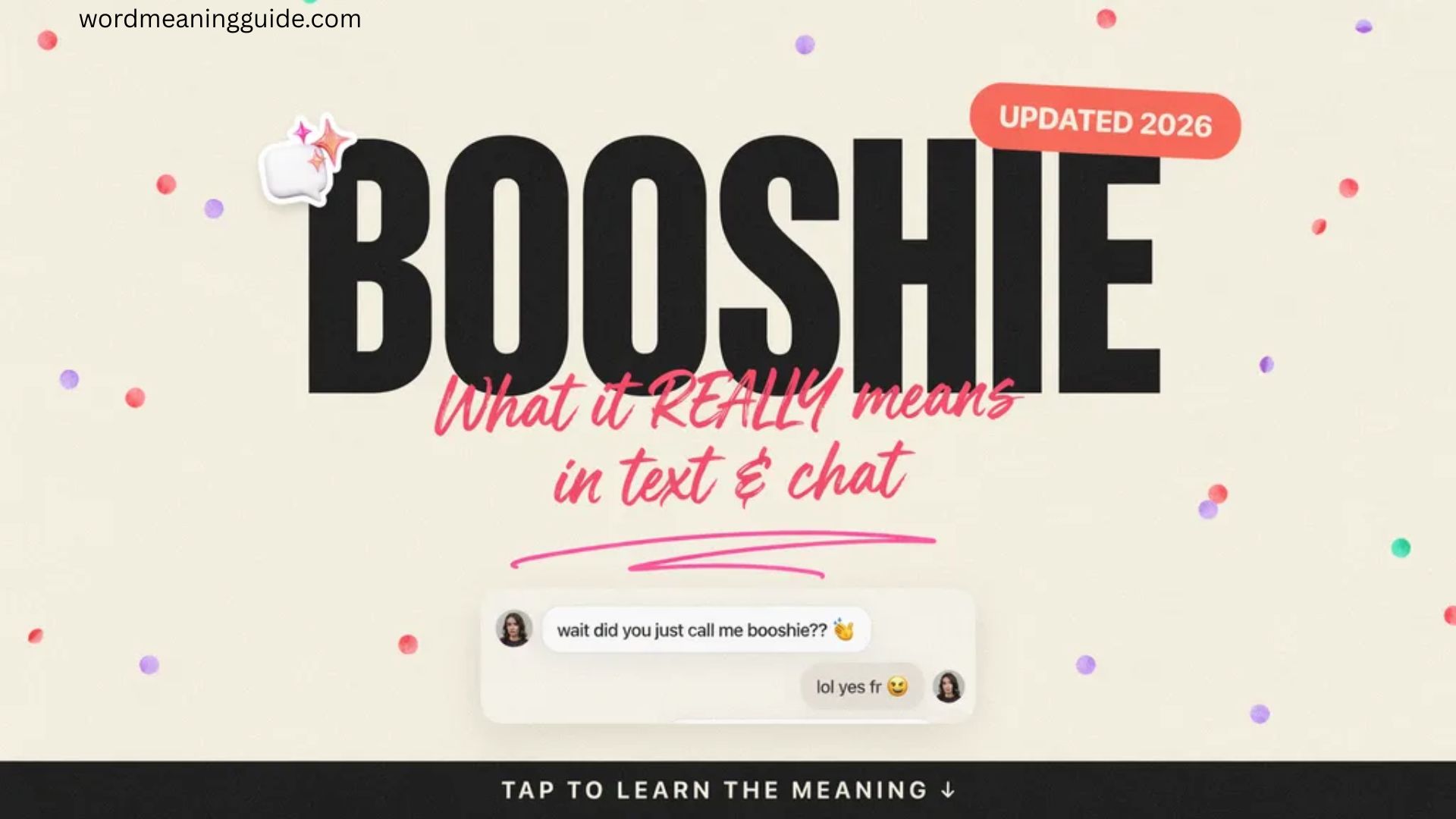
Picture this: you’re scrolling through your messages when your best friend texts, “Omg she ordered a sparkling water at McDonald’s — so booshie.” You laugh. You get it. But do you actually know what “booshie” means? Or are you just riding the wave of cultural context and emoji energy?
You’re not alone. Slang evolves faster than dictionaries can keep up, and “booshie” is one of those words that has quietly planted itself into everyday digital conversation without ever making it into a formal glossary. It floats through Instagram captions, TikTok comment sections, group chats, and Twitter threads — always with a knowing wink, never with a footnote.
This article breaks down everything you need to know about the booshie meaning: where it came from, how it’s used today, how it differs from “bougie,” and why understanding it actually matters in 2026’s hyper-connected, slang-saturated communication landscape. Whether you’re trying to decode a text or use the word correctly yourself, you’ve come to the right place.
What Does “Booshie” Mean in Chat or Text?
At its core, booshie is an informal, often playful spelling variant of “bourgeois” — or more accurately, a phonetic cousin of the popular slang term “bougie.” It describes someone or something that gives off an air of being uppity, high-class, pretentious, or overly fancy — usually in a slightly ridiculous or self-aware way.
When someone calls a person “booshie,” they’re often pointing out that the person is acting like they’re too good for ordinary things. Ordering oat milk lattes at a dive bar? Booshie. Refusing to eat fries unless they’re truffle-seasoned? Definitely booshie.
But here’s the nuance that most definitions miss: booshie isn’t always an insult. Depending on the tone, the relationship between speakers, and the platform, it can land anywhere on the spectrum from gentle teasing to genuine admiration — or even as a badge of identity.
“Slang doesn’t just describe behavior — it encodes social relationships and group identity. A word like ‘booshie’ is doing cultural work that formal language can’t.” — Sociolinguist perspective on internet vernacular
Different Meanings Based on Context
One of the most fascinating things about the booshie meaning is how flexible it is depending on who’s saying it, to whom, and where.
In a teasing context: “She brought a charcuterie board to a house party — so booshie lol.” Here it’s affectionate mockery. Nobody’s angry. It’s a running joke between friends.
In a critical context: “I can’t stand how booshie this neighborhood has gotten since the new coffee shops moved in.” This carries genuine frustration — a commentary on gentrification or social disconnect.
As self-identification: “I know, I’m lowkey booshie, I can’t help it.” Used this way, it’s almost a humble brag. The speaker is owning a certain lifestyle or taste level with a smirk.
As a compliment: “You got a reservation at that new rooftop restaurant? That’s booshie, I love it.” Said with admiration, not shade.
Explore More Enchanté Meaning: What It Really Means in Chat, Text, and Everyday Life (Updated for 2026)
Understanding these layers is the difference between laughing with someone and accidentally offending them.
Origin and History of the Booshie Meaning
To understand where “booshie” comes from, you have to rewind to 19th-century France. The word bourgeois was used to describe the rising middle class — people who had enough money to aspire to upper-class lifestyles but weren’t aristocracy. Over time, it became a term for anyone who placed excessive value on material wealth, status, and social appearances.
Fast forward to American urban culture in the 20th century, where Black communities began using “bourgie” or “bougie” to describe people who acted above their station — usually someone from the same community who suddenly acted like they were better than everyone else. It had an edge of class critique baked into it.
Then came the internet. Spelling variations exploded. “Bougie” became “boujee” (famously popularized by Migos’ 2016 hit “Bad and Boujee”), which became “booshie” — a softer, more playful phonetic version that caught on in text messaging and casual online conversation.
By the early 2020s, “booshie” had developed its own distinct identity. While “bougie” often carries stronger class commentary, “booshie” tends to feel lighter, cheekier, and more affectionate. It’s the version you’d use with your friend, not the version you’d use in a class analysis essay.
Linguists who study digital vernacular note that spelling variations like this often serve an important purpose: they signal in-group membership. Spelling “bougie” as “booshie” communicates that you learned the word organically — from people, not from a textbook.
Booshie or Boujee — What’s the Difference?
This is one of the most searched questions related to the booshie meaning, and for good reason. The two words are closely related but have developed distinct personalities.
Boujee — spelled this way — is largely associated with the Migos cultural moment and tends to carry glamour, aspiration, and hip-hop culture. When someone says “she’s boujee,” there’s often a compliment embedded in it. It can mean wealthy, stylish, and desirable.
Booshie, by contrast, tends to carry a little more gentle irony. It’s the version you use when you’re lovingly poking fun. It can still be a compliment, but it’s usually wrapped in a knowing smile. It suggests someone who acts fancy, whether or not they actually are.
Think of it this way: a celebrity might be boujee. Your coworker who refuses to drink tap water and only eats artisan sandwiches? That’s booshie energy.
Booshie Girl Meaning
In popular culture and social media, “booshie girl” has taken on a life of its own. It describes a young woman who has high standards, loves nice things, is particular about her lifestyle, and isn’t apologetic about any of it.
A booshie girl might obsess over her skincare routine, always order the premium version of everything, and refuse to settle for mediocre experiences. She’s not necessarily wealthy — she just carries herself with a certain standard.
Importantly, “booshie girl” in 2026 has evolved from a phrase used to tease women into something many young women claim proudly. Influencer culture and the “that girl” aesthetic movement have contributed to the normalization of this identity. Owning the label “booshie” has become a form of self-expression rather than a social liability.
How People Use “Booshie” in Real Conversations
The word flows most naturally in casual, digitally-native conversation. It’s not the kind of word you’d drop in a job interview or a formal email. But in the right contexts, it works beautifully.
Here are four real-life examples of booshie in text messages:
Example 1 — The Friendly Roast
Priya: I told my mom I don’t eat white bread anymore Jade: Lmaooo you’re so booshie 😭
Example 2 — The Self-Aware Confession
Tyler: okay yes I got the $18 smoothie. I know. I’m booshie and I accept it.
Example 3 — The Genuine Compliment
Marcus: you really got a hotel room for your birthday? that’s so booshie, I love it for you ✨
Example 4 — The Social Commentary
Aisha: this new café literally doesn’t have WiFi because they want you to “be present.” booshie nonsense.
Notice how the tone shifts completely across these four examples — from teasing to self-deprecating to admiring to critical — while the word itself stays the same. That’s the power of context-dependent slang.
When It’s Appropriate vs. Awkward
Like most slang, booshie has a comfort zone. Using it outside that zone can feel forced or confusing.
When it feels natural:
- Between close friends who share a casual texting style
- In social media captions with a playful or self-aware tone
- In comment sections when reacting to something fancy or extra
- When gently teasing someone you know well
When it feels awkward:
- Using it with people much older than you who won’t recognize it
- Dropping it in professional settings
- Using it sarcastically with someone who might take it as a genuine insult
- Applying it in cultures or communities where “bougie” hasn’t yet evolved into “booshie”
The rule of thumb: if you have to stop and explain what booshie means, the moment has already passed.
Insider Tip: Reading the Room With Booshie
Here’s something most articles won’t tell you. The word “booshie” signals your cultural fluency in a very specific way. People who use it tend to be:
- Chronically online in a self-aware, often humorous way
- Part of communities where class and taste are frequently discussed casually
- Comfortable using Black American Vernacular English (AAVE)-influenced slang in their daily speech
This matters because cultural sensitivity is important. Words that originate in AAVE or specific cultural communities carry a history. Using them appropriately means understanding that history — not just mimicking the sound. “Booshie” is now widespread enough that it functions across many communities, but knowing its roots shows respect for where it came from.
Common Mistakes and Misunderstandings
Confusing Booshie With Insults
One of the most common mistakes is assuming “booshie” is always negative. Because it carries a tone of “acting above your station,” people sometimes deploy it as a straightforward put-down. But it almost never lands that way among people who use it fluently. The intended energy is usually playful, not hostile.
Thinking Booshie Is a Formal Word
It’s not. It’s not in the Oxford English Dictionary. It’s not in Merriam-Webster (at least not yet — dictionaries are always playing catch-up with living language). Using it in an essay, a work email, or any formal context will undermine your credibility rather than add color to your writing.
Mixing It With American Sign Language (ASL)
In text-message culture, “ASL” means “age, sex, location” — but in other contexts, it refers to American Sign Language. Similarly, “booshie” sometimes gets mixed up with entirely unrelated terms by people who hear the sound but miss the cultural context. Always trace the context before assuming you know what a slang word means.
Assuming Everyone Knows It
In 2026, “booshie” is widespread but not universal. Generational, geographic, and cultural gaps mean that someone who didn’t grow up online or in communities where this word circulates may have never encountered it. Don’t assume shared vocabulary without checking.
Emotional Tone Behind “Booshie”
This is the part that makes booshie genuinely interesting from a linguistic perspective. The word carries what sociolinguists might call affective ambiguity — the emotional tone is genuinely flexible.
Research into internet slang and digital communication shows that tone-ambiguous words like “booshie” thrive online because they allow speakers to preserve plausible deniability. You can call your friend booshie and, if they get offended, walk it back with “I meant it as a compliment!” The word’s flexibility is a feature, not a bug.
This makes it particularly popular in an era where social media communication has to perform multiple functions simultaneously: entertaining a public audience, maintaining private friendship dynamics, and managing one’s own personal brand — all at once.
Booshie Meaning in English: The Formal-ish Definition
If you had to write a dictionary entry for it, booshie would look something like this:
booshie (adjective, slang) Describing a person, behavior, or thing that exhibits qualities associated with wealth, elitism, or pretentiousness — usually in a mild, often humorous way. Can carry connotations of class aspiration, high standards, or unnecessary extravagance. Tone varies from affectionate to critical depending on context.
Synonyms (informal): bougie, boujee, fancy, extra, pretentious, uppity, high-maintenance Antonyms (informal): chill, low-key, regular, down-to-earth, no-frills
Also Read This 35+ Other Ways to Say “Please Be Advised” (Formal, Informal & Professional Alternatives 2026 updated)
Booshy Rich — When Booshie Meets Wealth
A related expression that has emerged in some communities is “booshy rich” (note the alternate spelling “booshy”) — which describes someone who is wealthy in a very visible, slightly over-the-top way. Not just rich, but performatively rich. The kind of rich that comes with unnecessary luxury: heated sidewalks, a dog that eats organic, a car that you park in climate-controlled storage.
“Booshy rich” is almost always used with a mix of envy and gentle mockery. It points to wealth that has crossed the line from practical into theatrical.
Booshie People — Who Gets the Label?
So who are the prototypical “booshie people” in pop culture? The label gets applied to:
- Influencers who treat basic activities (like grocery shopping) as aesthetic experiences
- Characters in TV shows who refuse to “rough it” under any circumstances
- Celebrities who are surprisingly particular about small things
- Friends who always upgrade to business class even for short flights
- Anyone who has an opinion about which water brand tastes better
The key is a certain commitment to elevated standards that, from the outside, looks somewhere between impressive and slightly absurd.
Bougie Slang Meaning — The Extended Universe
“Bougie” and its variations exist within a larger galaxy of class-related slang. Understanding where booshie sits in this universe helps:
- Extra — doing too much, often with a dramatic flair
- Fancy — elevated but not necessarily pretentious
- Classy — a compliment suggesting elegance
- Uppity — historically charged; often carries racial undertones in American usage
- Pretentious — formal and critical; implies performance without substance
- Snobby — condescending attitude about taste or status
- Booshie — playful, affectionate, warm; less cutting than most of the above
Common Platforms Where Booshie Appears
“Booshie” has found its natural habitat across a few key platforms.
TikTok is where the word gets its biggest workout, especially in content about lifestyle, relationships, and social dynamics. Creators use it to tag their own “fancy” moments or call out relatable behaviors.
Twitter/X uses it in snappy one-liners and commentary about cultural trends, gentrification, and celebrity behavior.
Instagram deploys it in captions — especially on Reels about self-care, food, travel, or shopping.
Text messages and DMs are where it lives most authentically — in the casual, unperformed conversations between people who know each other well.
Interestingly, a 2024 study on digital slang circulation found that words that originate in private messaging tend to develop stronger in-group identity markers than words that first appear in public posts. Booshie fits this pattern — it feels most natural in private conversation, which is part of why it still feels authentic even after going mainstream.
Is Booshie Still Popular in 2026?
Yes — with an asterisk. Slang has a lifecycle: emergence, peak adoption, ironic use, and eventual saturation. As of 2026, booshie is in what linguists would call its “mature phase.” It’s past peak novelty but hasn’t become so overused that it feels stale.
What keeps it alive is its versatility. Unlike very specific viral terms that burn out because they only fit one context, booshie can describe almost any situation involving elevated standards or performative taste. That adaptability gives it longevity.
Gen Z and younger millennials continue to use it freely, while Gen Alpha is starting to encounter it. If it follows the pattern of “bougie” — which has been circulating for decades without disappearing — booshie has plenty of life left.
Discover More Other Ways to Say Emotional Intelligence: Formal, Informal & Professional Alternatives In 2026
Booshie in Social Media Culture
Social media didn’t just spread the word booshie — it shaped its meaning. The rise of aesthetic culture, influencer marketing, and the performance of lifestyle on platforms like Instagram and TikTok created the perfect soil for booshie to grow.
When everyday experiences — morning routines, coffee, gym sessions, grocery hauls — become content, they become subject to aesthetic judgment. And “booshie” is one of the most useful tools we have for commenting on that judgment with both humor and affection.
The irony is that many people calling things “booshie” online are doing so from within a highly curated digital life. The word has become a way of laughing at a culture you’re also participating in — which is very 2026.
Can Booshie Be a Compliment?
Absolutely — and this is perhaps the most interesting evolution in the word’s meaning. In communities where elevated standards, self-investment, and luxury taste are celebrated, being called booshie is something to aspire to.
“You’re so booshie” said admiringly is essentially saying: you have standards, you take care of yourself, you don’t settle. In wellness culture, in fashion circles, among people who value self-investment, booshie operates as a compliment more often than not.
This dual nature — part critique, part compliment — is what keeps the word culturally alive and interesting. It holds tension in a productive way.
Related Slangs and Abbreviations
If “booshie” is in your vocabulary, these likely are too:
- Bougie — the more formal parent term; similar meaning
- Boujee — aspirational glamour; often a compliment
- Extra — doing too much; similar vibe but broader application
- High-key — openly, without hiding it (“I’m high-key booshie”)
- Low-key — subtly, with some embarrassment (“I’m low-key booshie about my skincare”)
- Slay — executing something impressively; often paired with booshie moments
- Ate — did something exceptionally well; “she ate with that outfit, so booshie”
- Main character — acting like life is a movie centered on you; frequent booshie overlap
- That girl — a lifestyle aesthetic around discipline and elevated standards
Why Understanding Slang Like Booshie Matters
This might seem like a light topic — it’s just a funny word people use in texts, right? But understanding slang like booshie actually matters more than most people realize.
Language is how we signal belonging. It’s how we communicate values, politics, humor, and care — often in a single word. When you understand the booshie meaning in its full context, you understand something about class consciousness in 2026, about how Black American vernacular has shaped mainstream digital culture, about how the internet has accelerated language change in ways we’re still mapping.
According to findings published in the field of digital linguistics, slang competency has become a genuine social skill in the age of online communication. People who understand the nuances of terms like booshie are better communicators — they read tone more accurately, avoid more misunderstandings, and connect more authentically with the people they talk to.
That’s not a small thing.
Frequently Asked Questions
What does booshie mean in a text message?
In a text message, booshie typically describes someone or something that seems fancy, pretentious, or above ordinary things — usually said with a playful or affectionate tone. It can be used to tease a friend, admire a lifestyle choice, or comment on anything that seems unnecessarily elevated or high-class.
Is booshie the same as bougie?
They’re closely related but not identical. Both come from the word “bourgeois” and carry similar meanings around class aspiration and high standards. However, “bougie” tends to be used in more serious or admiring contexts, while “booshie” usually carries a lighter, more playful, or self-aware tone. Booshie is often used affectionately rather than critically.
Where did the word booshie come from?
Booshie traces its roots to the French word “bourgeois,” meaning the middle or upper-middle class. Over time, this evolved into the American slang “bougie,” particularly within Black American communities, and “booshie” emerged as a phonetic spelling variant — softer and more casual — that caught on through text messaging and internet culture.
Is booshie an insult?
Not necessarily — and this is one of the most important nuances of the booshie meaning. While it can be used critically, it is very often used affectionately or as a light-hearted tease. Context matters enormously. Among close friends, being called booshie is usually more of an inside joke than a genuine put-down.
Can you call yourself booshie?
Yes, and many people do — usually with a smirk. Calling yourself booshie is a form of self-aware humor. It signals that you know you have elevated tastes or high standards, and you’re comfortable laughing at yourself for it. It’s often used as a humble brag.
What is a booshie girl?
A booshie girl is someone, typically a young woman, who holds high standards for her lifestyle, prefers quality over quantity, is particular about her experiences, and doesn’t apologize for it. The term has evolved from a mild tease into an identity many women claim proudly — especially within influencer and wellness culture.
Is booshie appropriate to use with anyone?
Not quite. It works best in casual, familiar conversations with people who understand slang. Using it with older generations, in professional settings, or with people unfamiliar with internet culture can cause confusion or unintended offense. Always read the room.
What’s the difference between booshie and pretentious?
“Pretentious” is a formal, often harsh criticism — it implies someone is performing sophistication they haven’t earned. “Booshie” is informal and usually warmer. It acknowledges elevated behavior but doesn’t necessarily condemn it. Someone pretentious is trying too hard and failing; someone booshie is just unapologetically fancy.
How do you spell booshie correctly?
The most common spelling is “booshie,” though you’ll also see “booshy,” “booshee,” and variations. There is no officially standardized spelling since it’s informal slang. “Booshie” is the most widely used and recognized form in 2026.
Is booshie still used in 2026?
Yes. Booshie has entered what linguists call its mature phase — past peak novelty but still actively used. Its flexibility across contexts has kept it alive. Expect to keep seeing it in group chats, TikTok captions, and Instagram comments for the foreseeable future.
Conclusion:
At first glance, “booshie” looks like just another piece of internet slang — here today, forgotten tomorrow. But dig a little deeper, and it turns out this word carries a surprising amount of cultural weight.
It’s a window into how we talk about class, aspiration, and taste in an age when everyone’s lifestyle is potentially content. It’s a product of the long journey from French philosophical terminology to Black American vernacular to global internet culture. And it’s proof that language, even in its most casual forms, is always doing something meaningful.
Whether you use it to tease your friend about their expensive coffee order, to describe your own unashamed love of luxury bedding, or to comment on a celebrity’s unnecessarily elaborate lifestyle, booshie is a word that understands irony, affection, and social awareness all at once.
In 2026, that kind of linguistic flexibility is genuinely rare — and genuinely valuable. Now that you know what booshie really means, you can use it exactly the way it was intended: with warmth, wit, and just the right amount of shade.

Mr. Yaseen is a passionate content creator and language enthusiast dedicated to making words simple and meaningful for everyone. As the author behind WordMeaningGuide.com, he focuses on delivering clear, accurate, and easy-to-understand definitions that help readers improve their vocabulary and communication skills. With a keen eye for detail and a love for language, Mr. Yaseen ensures every piece of content is user-friendly, informative, and valuable for learners of all levels.