Have you ever had a song play in your head on repeat — all day, all night, even during your morning shower — and had absolutely no idea how to describe it? Then you texted your best friend something like, “LSS pa rin ako sa that song omg” and they immediately knew exactly what you were talking about?
That is the power of LSS.
In an era where music streams at the touch of a finger and viral audio clips flood your For You Page every few hours, the phenomenon of getting a song permanently lodged in your brain has never been more relatable. And with it, the slang term LSS has quietly crept from Southeast Asian group chats into the global digital vocabulary.
Whether you stumbled across this term on TikTok, saw it in an Instagram caption, or heard it from a Filipino friend, this article covers everything you need to know about LSS meaning in song, where it came from, how to use it correctly, and why it has become one of the most emotionally resonant slang terms of the digital age.
Buckle up — this one’s going to be stuck in your head too.
LSS Meaning in Song – Quick Meaning
Let’s cut straight to it.
LSS stands for “Last Song Syndrome.”
It refers to the experience of having a specific song — or even just a fragment of it, like a chorus or a catchy hook — play on an unstoppable loop inside your head. You didn’t ask for it. You can’t turn it off. And somehow, the more you try to forget it, the louder it gets.
Simple Definition:
LSS (Last Song Syndrome) is a slang term used to describe the involuntary and often obsessive mental replay of a song or musical phrase, typically after hearing it recently.
It is the linguistic cousin of what scientists call an “earworm” — but with more personality, more relatability, and infinitely more meme potential.
Quick Examples:
- “I’ve had LSS with that new Olivia Rodrigo track for three days straight.”
- “Warning: don’t listen to that viral TikTok sound unless you want serious LSS.”
- “My LSS right now is literally just the chorus of a commercial jingle.”
How to Use LSS in Chat: Examples and Dialogues
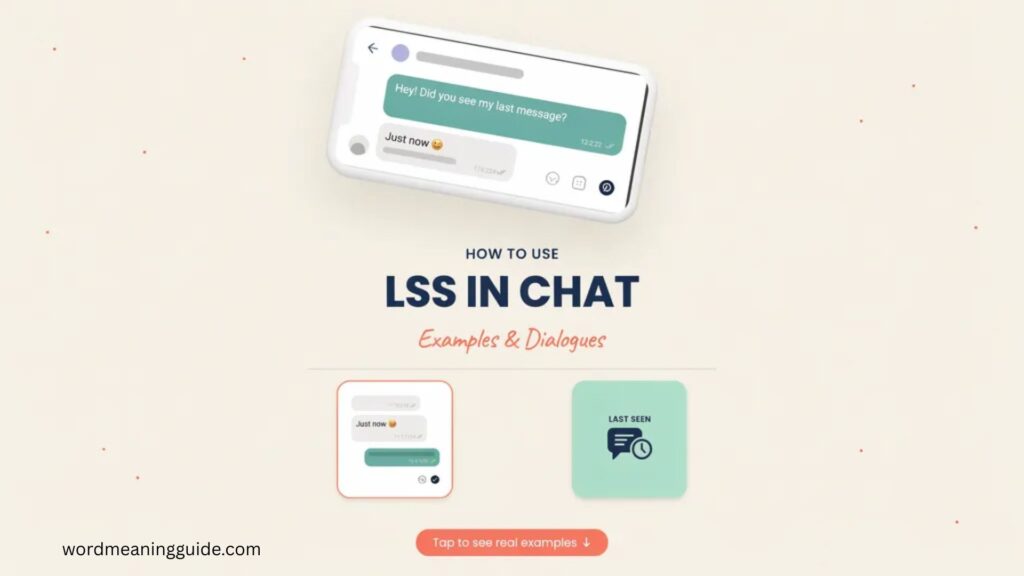
Using LSS in everyday conversation is simpler than you might think. It functions both as a noun and a descriptive phrase. You can “have LSS,” “get LSS,” or simply declare that you are “LSS.”
Here are some natural ways to drop it into your messages:
- As a noun: “This song gave me LSS.”
- As a state: “I’m so LSS right now, send help.”
- As a warning: “Don’t play that — instant LSS.”
- As a complaint: “Why do bad songs always give the worst LSS?!”
The beauty of LSS is how it packs an entire emotional experience into three letters. It is precise, expressive, and universally understood by anyone who has ever been haunted by a bop at 2 AM.
Explore More FYP Meaning: What It Really Means on TikTok, Instagram & Social Media In 2026
Origin and Background
To understand where LSS came from, you need to take a brief trip to the Philippines.
LSS is a Filipino-origin internet slang term that emerged from Philippine pop culture, particularly in the early 2000s and gained massive traction through social media in the 2010s. Filipino internet users, known for their vibrant and creative online language, coined the phrase “Last Song Syndrome” as a playful, pseudo-medical term for the earworm experience.
The word “syndrome” was used humorously — not to medicalize the experience, but to dramatize it. Because let’s be honest: when you’ve had the same eight-second hook replaying in your brain for 72 hours, it does start to feel like a syndrome.
The term spread organically through Twitter and Facebook communities in the Philippines before crossing borders thanks to the global reach of K-pop fandoms, OPM (Original Pilipino Music) stans, and eventually TikTok. Today, LSS is used fluently in Malaysia, Indonesia, Singapore, and increasingly in Western digital spaces.
Interestingly, scientists and psychologists have studied the earworm phenomenon for decades. Dr. James Kellaris, a marketing professor who has extensively researched involuntary musical imagery, estimates that nearly 98% of people experience earworms regularly. Songs with a fast tempo, repetitive structures, and unexpected intervals are the most common culprits.
LSS gave that scientifically recognized experience a catchy, culturally resonant name — and the internet ran with it.
Personality Traits and Usage Context of LSS
Not everyone who uses LSS uses it the same way. How you deploy this term says something about you.
Music lovers and superfans use it as a badge of honor — “Day 5 of LSS with BINI’s new single and I have zero complaints.” It signals deep emotional investment in an artist or track.
Casual listeners use it as a light complaint — “Ugh, LSS again with that ad jingle.” It communicates mild annoyance at an involuntary mental intruder.
Nostalgic users bring it out for throwbacks — “Heard a song from 2009 today and now I’m LSS for life.” It pairs beautifully with nostalgia content.
Meme creators weaponize it — sharing audio clips on TikTok with captions like “Sharing my LSS so you suffer too.” This is perhaps the most powerful social use of the term.
In all contexts, LSS communicates a shared human experience — the involuntary, sometimes joyful, sometimes maddening grip that music has on the mind.
Real-Life Conversations
Nothing explains a slang term better than seeing it in the wild. Here are realistic scenarios where LSS appears naturally.
1. WhatsApp Chat
Mia: okay i made a huge mistake
Sam: what happened lol
Mia: i played that viral “espresso” remix once at lunch
Mia: IT IS NOW 11PM AND I AM STILL LSS SEND HELP
Sam: HAHAHA welcome to the club
Sam: it took me a week to recover
Mia: a WEEK?! 😭
2. Instagram DMs
@jaydenmusic: bestie your playlist was immaculate but now i’m LSS with literally every song from it
@karlarecs: that’s the highest compliment you could give me honestly
@jaydenmusic: i woke up humming the third track and i don’t even know the title yet
@karlarecs: it’s doing its job then 😂
Also Read This Professional Ways to Say “Good Luck in Your Future Endeavors” In 2026
3. TikTok Comments
On a video where someone hums a catchy melody without naming it:
@user929: bro dropped the most dangerous LSS of 2026 without even telling us the song name
@notkailey: this should be illegal there’s no cure
@musicstanned: i’ve been humming this for 6 hours. SIX.
@originalPoster: sharing my suffering is my love language 💀
Emotional and Psychological Meaning
LSS is not just a fun internet term. It taps into something genuinely profound about the human relationship with music.
Music is processed by the auditory cortex, but it also activates the limbic system — the brain’s emotional center. When a song triggers LSS, it is often because it has formed an association with a feeling, a memory, or a moment. Your brain loops it not out of malfunction, but out of meaning.
Dr. Victoria Williamson, a music psychologist, has noted that earworms are most likely to surface during moments of low cognitive load — like walking, doing chores, or trying to fall asleep. The brain, seeking stimulation, replays the most emotionally charged or melodically “sticky” content it encountered recently.
This is why LSS hits hardest with songs tied to specific emotions: a breakup track, a summer anthem, a song that played during a meaningful night.
Why People Connect With It:
It validates a universal experience. Almost everyone has had a song stuck in their head and felt slightly unhinged by it. Saying “I have LSS” instantly builds a bridge of shared humanity.
It gives language to something previously unnameable. Before LSS, how did you explain this to someone? “I have a song in my head” barely scratches the surface. LSS captures the obsessive, helpless quality of it.
It celebrates music’s emotional power. If a song can take up permanent residence in your mind, it is because it moved something in you. LSS is, in a strange way, a compliment to the artist.
It creates community. Posting “I have LSS with this” online is an invitation — come suffer with me, come love this with me.
Usage in Different Contexts
1. Social Media
LSS thrives on social media, where music discovery is constant and viral sounds spread like wildfire. On TikTok, songs can become cultural phenomena overnight, and with that comes mass collective LSS events where thousands of users simultaneously can’t get a track out of their heads.
Captions like “POV: you gave the entire comment section LSS” or “I am legally responsible for your LSS right now” have become a TikTok content format in themselves.
On Twitter/X, users live-tweet their LSS journey: the moment a hook catches them, the denial phase, the acceptance, and eventually the surrender. It is participatory, comedic, and deeply relatable.
2. Friends and Relationships
Among friends, sharing your current LSS is an act of intimacy. It says: here is what my brain is obsessing over right now. In close friendships, recommending a song and then texting “you’ll get LSS, I promise” is almost a love language.
In romantic relationships, LSS carries even more weight. The song that gave you LSS after your first date. The track you couldn’t stop playing after a heartbreak. Music and memory intertwine deeply, and LSS is the language for that intersection.
3. Work or Professional Settings
Interestingly, even professional settings have started to see casual use of LSS — particularly in creative industries, entertainment, and media. A music producer might say in a team meeting, “The goal is to engineer legitimate LSS with this hook.” A content strategist might note, “This brand jingle created serious LSS — engagement metrics reflect it.”
In these contexts, LSS transitions from slang to almost a technical metric of memorability. If a song creates LSS, it is doing its job.
4. Casual vs Serious Tone
LSS can be used lightly or with genuine emotional weight. Casually, it is playful — the language of memes and group chats. But in a more serious context, someone might say “I’ve had LSS with this song since my dad passed — he used to play it all the time” and suddenly the term carries a whole different gravity.
This tonal flexibility is one of the reasons LSS has endured and spread. It adapts to the emotional register of the moment.
Common Misunderstandings
Like any piece of internet slang, LSS has been misused, misunderstood, and occasionally mangled. Here are the most frequent errors to watch out for.
1. Thinking LSS Means “Last Song Played”
This is probably the most common misconception, especially among users encountering the term for the first time. Because LSS contains the word “last,” people assume it refers to the most recent song played on a playlist or streaming platform — a purely technical descriptor.
It does not.
LSS is entirely about subjective experience. It describes a mental state, not a playback history. The “last” in Last Song Syndrome refers colloquially to the song that got stuck — the one that won’t leave — not a timestamp.
2. Assuming It’s Always Positive
Not every LSS is a happy experience. Sometimes the song that burrows into your brain is one you actively dislike — an overplayed commercial tune, an ex’s favorite track, a children’s song your toddler has had on repeat. In these cases, LSS is genuinely frustrating.
Do not assume that saying “I have LSS” means the person loves the song. Context matters. “Worst LSS of my life” is a very real sentence.
3. Using It in Formal Writing
LSS is internet slang. It belongs in casual digital communication, social media captions, text messages, and informal conversations. Using it in a formal essay, professional report, or academic paper would be jarring and inappropriate — unless you are specifically writing about internet slang (like this article), in which case it requires proper context and definition.
Save LSS for your group chats and your captions. Leave it out of your cover letters.
Modern and Relatable Examples (2026 Updated)
In 2026, LSS continues to evolve with the music landscape. Hyperpop, bedroom pop, and AI-generated viral sounds have created entirely new LSS vectors. Here are some examples that reflect current usage:
- “Whoever put that Sabrina Carpenter bridge in my algorithm, I am filing a formal complaint — day 4 of LSS.”
- “The new BINI single destroyed me. Full LSS. Cannot function.”
- “An AI-generated viral sound gave me LSS and I don’t even know if it’s technically a ‘real’ song.”
- “My Spotify Wrapped is just going to be whatever gave me the worst LSS this year.”
- “TikTok’s algorithm found my weakness and exploited it. LSS since Thursday.”
These examples show how LSS has grown beyond a simple definition into a cultural shorthand for the entire experience of being musically hooked in the digital age.
Comparison Table
| Term | Meaning | Origin | Tone | Platform Usage |
| LSS | Involuntary mental replay of a song | Filipino internet slang | Casual, emotional, humorous | TikTok, Twitter, WhatsApp, IG |
| Earworm | Scientific term for stuck song | English/German academic term | Neutral, descriptive | Academic, formal, some casual |
| BOP | A really good, catchy song | African-American internet slang | Enthusiastic, celebratory | Twitter, TikTok, general internet |
| Hypnotized by a song | Common phrase for obsession with a track | General English phrase | Casual, informal | All platforms |
| On loop | Repeatedly listening to a song voluntarily | General English phrase | Neutral | Spotify, music communities |
Key Insight:
What separates LSS from all the alternatives is its specificity and its emotional texture. “Earworm” is clinical. “BOP” is praise. “On loop” implies choice. But LSS captures the involuntary, almost helpless quality of being caught by music — and it does so with warmth, humor, and a hint of dramatic flair.
Variations and Types of LSS
Not all LSS is created equal. Here is a breakdown of the unofficial categories that internet users have organically developed:
Happy LSS — A joyful, welcome earworm. The song is a certified bop and you don’t even mind being haunted by it. “Blessed LSS.”
Painful LSS — The song attached to a memory you’re still processing. A heartbreak anthem, a song from a hard season. Bittersweet at best, destabilizing at worst.
Cursed LSS — A song you actively dislike but cannot escape. Jingles, overplayed pop hits, children’s songs. Universally complained about.
Nostalgic LSS — A throwback track that transports you back in time. Often triggered by stumbling across old playlists or hearing a song in a public space. Deeply emotional.
Accidental LSS — You heard a snippet. A ringtone. A neighbor’s music. You didn’t even choose to hear the whole song, and yet here you are, trapped.
Shared LSS — When you and your friends are all suffering from the same musical haunting simultaneously. Solidarity in suffering. The best kind.
Top Five Tips to Avoid Misusing LSS
- Use it for involuntary experiences only. If you chose to play a song 40 times today, that is just being a fan. LSS is about songs that play in your mind without permission.
- Do not abbreviate or alter it carelessly. “LS” or “L.S.S.” without context will confuse people. Keep it clean: LSS.
- Be mindful of tone. Specify if your LSS is joyful or miserable. “Best LSS” and “worst LSS” carry very different emotional messages.
- Do not use it in formal contexts. LSS is slang. Respect the register.
- Credit the culture. If someone from outside the Philippines uses LSS and someone asks where it comes from, knowing and acknowledging its Filipino roots is both accurate and respectful.
How to Respond When Someone Uses It
When a friend declares they have LSS, the right response depends on the vibe. Here is a quick guide:
Casual Replies
- “Same honestly, that song is dangerous.”
- “Which song?? Is it contagious??”
- “Welcome to the club. Population: everyone who’s heard it.”
Funny Replies
- “I’m so sorry for your loss. Of mental peace.”
- “Filing a lawsuit on your behalf against the artist.”
- “Have you tried replacing it with an even worse song? No? Same.”
Mature/Confident Replies
- “Good taste. That song deserves to live rent-free in your head.”
- “That’s your brain recognizing quality. Lean into it.”
- “There are worse fates. Let the music move you.”
Private or Respectful Replies
If someone’s LSS is clearly tied to grief or emotional pain:
- “That’s a beautiful song to carry with you.”
- “Music has a way of holding our important moments. That sounds like one.”
- “I hope it brings you more comfort than pain over time.”
Reading the emotional context before firing off a joke is always the mark of a thoughtful communicator.
Regional and Cultural Usage
While LSS was born in Filipino internet culture, its reach today is genuinely global. Here is how different regions of the world engage with the term.
Western Culture
In the United States, United Kingdom, and Australia, “earworm” remains the dominant mainstream term. However, among younger, digitally connected users — particularly K-pop fans, Southeast Asian diaspora communities, and TikTok-native audiences — LSS has achieved meaningful recognition. It is increasingly used in online music communities and fan spaces without requiring explanation.
Asian Culture
LSS is deeply embedded in Southeast Asian digital culture. In the Philippines, it is standard vocabulary — you will find it in news headlines, music reviews, and everyday conversation. In Malaysia, Indonesia, and Singapore, it has wide adoption among Millennial and Gen Z users. In South Korea and Japan, similar terms exist in local slang for the earworm experience, but LSS itself has entered the vocabulary through Filipino pop culture exports and cross-cultural fan communities.
Middle Eastern Culture
In Arabic-speaking digital spaces, LSS is used primarily by younger, English-fluent users and K-pop or OPM (Original Pilipino Music) fans who have encountered the term through fandom communities. Direct translation equivalents exist in colloquial Arabic for the earworm experience, but LSS as a term is increasingly recognized in mixed-language digital conversations, particularly on TikTok and Twitter.
Global Internet Usage
The globalization of LSS is a testament to the universality of the experience it describes. Music is a language without borders, and so is the helpless joy/frustration of having a song loop endlessly in your mind. As TikTok continues to bridge cultural and linguistic gaps through shared audio experiences, LSS is finding new audiences in every corner of the world.
The Philippines gave the internet a perfect word for a universal human experience, and the internet, being the internet, adopted it wholesale.
Frequently Asked Questions
What does LSS mean in song context?
LSS stands for Last Song Syndrome. In a song context, it refers to having a song involuntarily replay in your mind on a loop, often after hearing it recently. It is the experience of being mentally “haunted” by a track you cannot stop thinking about.
Is LSS a Filipino term?
Yes. LSS originated in Filipino internet and pop culture. It emerged in the early 2000s and spread widely through social media in the 2010s. While it began in the Philippines, it is now used globally, particularly among digitally connected younger audiences.
Is LSS the same as an earworm?
They refer to the same underlying experience — the involuntary replay of music in the mind. However, “earworm” is a more neutral, scientific-sounding English term, while LSS is casual, culturally specific internet slang with more emotional and humorous connotations.
Can LSS be a negative experience?
Absolutely. While LSS is often used lightheartedly, it can refer to songs tied to painful memories, songs you dislike but cannot escape, or tracks that cause genuine sleep disturbance. The emotional register of LSS depends entirely on the song and the person experiencing it.
How do I get rid of LSS?
Music psychologists suggest several strategies: listening to the full song (rather than just the fragment), singing the earworm to completion, distracting yourself with a different melody, or engaging in a cognitively demanding task. However, there is no guaranteed cure — and if the LSS is a good one, many people would argue you shouldn’t try.
Is it okay to use LSS outside the Philippines?
Yes, entirely. Language evolves through cultural exchange, and LSS has organically spread beyond its geographic origins through digital communities. Using it respectfully and knowing where it comes from is the only courtesy required.
Why do catchy songs cause more LSS than others?
Songs with repetitive melodic patterns, fast tempos, unexpected note jumps, and simple lyrics tend to cause stronger LSS. This is because those structural features make them easier for the brain to memorize — and harder to stop replaying. Hooks, bridges, and pre-choruses are particularly dangerous territory.
Conclusion
There is a reason LSS has become one of the most beloved slang terms of the digital music era. It takes something intimate and universal — the experience of being captured by music, of having a song become the involuntary soundtrack of your day — and wraps it in three perfectly chosen letters.
It is specific enough to be meaningful. It is playful enough to invite connection. And it is emotionally honest enough to hold real weight when the song attached to it carries real meaning.
From Filipino group chats to global TikTok feeds, from Spotify wrapped confessions to 2 AM tweets, LSS has become the language of being human in the age of infinite music. Every time a beat lodges itself in your brain and refuses to leave, every time you hum a hook you cannot name, every time you open your messages just to say “I am LSS and I cannot be stopped” — you are speaking the same language as millions of people around the world.
So the next time a song takes up permanent residency in your mind, embrace it. Name it. Share it. Because somewhere out there, someone else is humming the exact same eight bars, and they are waiting for you to say: “LSS. You too?”

Mr. Yaseen is a passionate content creator and language enthusiast dedicated to making words simple and meaningful for everyone. As the author behind WordMeaningGuide.com, he focuses on delivering clear, accurate, and easy-to-understand definitions that help readers improve their vocabulary and communication skills. With a keen eye for detail and a love for language, Mr. Yaseen ensures every piece of content is user-friendly, informative, and valuable for learners of all levels.