Imagine you’ve just wrapped up a complicated project. A colleague stayed late to help you meet a deadline. A customer service agent resolved your issue in record time. Or a mentor spent an hour walking you through a difficult decision. You want to express your gratitude — but “Thank you for your assistance in this matter” feels stiff, robotic, and copied from a legal document.
You are not alone. Millions of professionals, students, and everyday communicators face this exact challenge every day. How do you say “thank you” in a way that feels genuine, fits the context, and actually lands with the other person?
The answer lies in variety, intention, and emotional awareness. This guide walks you through more than 50 ways to express gratitude — from polished professional alternatives to warm, heartfelt phrases — so you always have the right words ready when it matters most.
What Does “Thank You for Your Assistance in This Matter” Mean?
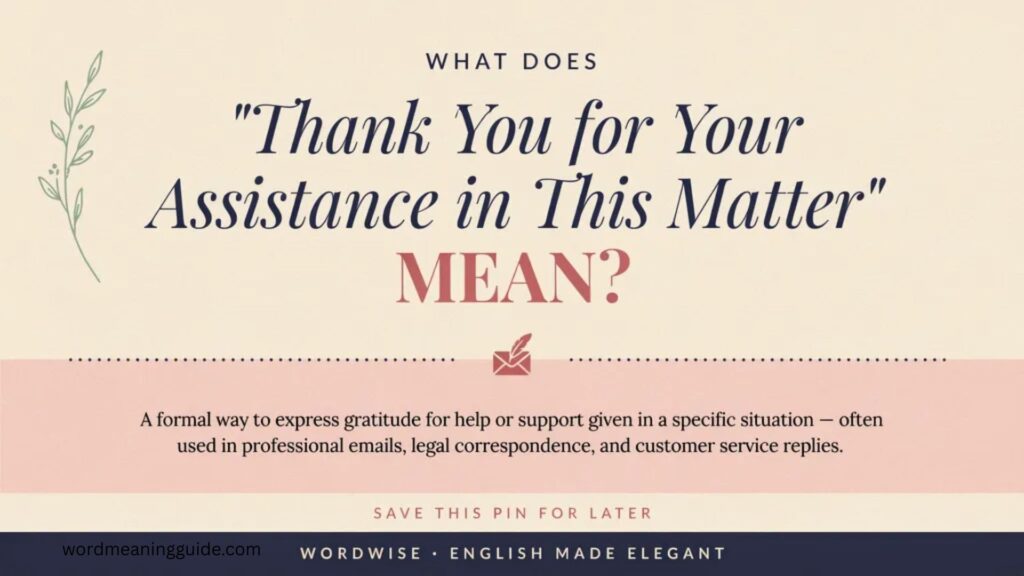
At its core, “thank you for your assistance in this matter” is a formal expression of gratitude. It acknowledges that someone provided help, support, or guidance in a specific situation. The phrase is widely used in professional correspondence — emails, letters, business memos, and formal requests.
The word “assistance” signals meaningful effort. It goes beyond a casual favor and implies that someone gave their time, expertise, or resources to help resolve something. The phrase “in this matter” anchors the gratitude to a particular issue or context, making it specific rather than general.
However, the phrase can sometimes feel cold or impersonal when used out of context. Think of it as a formal suit — perfect for a board meeting, but awkward at a birthday dinner. Knowing when to wear it, and when to swap it for something more fitting, is the key to effective communication.
When Should You Use These Alternatives?
Knowing when to use different expressions of thanks is just as important as knowing which ones to use. Here is a simple breakdown:
Use formal alternatives when writing professional emails, responding to clients, communicating with managers or executives, or drafting any official correspondence. Phrases like “I sincerely appreciate your assistance” or “I am grateful for your cooperation” work beautifully in these contexts.
Use warm, personal alternatives when thanking a friend, family member, or close colleague. Phrases like “Thanks for always being there” or “I can’t thank you enough” carry emotional weight that formal language cannot.
Use brief alternatives in quick responses, text messages, or casual workplace chats. Something like “Much appreciated” or “Thanks a ton” conveys gratitude without over-formality.
Use detailed alternatives when the help provided was significant. If someone went out of their way for you, saying “I truly appreciate your time and effort” or “Your support means a lot to me” shows that you noticed the depth of their contribution.
According to a study published in the journal Emotion, expressing gratitude not only strengthens relationships but also increases the likelihood of the helper offering support again in the future. In other words, how you say thank you genuinely matters.
Is It Professional or Polite to Say “Thank You for Your Assistance in This Matter”?
Yes — absolutely. The phrase is entirely professional and polite. In fact, it is one of the most widely accepted expressions of formal gratitude in business English.
However, “professional” and “effective” are not always the same thing. Communication expert Dr. John Gottman, who has spent decades studying relationship dynamics, notes that specificity in appreciation dramatically increases its impact. Instead of a generic phrase, referencing what the person actually did makes your gratitude feel earned and authentic.
So while “thank you for your assistance in this matter” is appropriate in formal writing, layering it with specificity — or replacing it with a phrase that better suits your tone and relationship — often produces a stronger result.
Professional Alternatives: Ways to Say “Thank You for Your Assistance in This Matter”
1. Thank You for Your Help
Simple, clean, and universally understood. This phrase works across almost every professional and personal context. It strips away the formality without losing the sincerity.
Use it when: Following up after a meeting, thanking a colleague for covering a task, or wrapping up an email chain.
2. I Appreciate Your Assistance
This phrase maintains professionalism while adding a personal touch through the word “appreciate.” It suggests that the help was noticed and valued.
Use it when: Responding to a client who resolved a billing issue or thanking a coworker who covered for you.
3. Thank You for Your Support
A versatile phrase that works in both professional and personal settings. “Support” implies something broader than a single task — it suggests ongoing backing or encouragement.
Use it when: Thanking a manager who advocated for you during a review or a friend who stood by you through a tough period.
4. Many Thanks for Your Help
This British-influenced phrase adds warmth through the word “many,” implying that the gratitude is abundant, not just a formality.
Use it when: Closing a professional email or thanking a vendor who went the extra mile.
5. Thank You for Taking the Time to Help
This phrase specifically acknowledges the resource that was spent — time. Since time is universally understood as valuable, this expression carries a unique weight.
Use it when: Someone paused their own busy schedule to assist you with a task or answer your questions.
6. I’m Grateful for Your Assistance
The word “grateful” elevates this phrase above simple thanks. It conveys a deeper emotional register and is appropriate in situations where the help made a significant difference.
Use it when: Someone resolved an urgent or stressful problem on your behalf.
7. Thank You for Your Cooperation
This phrase implies a collaborative dynamic. It’s commonly used in legal, governmental, or corporate communication to acknowledge mutual participation in a process.
Use it when: Closing a formal investigation, audit, or compliance-related process.
8. Thanks for Your Guidance
“Guidance” acknowledges wisdom or expertise shared. It is especially meaningful in mentorship, coaching, or advisory relationships.
Use it when: Thanking a mentor, supervisor, or senior colleague who shared their knowledge or direction.
9. Thank You for Your Prompt Assistance
Adding “prompt” specifically honors the speed of the response. In professional settings where timeliness matters, this phrase signals that you noticed and appreciated the efficiency.
Use it when: Someone resolved a technical issue quickly, responded to an urgent request, or handled a time-sensitive matter without delay.
10. I Truly Appreciate Your Help
The adverb “truly” adds sincerity and prevents the phrase from sounding like a template. It reads like something a real person said, not something auto-generated.
Use it when: You want your gratitude to feel personal even in a professional email.
11. Thank You for Your Valuable Assistance
Calling the assistance “valuable” reframes the interaction — it makes the helper feel that what they contributed had real worth.
Use it when: Acknowledging expert advice, specialized knowledge, or unique contributions.
12. Much Appreciated
Short, punchy, and professional. This phrase is ideal for quick replies, Slack messages, or closing lines in email chains.
Use it when: A colleague sends you a document you requested, or a teammate completes a minor task promptly.
13. Thank You for Your Continued Support
The word “continued” implies an ongoing relationship and acknowledges a pattern of helpfulness, not just a one-time event.
Use it when: Writing to long-term clients, loyal partners, or colleagues who consistently show up for you.
14. I Appreciate Your Time and Effort
This phrase acknowledges two specific investments: time and effort. It is particularly meaningful when someone put significant work into helping you.
Use it when: A colleague spent hours preparing materials, a mentor gave extensive feedback, or a volunteer contributed personal energy to a cause.
15. Thank You for Your Kind Assistance
The adjective “kind” softens the formal tone and adds a human dimension. It works beautifully when the help was delivered warmly or generously.
Use it when: Someone went above and beyond their duty to be helpful, or when you want to honor both the help and the person’s demeanor.
16. Thanks for Stepping In
This phrase acknowledges that someone intervened at a critical moment. It carries a heroic undertone — as if someone stepped into a situation when it mattered most.
Use it when: A colleague covered for you unexpectedly, or someone resolved a problem before it escalated.
17. Thank You for Your Professionalism
This phrase is unique because it thanks the person not just for what they did, but for how they did it. It honors their conduct, attitude, and character.
Use it when: Providing client feedback, closing a dispute gracefully, or acknowledging a difficult situation handled with class.
18. I Sincerely Appreciate Your Assistance
“Sincerely” adds weight and formality. It tells the reader that your gratitude is genuine, not performative.
Use it when: Writing formal letters, official correspondence, or acknowledgments that will be seen by multiple parties.
19. Thank You for Your Help and Cooperation
Combining help and cooperation acknowledges both the effort and the collaborative spirit behind it. This phrase is excellent for team environments.
Use it when: Wrapping up a cross-departmental project or thanking multiple stakeholders for working together.
20. I’m Thankful for Your Support
A slightly more personal version of the formal alternatives. “Thankful” carries a quiet, heartfelt tone that resonates in both professional and personal communication.
Use it when: Writing thank-you notes after a difficult period, or to someone who provided emotional or professional backing.
21. Thank You for Addressing This Matter
This phrase specifically acknowledges that the person handled something — a problem, complaint, or request. It is particularly useful in customer service or administrative contexts.
Use it when: Closing a complaint case, following up with a department that resolved an issue, or writing to a government agency.
22. Your Help Is Greatly Appreciated
Passive in construction but warm in tone, this phrase is ideal when you want the help — rather than the helper — to be the subject of attention.
Use it when: Writing to a team, a department, or a group whose collective effort made a difference.
23. Thank You for Your Efforts
“Efforts” is a word that acknowledges work without specifying the outcome. It is generous and gracious — it thanks the person for trying, not just for succeeding.
Use it when: Someone worked hard on a task that didn’t go as planned, or when you want to honor the process as much as the result.
24. Thanks for Your Attention to This
A polished, formal phrase commonly used in business emails. It acknowledges that the person gave focus and priority to your matter.
Use it when: Following up with a client, vendor, or service provider who addressed your request.
25. I Appreciate the Help You Provided
Straightforward and conversational, this phrase adds a human touch by using “you provided” rather than the more abstract “your assistance.”
Use it when: Writing informal professional emails or messages where you want to sound approachable.
26. Thank You for Your Assistance and Understanding
This phrase pairs practical help with emotional intelligence. It acknowledges both the action taken and the compassion extended.
Use it when: Situations required patience, flexibility, or empathy — such as deadline extensions, accommodations, or sensitive discussions.
27. With Thanks for Your Assistance
A classic, closing-line phrase. It is often used as a sign-off in formal letters and emails, similar to “with regards.”
Use it when: Ending a formal letter, legal correspondence, or professional request.
Heartfelt Alternatives: Warm Expressions of Gratitude
Sometimes professional language is not enough. When someone’s support has been deeply meaningful, these warmer expressions carry the emotional weight the moment deserves.
I Appreciate Your Help
A clean, sincere statement that works across contexts. It’s personal without being sentimental.
Thank You for Being There
This phrase honors presence and reliability. It goes beyond the task and thanks someone for their consistent emotional availability.
Your Support Means a Lot
Understated and deeply genuine. This phrase tells someone that their effort registered not just logistically, but emotionally.
Many Thanks for Your Guidance
A graceful way to acknowledge wisdom shared. Perfect for mentors, teachers, and advisors.
Thanks for Your Encouragement
This expression acknowledges the motivational support someone offered — the kind that helps you believe in yourself when you’re struggling.
I Value Your Help
Framing help as something you “value” treats it as an investment — it implies the help contributed something lasting to your life or work.
Thank You for Your Time
One of the most respectful phrases available, because time is finite and personal. Saying this tells someone you don’t take their availability for granted.
Thanks for Your Dedication
This phrase is especially powerful in professional settings where someone went far beyond what was expected of them.
Heartfelt Thanks for Your Help
“Heartfelt” is a beautiful modifier that signals genuine emotion. Use it when a note of thanks needs to carry significant personal weight.
Thanks a Ton for Your Assistance
A warm, informal expression that brings energy and personality to your gratitude. Perfect for close colleagues or friendly professional relationships.
Thanks for Backing Me Up
This phrase acknowledges solidarity. It’s ideal when someone defended your position, supported your idea, or stood up for you.
I’m Indebted to You
A powerful phrase that implies the person’s help was so significant, you feel a sense of lasting obligation. Use with care — it is best reserved for truly meaningful acts.
Thank You for Standing by Me
This expression honors loyalty and consistency. It is best used when someone supported you during a challenge, not just a task.
Sincere Thanks for Your Support
Formality meets warmth. This phrase is ideal for situations where you want to be professional but also genuine.
Much Obliged for Your Help
A classic expression with a slightly old-fashioned charm. It signals that you feel a sense of duty to acknowledge the help received.
I Can’t Thank You Enough
Use this when words genuinely feel insufficient. It expresses gratitude that exceeds what language can fully capture.
Thank You for Your Generosity
When someone’s help went above and beyond — giving more than required — this phrase specifically honors that spirit of giving.
Thanks for Your Commitment
Perfect for long-term projects or partnerships where someone demonstrated dedication over time, not just in a single moment.
Appreciating Your Efforts
A brief, gracious acknowledgment that works well in closing lines, brief notes, or acknowledgments sections.
Thank You for Your Kind Help
This phrase honors both the help and the spirit in which it was given. Kindness is its own form of generosity.
Grateful for Your Support
Direct and sincere. This phrase has the quiet confidence of someone who knows exactly what they feel.
Thanks for Always Being There
A deeply personal expression of gratitude for consistency and reliability over time. Best used for close relationships or long-term professional partners.
I Truly Appreciate Your Support
The word “truly” lifts this phrase from polite convention to genuine feeling. It reads as personal, intentional, and warm.
Thank You for Your Valuable Help
Calling help “valuable” signals that it contributed something meaningful — an insight, a resolution, or a resource you could not easily replace.
Thanks for Lending a Hand
A casual, friendly expression that works well in informal professional settings. It implies teamwork and mutual support.
Bonus Section: Short Polite Thank-You Messages
Sometimes you need brevity. Here are clean, polished short phrases that work perfectly in messages, notes, and quick responses:
- “Thank you so much — your help made all the difference.”
- “I’m genuinely grateful for your time and support.”
- “Your assistance was exactly what I needed.”
- “I can’t express how much your help meant to me.”
- “This wouldn’t have been possible without you.”
- “Thank you for everything you did — it was above and beyond.”
- “You made a difficult situation so much easier.”
- “I’m lucky to have your support in my corner.”
- “Thank you for being so helpful and understanding.”
- “Your kindness and assistance will not be forgotten.”
Frequently Asked Questions (FAQs)
Is “Thank You for Your Assistance in This Matter” Too Formal for Everyday Use?
Yes, in most everyday situations, the phrase can feel overly stiff. It originated in formal correspondence — legal letters, business communication, and official requests. For casual conversations, emails to friendly colleagues, or personal thank-you notes, opt for warmer, simpler alternatives like “thank you so much for your help” or “I really appreciate everything you’ve done.”
Can I Use These Phrases in Both Emails and Verbal Communication?
Absolutely. Most of these phrases work seamlessly in both written and spoken contexts. Some — like “Much obliged” or “With thanks for your assistance” — lean more naturally toward writing, while others like “Thanks for always being there” or “I can’t thank you enough” feel natural to say out loud.
What Is the Most Professional Way to Say Thank You in a Business Email?
Some of the most polished options for business emails include: “I sincerely appreciate your assistance,” “Thank you for your prompt response,” “Your help is greatly appreciated,” and “I appreciate your time and effort.” The key is to match the level of formality to your relationship with the recipient and the nature of the situation.
How Do I Make a Thank-You Message Feel More Personal?
Add specificity. Instead of saying “thank you for your help,” say “thank you for staying late to help me finalize the presentation — it made a real difference.” Research consistently shows that specific, detailed expressions of gratitude feel more authentic and have a stronger emotional impact on the recipient.
Are There Cultural Differences in How Gratitude Should Be Expressed?
Yes, significantly. In some cultures, effusive gratitude can feel uncomfortable or even inappropriate. In others, failing to express sufficient thanks is considered rude. When communicating across cultures, it is worth considering whether a brief, direct thank-you or a more elaborate expression is more appropriate. Observing the tone used by others in that cultural context is always a safe guide.
What Should I Avoid When Writing a Thank-You Message?
Avoid over-apologizing alongside your thanks (“I’m so sorry for the trouble, but thank you”), using hollow filler phrases that don’t convey real emotion, and making the thank-you about yourself rather than the helper. A good thank-you message is focused outward — it centers the other person and honors their specific contribution.
Final Writing Tips for Expressing Gratitude
Be specific. Generic thank-yous fade quickly. Specific ones are remembered. Mention what was done, why it mattered, and how it helped you. This transforms a polite formality into a genuine acknowledgment.
Match your tone to the context. A heartfelt thank-you note to a mentor should not read like a legal closing line. A professional email should not be littered with informal slang. Read the room, then write accordingly.
Timing matters. Express your gratitude promptly. A thank-you sent the same day as the help received is far more impactful than one sent a week later. According to behavioral researchers, timely gratitude reinforces the other person’s sense of having done something meaningful.
Write from the recipient’s perspective. Think about what the person gave up — their time, expertise, or emotional energy — to help you. Naming that sacrifice, even briefly, makes your gratitude feel earned.
Don’t bury the thanks. If someone helped you significantly, lead with the gratitude rather than burying it at the end of a long email. The first sentence sets the tone.
Conclusion
Words of gratitude are among the most powerful in any language. Whether you choose the polished formality of “I sincerely appreciate your assistance” or the warm simplicity of “thanks for always being there,” what matters most is that the words you choose reflect genuine recognition of another person’s effort.
The phrase “thank you for your assistance in this matter” has its place — but it is just one note in a rich vocabulary of appreciation. With the alternatives and guidance in this article, you now have more than 50 ways to say thank you that are thoughtful, context-appropriate, and genuinely felt.
Use them often. Gratitude is one of the rare things in life that costs nothing to give and yet means everything to receive.

Mr. Yaseen is a passionate content creator and language enthusiast dedicated to making words simple and meaningful for everyone. As the author behind WordMeaningGuide.com, he focuses on delivering clear, accurate, and easy-to-understand definitions that help readers improve their vocabulary and communication skills. With a keen eye for detail and a love for language, Mr. Yaseen ensures every piece of content is user-friendly, informative, and valuable for learners of all levels.